Ghosts and ‘Ka’ (Snow)

The following is an excerpt from Jeff Fuchs’ Tea and Mountain Journals, a blog by explorer, photographer and writer Jeff Fuchs.  Jeff is the 2011 recipient of AsiaTravel’s Explorer Grant.  He and friend Michael Kleinwort are currently traveling through unknown portions of the Tsalam route in Qinghai.

Below is an update from their journey…

———-
We are hunting a ghost, ghosts in fact it seems. The Salt Route that hasn’t been documented, this Tsalam that I have dreamt about and that we now seek is becoming akin to chasing vapours, or trying to track windblown sand. My western notion of a ‘route’, the idea of one single ‘route’ being the Salt Road has been annihilated. I should have known better than to assume any one path, road or route can be omnipotent upon the mighty Tibetan Plateau. The essence (which I’ve temporarily lost sight of) of a “route”, especially a trade route through these motionless and giant spaces is made up of many various paths that join, stretch and then veer off from one another. A route here at least, is the sum of its parts, and its parts are fragmented trails, not a single path. A route may have a name but it inevitably has many feeders that contribute – and the route of salt is true to this.
Lower Honkor is a dozen kilometers from the fractious Sichuan border with Qinghai and Michael and I are welcomed by a friendly but wary contingent of border police. Michael and I are both wearing the faces of slightly weary but expectant travelers, who have finally arrived to their long dreamt of paradise. This ‘paradise’ we arrive to is a series of ill-kept row houses, a school compound and a block of buildings that are surrounded by newly built wall. All of this seems shoved into a windblown valley along the Nyi Chu (Nyi River) with a single road adhering it together.
We are told gently that no, we cannot dither about indefinitely asking the elders about salt, and no we cannot trek because of ‘dangers’ – though what dangers we would be likely to encounter, no one elaborates on.
Ghosts and ‘Ka’ (Snow)

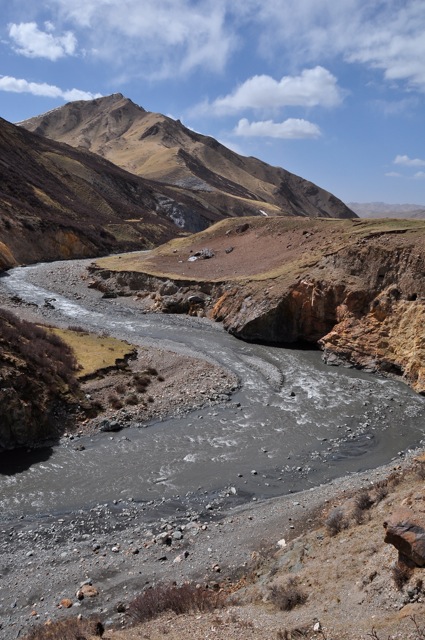
The Nyi Chu river provided a valley ‘trail’ by which salt caravans, single yak, and nomads accessed the salt sources of Qinghai

Our moods collectively darken, as at this point we need direct communication not promises and smiles that fade with light. My tea consumption (a consistent antidote to all things stressing) has increased to where I’ve got my thermos filled and by my side at all hours. I’ve got a twitch in my left eye jumping around – there is frustration at this point; one of any ‘exploration’s’ less talked about inevitabilities. We’ve been pointed in directions, gotten whiffs of the salt, the route, felt we’re close only to have the door (which has been permanently ajar, but not open) swing shut on us. The hints, though, are enough.

But then, unexpectedly for reasons that don’t matter but do confuse, we are offered information by locals that yes, salt came through this valley, but never in large amounts and certainly not in caravans, but rather, in groups of two’s and three’s. Yes, salt came in but not from the south as I had imagined, but rather from further west. Families, or simply family members would depart and be back within a week or ten days with a yak or two laden with salt from Sichuan, or this new western locale that is emphasized.

“So should we head to Sichuan’s salt sources”? We ask.

“Mado”, this name comes out at us from nowhere.

“Mado is where you must go to explore the real salt history. It is there that the best salt on the plateau exited”. There are salt and brine wells and salt lakes throughout the Himalayas and upon the Tibetan Plateau, but these are largely mere blips, or well-documented sources. It is the existence of the sources in the nomadic areas that beckon me on – the less documented and ‘hidden’ from view salt centres that we are hunting…and of course those few bodies and minds that still carry their own remnants of tales from the ancient days of trade.

Honkor – Mado

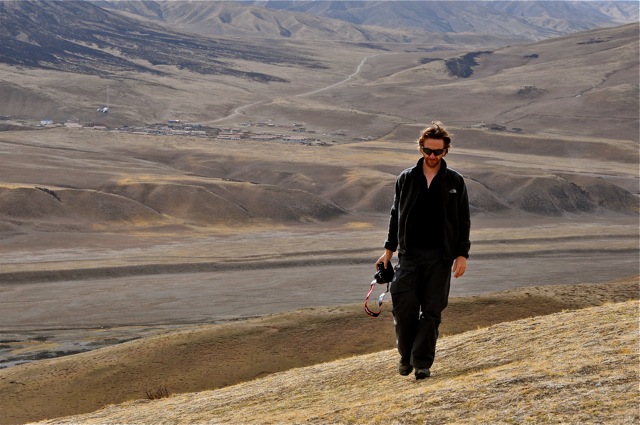
Some would call these wastelands, vast spaces of emptiness that can host only the most rugged life forms…from my heavy eyes; I see that this is as a place of great and silent power that cannot be bent by human hands. These bleak and stunning landscapes measure risk and beauty differently and the ‘reward’ for mistakes or failure here is harsh and often fatal.

Ghosts and ‘Ka’ (Snow)

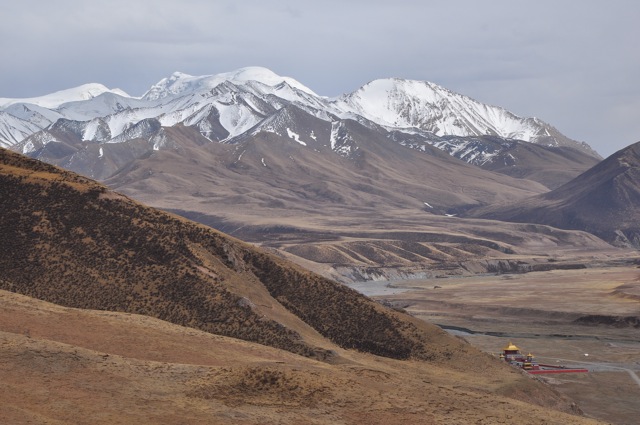
Vast and empty – valleys at 4,000 metres near Mado

We are heading west to Mado and the famed salt lake awaits us (we think). Mado County rests at 4,300 metres and it is known for being one of the coldest counties of all of the Tibetan regions. It is called Marduk to the Tibetans meaning, “high place” and it is that, though the ‘town’ itself was more of a nomadic seasonal dwelling place wedged into a long lake shaped valley.

———-
For the full post, please visit http://www.tea-and-mountain-journals.com/
Image: Jeff Fuchs

Amne Machin – A Rush of White and a Kora

The following is an excerpt from Jeff Fuchs’ Tea and Mountain Journals, a blog by explorer, photographer and writer Jeff Fuchs.  Jeff is the 2011 recipient of AsiaTravel’s Explorer Grant.  He and friend Michael Kleinwort are currently traveling through unknown portions of the Tsalam route in Qinghai.

Below is an update from their journey…

———-

Amye Maqen (Amne Machin, Anye Machin) <http://en.wikipedia.org/wiki/Amne_Machin>, the stout, the muscular, and for much of time, the utterly hidden from the outside world…our first glimpse of it is of a snow capped wonder that appears far closer than it is. There seem to be as many ways of spelling it as their are potential descriptives. Neither wind blown sand nor a haze can obscure its brilliant bulk. It seems to hang from the sky as we come in from the northwest towards the makeshift town at its base, Xiadawu (or in the more flavoured local Tibetan ‘Da’wurr’ – ‘Place that is difficult for horses’). In Joseph Rock’s accounts of the mountain and bandit ridden regions back in 1930 he estimated the broad peaks of Amne Machin to be 30,000 feet, a guess that was later proven to be 3,000 metres off.


Amne Machin – A Rush of White and a Kora

Amne Machin from the northwest


The Amne Machin range itself is an eastern extension of the greater Kunlun Mountain range, one of Asia’s longest most legend laden mountain chains. Located in the Golog Tibetan Autonomous Prefecture it is here that the Yellow River (so named because of wind-blown loess that is carried in from Central Asia) rises before winding eastward. At its rounded and almost friendly white peaks it achieves just over 6,200 metres.

Mountains cannot be compared to other of their kind in my eyes. Mountains are landscapes, heaps of stone and snow unto themselves and each has their own thin-aired identity. Sacred to the Golog (Golok) nomads, Amne Machin is almost directly due east of our pristine salt lake near Mado (Mardo) that we’ve most recently left. It also lies on the route that nomads from southwest took to access their precious salt. Few nomadic caravans would pass up the chance to visit and circumambulate the sacred Amne Machin range while undertaking a perilous journey to source salt. Ever practical, the Tibetan traders saw the value of doing both trade for a revered commodity and a little cleansing of past ills.

This mountain that has long played a role in local nomad’s worship of the divine, has withstood weathering seasons and has become more iconic in the eyes of men over time. The fact that it lies as a northwest-southeast diagonal throughway for traders only increases the curiosity for Michael and I. How much is left in memory and physicality of the salt route legacy? How much of any trade route – seldom acknowledged, documented or discussed – will survive? It is in this way that these journeys and explorations are truly ‘exploratory’ with nothing being guaranteed.

The town of Xiadawu, sits in a small cupped valley and is a dusty mess of pool tables, remarkably shabby huts and a main square of errant apathetic dogs that have forgotten their roles. Xiadawu’s decrepit appearance serves as an entry to something far greater than itself, Amne Machin, which erupts to the east. Flowing west out of the mountains past the town, the swerving breadth of the Nam Chu (Nam River) wanders through, over and around valleys in a never-ending search.

Amne Machin – A Rush of White and a Kora

Namchu (Nam River)

Our host, Tsering, is to be found out of town – it is he who will arrange our kora/ circumambulation around the great mountain. The ‘kora’ or counterclockwise circumambulation literally refers to a pilgrimage. For many eastern religions this act is believed to be a physical way to cleanse or clear away one’s past sins.

If in fact this is the case it may well take a few more than one rotation for Michael and I to wipe our collective slates clean.

Amne Machin – A Rush of White and a Kora

Around us the landscape ripples with Spring’s pending arrival – ridges verging on going from ochre to green. Still though, the high peaks remind in a glance that up here at over 4,000 metres winter isn’t really ever truly ‘over’.

Our host Tsering tells us that, yes, the salt traders came through here as part of their annual travels – more specifically nomadic traders, who, coming from further east, would add the kora of the mountain to their travels to the salt lakes. A kind of double-pronged travel plan: salt for need and profit, kora for life-cleansing benefits.

Amne Machin – A Rush of White and a Kora

———-

For the full post, please visit http://www.tea-and-mountain-journals.com/
Image: Jeff Fuchs

Saving the Secret Towers

The following is an excerpt from an article in The Wall Street Journal by Mitch Moxley, a Canadian journalist with national and international reporting experience. He’s written on politics, travel, business and other topics from China, Mongolia, Japan, Vietnam and the Philippines. He is currently based in Beijing, China.

———-

The ride from Chengdu to Danba Valley is one to be endured, not enjoyed. The journey is by a smoke-filled bus with tiny seats that barrels deep into the mountains of western Sichuan province, shaking and rattling on a single-lane road that is often strewn with fallen rocks. A hair-raising view out the window is of the Dadu River below.

This is the route to one of China’s most enduring architectural mysteries. Ten hours and 400 kilometers into the journey, the valley opens to reveal green mountains topped with snowy peaks. On a ridge above stand a half-dozen rock towers, like ancient smokestacks.

The Secret Towers of Western China

View Slideshow

Saving the Secret Towers

James Wasserman for The Wall Street JournalOne of the many multi-faceted towers in the village of Suopuo, Danba County, Sichuan, China.


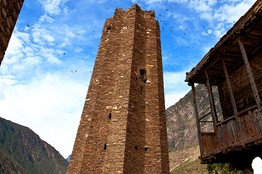
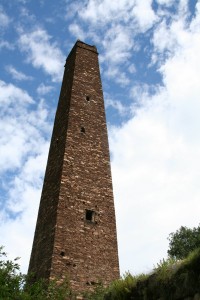
Across the remote, earthquake-prone regions of western Sichuan and Tibet, there are hundreds of these structures. They are built of cut stone, brick and timber, date back as far as 1,700 years and stand up to 50 meters tall. No one is sure of their purpose, though theories abound: They were watchtowers, way stations, status symbols. Some say they have religious meaning.

Striving to save the towers from the forces of neglect, earthquake and a planned hydropower dam are a small number of preservationists, including Frédérique Darragon, a 61-year-old global adventurer—sailor, dancer, trekker, polo player— turned amateur archaeologist by her love for these mysterious structures.

The daughter of a wealthy Parisian inventor and machine maker who died when she was 4 years old, Ms. Darragon spent childhood summers riding horses in England and winter breaks skiing in the Alps. She worked on a kibbutz in Israel and in 1971 sailed across the Atlantic in the first race from Cape Town to Rio de Janeiro. She returned to Paris, graduated from university there and then did some work as a model—”Not high fashion,” she says, “just for extra money”—played polo in Paris and Buenos Aires and became a lauded samba dancer in Rio.

During the early ’90s, Ms. Darragon spent several months a year traveling alone through China, often by foot in areas that are still rarely visited by Westerners. It once came close to killing her: In 1993, while searching for endangered snow leopards in Tibet, she suffered a stroke when a fire she built in a cave consumed too much of its oxygen supply. She lay for three days before being rescued by Tibetan shepherds.

Three years later, Ms. Darragon saw her first towers, while traveling near Danba. A year after that she saw similar towers in Tibet—800 kilometers away—and was hooked. “When I learned that neither Westerners nor Chinese had researched them and that practically nothing was known about them, I could not resist trying to crack their mystery,” Ms. Darragon says of her long affair with the ancient towers.

The Danba Valley, home to ethnic Tibetan and Qiang villages, is one of the best—and most accessible—places to explore the towers. Five kilometers from Danba city (danba means “town of rocks”) a series of sprawling villages collectively called Suopo has about 80, some in ruins but many still standing, and some of them more than 30 meters high.

Until recently, nobody knew the towers’ age with any real degree of certainty. There are references in texts from the Han Dynasty, which lasted for about 400 years starting in 206 B.C., but the peoples who historically populated the tribal corridor of Sichuan and Tibet lacked a written language, so there was no documentary evidence of the towers’ origin. Chinese archeologists had taken scant interest in the riddle.

Saving the Secret Towers

James Wasserman for The Wall Street JournalChiles hang outside a window in Danba County.

It was a linguist who wrote one of the first papers on the subject, in 1989. Sun Hongkai, now retired from the Chinese Academy of Social Sciences, had first seen the towers during a 1956 visit to Sichuan to investigate the Qiang language. “People in the area did not pay attention to the towers,” Mr. Sun says. “Many were destroyed during the Cultural Revolution. People used the stones for building materials.”

In the 15 years since Ms. Darragon was drawn to the mystery, she has devoted much of her life to cataloging, dating and fighting to preserve hundreds of the enigmatic stone skyscrapers.

In 2001, with funding from U.S. media mogul Ted Turner, a fellow sailing enthusiast she’s known for decades, she created the nonprofit Unicorn Foundation, dedicated to education and humanitarian projects.

“I’m very proud of Frederique and the work she’s done in China,” Mr. Turner says. “Her amazing discoveries are astounding, and her commitment and dedication to the preservation of some of China’s great artifacts and structures will always be admired and respected.”

————

To read the full article, click here. To inquire about journeys to see these towers in Sichuan, please e-mail info@wildchina.com.

Amne Machin White and A Travelling Circus

The following is an excerpt from Jeff Fuchs’ Tea and Mountain Journals, a blog by explorer, photographer and writer Jeff Fuchs.  Jeff is the 2011 recipient of AsiaTravel’s Explorer Grant.  He and friend Michael Kleinwort are currently traveling through unknown portions of the Tsalam route in Qinghai.

Below is an update from their journey…

———-
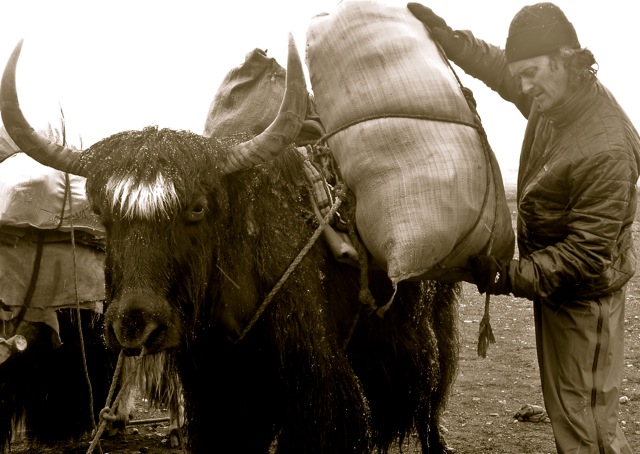
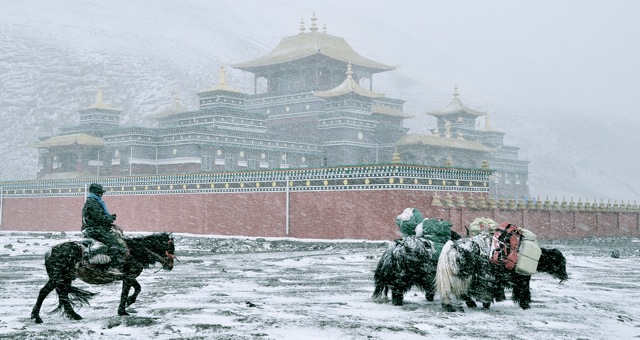
Our two yak stand still in the blowing white snow; around them there is nothing to suggest a specific time-period and looking at their ice-encrusted wool I imagine a time long ago when gas-spewing, noise machines on wheels hadn’t yet taken over – where movement on land required the foot or hoof. Here, now, in this blowing snow beneath a mountain it is remarkably easy to imagine this time.
Amne Machin White and A Travelling Circus

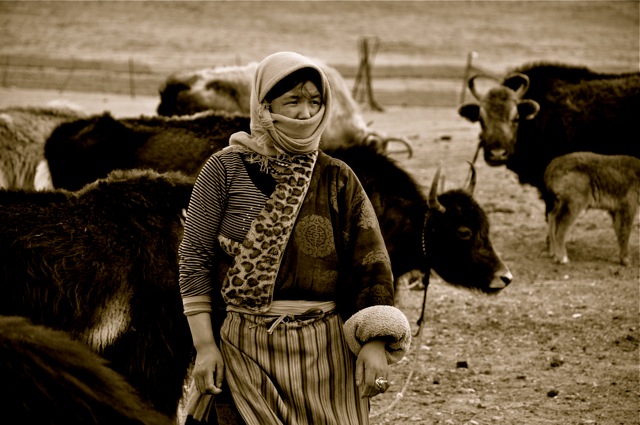
The yak stand before us resigned and powerful, and it is evident that it is in their DNA and memory banks to wait, to be loaded and to traipse where few beings can. Mobile, tough and silent they provide the broad backs for transport. Nomads delight in riding horses but in these parts no other ‘transporter’ can predictably claim the reliability title at altitude as can these behemoths.

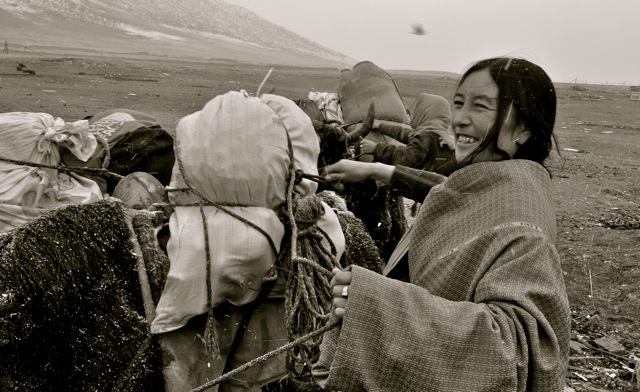
Apart from the yak, all things seem in rapid motion. Snow is contorting and rushing at us from above. The headwoman of the village is continuing to issue orders, while simultaneously tightening up yak wool cords around our gear.

Amne Machin White and A Travelling Circus

Ancient and essential, the art of loading and tying gear to mules or yak’s backs is something that has long been prized and traders often picked their muleteers or ‘yak-men’ based on their abilities in this skill. Our guide Neema, a short and slight man whose face wouldn’t be at all out of place in the Andes of South America is organizing our food and necessities into bigger bags that will also be tied onto the back and flanks of our yak. One item, an essential given the time of year is a double reinforced bag of dried yak dung patties – fuel for our life giving fires. We are above the treeline here at almost 4 km’s in the sky and the areas where we will tread will not yet have herds of yak…nor their vital ‘droppings’ for us to use.
Amne Machin White and A Travelling Circus

Huge flakes of snow explode into moisture as they pop against our jackets, and the mountains around us (that we can make out) are already building up their coats of white. The snow is unrelenting and it is hard to imagine a world without white. The winds are crafty, coming at us from all angles at once it seems.

Making our way out of the valley our vistas open up, but not our sightlines. They are paralyzed by drapes of white snow. Our contingent of moving bodies has somehow become eight bodies. The two yak seem to know precisely where they are going silently leading the way. Neema has mounted a chestnut pony – a lanky tough looking creature, and two dogs have joined along. One dog, a beige 10 kg livewire of energy looks part terrier and part fox, carrying a small diagonal scar on his snout which gives him the look of a seasoned street fighter.

The second dog, a Tibetan mastiff carries his black bulk easily and has the most forlorn brown eyes I have seen in a long while. Michael is wrapped in a black hood and I am encased for the wind and snow. Snow, as it does has at once darkened the entire day and made it so bright that we need the sunglasses for the glare.

Squeezing through a last bottleneck of space, we make out a hazy outline coming up to our left. Unseen to our right, down a plunging valley is the Nam River and the structure to our left, which clarifies as we approach, is the Ge Re Monastery, a new monastery that reminds me strangely of a mosque in shape. It sits as sort of a gateway into a bigger world beyond. It is still in the onslaught of snow…everything but the snow now seems still.

Amne Machin White and A Travelling Circus

———
For the full post, please visit http://www.tea-and-mountain-journals.com/
Image: Jeff Fuchs

Tibet Will Soon Reopen to Foreign Tourists

ANNOUNCEMENT: Travel bans to Tibet are expected to be lifted by the end of July.

Bans in 2011 have been said to be implemented on account of two major anniversaries – the 60th anniversary of the signing of the Seventeen Point Agreement for the Peaceful Liberation of Tibet on May 23, 1951, as well as the 90th anniversary of the founding of the Chinese Communist Party on July 1, 1921.

The destination will open its doors to visitors just as the rainy season begins to fade. To begin planning your journey to Tibet, please submit an inquiry here or e-mail us at info@wildchina.com.


Tibet Will Soon Reopen to Foreign Tourists

Buddhist art in Lhasa


Ecotourism: Greening Your Next Vacation

The following is an excerpt taken from the Spring 2011 issue of WEALTH Magazine.

———

Before solidifying your next vacation plans, consider the latest trend in eco-awareness — ecotourism.  We’ve spotlighted three green luxury travel destinations.

Every day, more people introduce another element of eco-awareness into their daily lives — recycling instead of discarding, opting for reusable grocery bags in lieu of paper or plastic ones, and choosing eco-friendly vehicles over gas guzzlers.  As you plan your next getaway, consider the latest trend for reducing your footprint on the planet — ecotourism.

According to The International Ecotourism Society (TIES), “Ecotourism is responsible travel to natural areas that conserves the environment and improves the well-being of local people.” Put simply, it’s an opportunity to experience areas around the world in their natural form without putting an environmental strain on them.

Converting your vacation into an eco-friendly travel experience will likely inspire more sustainable efforts in your everyday life.  “Not only do you have a feeling of satisfaction that you haven’t contributed to global warming, but you feel inspired and motivated to bring something back with you besides memories, pictures and videos,” says John Clifford, president of luxury travel consultancy InternationalTravelManagement.com based in San Diego.  “That’s the magic of travel — it’s very rewarding to people.”

What’s more, with eco-friendly travel, parents can expose their children to far more than they could through typical ski trips, beach excursions or European tours.  It’s a great opportunity to discover and adopt new habits that promote a more eco-friendly lifestyle at home.

“These practices, many of which are fairly simple, can inspire visitors to take them home and apply them to their own lives,” Clifford says.  “Whether it’s inspiring a family to grow their own vegetables in their yard, sponsor a nearby beach cleanup or park reforestation, or something similar — as long as the family comes back home with the impetus to ‘do something’ — the ecotourism and sustainable travel has made an impact on the family.”

While it’s possible to turn a trip to any destination into an eco-friendly vacation, several locations across the globe have made it a priority to promote ecotourism.  Consider any of these three spots that offer a one-of-a-kind luxurious experience, all while safeguarding the environment.

China’s Yunnan Province


Ecotourism: Greening Your Next Vacation


Most travelers immediately consider the bustling cities of Beijing or Hong Kong for their China vacation destinations of choice. But for those seeking an eco-focused experience, the Yunnan Province in Southwestern China is a lesser-known alternative.

Ecotourism has taken off in this region of China. Travelers can experience the region’s many natural wonders, says Mei Zhang, founder of AsiaTravel, a sustainable travel company based in Beijing. One such wonder is the United Nations Educational, Scientific and Cultural Organization (UNESCO) World Heritage site of the Three Parallel Rivers (Yangtze, Mekong and Salween rivers). In addition, over the last 10 years, Zhang says, there has been a surge in tourism facility construction projects – most pledging to have minimal impact on the environment.

ACCOMMODATIONS: For sustainable lodging, Zhang recommends the Linden Centre near Dali City. The estate – built by a local warlord in the years before the Communist Revolution – has been renovated with modern amenities yet maintains much of the original architecture of a traditional courtyard mansion. The hotel is meant to be a model of “architectural renovation, cultural conservation and a primary partner in the sustainable development of the local economy.”


Ecotourism: Greening Your Next Vacation

While it provides certain contemporary services, such as Wi-Fi, the hotel purposefully doesn’t include televisions in the rooms. Instead, guests are encouraged to interact with one another, hotel staff and villagers in such activities as accompanying one of the hotel chefs on a vegetable market visit.

For those who wish to gain the full experience of a Tibetan monastery, Zhang recommends the Songstam Hotel in Shangri-La. A true treasure of the community, the hotel was built by local craftsmen from local wood and stone, Zhang says. It features Tibetan rugs and antiques, and an almost completely Tibetan staff. The hotel also offers energy-efficient, wood-burning stoves in every room.

ACTIVITIES: Pudacuo National Park in Shangri-La provides the perfect opportunity to hike through a biologically sensitive area with a rich plant kingdom and many endangered species of animals, offering firsthand learning opportunities for younger children.

Shangri-La also is home to Songzanlin Monastery, the largest Tibetan Buddhist monastery in Yunnan. Monks live a frugal, rural lifestyle, eating meals together and choosing to walk or ride bikes rather than burn automobile gasoline. “You can visit the praying halls or join villagers for their local celebrations,” says Zhang, who says visitors’ behaviors naturally change when they’re in this eco-friendly area. “Visitors here walk into everyday life. When you get to these sacred places and everything’s so natural and beautiful, and you see the monks practicing, people are so inspired by their surroundings that they keep quiet and stay out of the way to respect the cultural heritage.”

Ecotourism: Greening Your Next Vacation


———

To learn more about AsiaTravel’s journeys to Yunnan, check out South of the Clouds & The Ancient Tea & Horse Caravan Road: An Expedition with Jeff Fuchs. The latter journey is a immersive, small group journey which departs September 12, 2011. For inquiries, please e-mail us at info@wildchina.com.


Tibet Expressway Opens

Travel to Tibet just got more convenient: the government has just finished a 38km highway linking Gonggar airport and Lhasa. At the ribbon-cutting on the 17th, government officials including Xi Jinping officially opened the 4 lane expressway that will allow visitors to Lhasa to cut about 30 minutes of travel time. When Tibet is reopened to visitors next month, AsiaTravel hopes that this will make getting off the beaten path with us just a little easier!

Sources: Xinhua and the China Daily

Discover Danba – Tibetan gem in western Sichuan

Traveling is easy these days. Planes, trains and ferries criss-cross the globe, Google maps and GPS can pinpoint your location in minute detail, and thousands of guidebooks, websites and blogs provide real-time information on almost every place imaginable. While this is certainly more convenient, it’s hard to imagine that same sense of exhilaration felt by great explorers doing something for the first time: Columbus setting foot on America; Hillary summitting Everest, for example. Earlier this month, however, I discovered that real off-the-beaten-path adventuresare still possible, if you know how to find them…


Discover Danba – Tibetan gem in western Sichuan

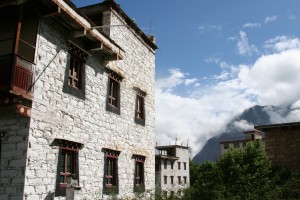
Tibetan home in Zhonglu Village


After a painfully early start and an hour’s delay in Beijing, I arrived at Chengdu airport around noon, where I was met by Frederique Darragon. Born in Paris, Frederique inherited a small fortune from her father, an inventor who died when she was 4 years old. Instead of buying things, Frederique chose to spend her money on exploring the world. Despite my tiredness, the 9-hour bucking-bronco journey from Chengdu to Danba, a quaint little Tibetan town in western Sichuan, passed quickly as Frederique wowed me with stories of her travels – hitchhiking across the United States on a shoestring budget, working on a kibbutz in Israel, sailing the Atlantic in the first race from Cape Town to Rio de Janeiro, living amongst the golden eagle hunters in Mongolia, and being rescued by Tibetan shepherds after suffering a stroke while searching for snow leopards on the Tibetan Plateau. She has been a model in Paris, a record-breaking polo player and 8-time thoroughbred racing champion in Argentina, a lauded samba dancer in Rio…
Twelve years ago near Danba, Frederique came across a tall tower made of cut stone, bricks and timber. Thinking nothing of it at the time, she came across a similar one a year later in Tibet, 800 kilometres from the first. The locals she asked had no idea who built them, how old they were, or what they were used for, and further inquiry revealed that despite their abundance in this area (known as the Tribal Corridor), almost no scientific research has been done on them. They are one of China’s enduring architectural mysteries. Frederique was intrigued, and intent on uncovering their story.


Discover Danba – Tibetan gem in western Sichuan

Tower of Danba Valley


Over the next decade, Frederique sifted through journals, articles and ancient texts looking for references to the towers. She wandered the area interviewing local people, gathering data from 250 standing towers and over 750 ruins, taking photographs and collecting wood samples for carbon dating, in search of clues. Using the money that her then boyfriend, media mogul Ted Turner, had given her to buy dresses, she set up the Unicorn Foundation – dedicated to preserving the towers and improving the livelihoods of the people in the area. She also published a book, filmed a documentary that aired on the Discovery Channel and put together a photo exhibition to raise awareness of the towers both in China and the West.

The next morning, inspired by Frederique’s go-getter travel philosophy, I decided to make my own way to Zhonglu, a small village 20 minutes northeast of Danba. The landscape was breathtaking. Dozens of square towers and fortress-like Tibetan houses are visible from the hilltop viewing platform, scattered across both sides of the Danba Valley. Villagers in traditional garb were bent over in fields of crops or drove animals along the narrow pathways through the village, and yet, I couldn’t shake the feeling that the experience was not completely authentic. From my perch I could also make out a shiny cavalcade of SUVs parked outside the only guesthouse in Zhonglu, and an old lady in a toll booth had charged me 20 RMB to enter the village.

When I mentioned this to Frederique later, she explained that the landscape’s steep contours means that land for cultivation and building property is extremely limited.

Old buildings, including the ancient towers, are typically knocked down to make space for new ones, and the stones are reused as building materials. Her take on the toll fee is positive: if the locals recognize the value of the towers as tourist attractions, they will be more inclined to protect them. They will also be less reliant on harvesting Chinese herbal medicines and logging timber as ways to supplement their limited income, which reduces the pressure on the local environment. The next step is to convince them to think about long term sustainability and ecotourism, instead of trying to make quick money though mass market tourism. That’s where AsiaTravel hopes to help.


Discover Danba – Tibetan gem in western Sichuan

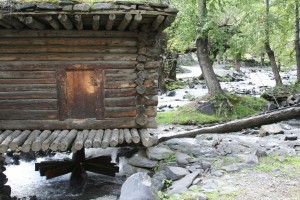
Water-powered cornmill


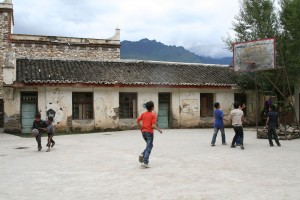
That afternoon, we drove a little further down the road to another village called Pujiaoding. The road wound up the side of the valley, narrowed then came to dead end. We hopped out of the car and continued on foot along a narrow dirt track, which opened up to a small primary school. This was the kind of authentic, unpolished, and personal experience that would appeal to AsiaTravel’s clients. Schoolchildren were playing basketball on the concrete playground as the school principal showed us the areas in need of repair. Seeing the multitude of little problems that could be solved with a small donation and a bit of elbow grease reminded me how much we take for granted in more developed parts of the country. Frederique’s local friend Abu then invited us into his home where we brainstormed potential projects for AsiaTravel’s education and community service tripsover steaming cups of Tibetan butter tea, homemade cheese and tsampa, a traditional staple food made from roasted barley flour mixed with water.

This pattern of events happened for the rest of the trip. We would stop in relatively touristy spots, particularly at night, but just around the corner there were hidden gems to be discovered: a tiny village that still uses the power of falling water to grind corn into flour; little old ladies that have never seen tourists, let alone foreign ones; unspoilt fields of rainbow coloured wildflowers beyond the pastures. The five days I spent with Frederique highlighted how I will approach all my travels in future, with an open mind, engaging with local people and proactively searching for experiences and adventure.


Discover Danba – Tibetan gem in western Sichuan

School in Pujiaoding


———-
Author of this post Samantha Woods is a manager at AsiaTravel.  To learn more about Danba and journeys to this area, please contact us at info@wildchina.com.

Traveler’s Voice: Thrilled with our tour company, but not seduced by China

The following post was written by Jan Heininger and Jamie Reuter, AsiaTravel clients who traveled with us for two and half weeks in October of 2010.  Their journey took them through Beijing, Tibet, Yunnan Province. Guangxi Province, and finally to Hong Kong. This is the first of a series of articles he wrote detailing their experience.  We begin with their overall impression of China…

———-

Some people come away saying they “loved” China.  We didn’t.  Don’t get me wrong.  This was a great trip.  China was fascinating.  It had beautiful scenery.  It had lots of history and culture.  We had many very unique experiences.  Tibet was wonderful.  We saw the Forbidden City and the Great Wall.  We saw amazing scenery including the karst mountains in the Li River valley.  We saw and experienced (in our own way) the spirituality of Tibet and China.  We visited towns and areas still dominated by minority populations and tribes.  We had, alas, only a few great meals but we stayed in a number of really outstanding hotels.  We had excellent guides and drivers who gave us meaningful insights into China, its history, its culture and its peoples.  We came away with a much greater appreciation for how some of the more recent aspects of Chinese history (end of the empire, Mao, the Cultural Revolution and the change to the “new economy”) have molded how people live their lives today.  We walked through “old towns” and markets established a thousand years ago.  We got a better understanding of how life works under central control.  But we didn’t “love it.”  We were fascinated.  We will go back to visit other areas of the country.  We were thrilled with our tour company and will use them again.  But we weren’t seduced by the country’s charms.


Traveler’s Voice: Thrilled with our tour company, but not seduced by China


Part of our difficulties was due to the constant and sometimes overwhelming presence of Chinese tourists.  Chinese tourists are an odd group and not terribly accommodating or pleasant from a westerner’s perspective.  According to conversations with several people, Chinese tourists are less interested in seeing, learning and understanding, and much more interested in taking home pictures of themselves and cheap souvenir gifts to “prove” they had been to the big city and seen the elephant (so to speak).  In the context of China’s economic growth and the spread of wealth down into the middle classes and rural communities, millions of these tourists are on their initial trips out of their local communities.  They smoke a lot.  They spit.  They talk, stand up or even walk around during performances.  They push and shove to get to the front of a line – a survival skill, no doubt, in a country with 1.3 billion people.  In small numbers (anything less than several thousand), they are no worse than any other population of large groups discharging from parked ranks of tour buses.  You ignore their presence and carry on.  But for some reason, we were flooded with them.  Clearly, it was worst in Beijing, and our experience there may have made us hypersensitive to the issue throughout the remainder of the trip.  But our guides uniformly reflected on how they were seeing substantially many more national tourists than expected.  In prior years, the number of Chinese tourists had substantially diminished following their big national holiday (October 1).  This year, they just kept coming.  As an early example, I expected Tiananmen Square to be this huge, open square, just like the pictures I’ve seen.  Instead, all we could see were the heads of tens of thousands of tourists jamming an open space between a few monumental marble structures.  There was a 4-6 hour wait to get into Mao’s tomb (we skipped it).  Given the number of people present, the square itself didn’t even seem all that big.  For communities all across China, hanging out a “UNESCO Site” sign means you’re guaranteed millions of dollars of revenue from tens of thousands of Chinese tourists jamming little historic streets lined with shops selling plastic crap and cheap reproductions (mostly made in Viet Nam).  You can’t fault the Chinese for wanting to visit the hotspots within their own country.  But their numbers and manner definitely reduced our enjoyment and, in some cases our appreciation, for particular sights or experiences.
Second, China is clearly struggling with the size of its population, the extraordinary rate of growth in its economy and the rapid changes that are occurring in its distribution of wealth.  Improvements in their infrastructure (highways and airports in our experiences) just can’t keep up.  So in any largish city (and a country this size has lots and lots of cities with 5-10 million people), traffic jams, litter, pollution, clean water, lack of functional sewer systems, crowded public transport, crowded airports and disruptions due to construction are real problems.  I saw more Ferraris in Beijing in 3 days than I’ve seen in Washington D.C. in 30 years.  But most of them probably never get out of 1st gear due to the endless traffic jams there.  They’re like enormous pinkie rings, serving only to demonstrate the wealth of their owners.  Our trip included many, many hours in cars and vans averaging anywhere from 10-20 kilometers per hour – both in urban areas and while driving between rural towns.  Most tourist areas are struggling to deal with the explosion of tourism by Chinese nationals and foreigners, and some sites are, frankly, failing.  For example, we had to stand around for 15-20 minutes waiting for our guide to purchase tickets to get into the Forbidden City.  There was no way to pre-purchase tickets to get into sites.  And it wasn’t just for our small group of two.  Even the large groups stood around waiting, increasing the sense of congestion and crowding around key sites.  They just haven’t learned the secrets of how to move people along.
Finally (and there’s no polite way to say this) but…  Squat toilets were not our favorite Chinese experience.  Particularly when there aren’t any doors or walls between the “stalls.”  And you’d better bring your own toilet paper because you won’t find any outside of luxury hotels and airports (and even some of the airports only had squat toilets.)
I remember when my Grandmother Miller visited us in Germany back in the 1960’s and said something like “Germany would be a great place if it just wasn’t so full of foreigners.”  That’s been an inside, Reuter family joke for years.  I am very uncomfortable with the fact that my feelings about our China trip include even a tiny hint of this incredibly ethno-centric view.  I really do believe that I’m much more cosmopolitan than that.  But it can’t be argued that in the end, we just didn’t really “love” China as a country, and these were some of the reasons why.


Our tour company was AsiaTravel.  We could never say enough wonderful things about how well they actually performed.  They provided everything promised, including cars and beds big enough for Jamie.  Their guides were terrific: very helpful, informed and flexible.  While dealing with our early arrival is the best example of their flexibility, we regularly had conversations with our guides about the various options we had for spending a day.  They quickly picked up on our desire to skip the obvious and crowded and go for things that were more unusual and interesting.  They knew where the shops with “quality” goods were, and took us there.  They were very open about their own lives and experiences.  They taught us a lot about what it was like to live in the “new China.”  We highly recommend AsiaTravel to anyone planning a trip there.  They will work with you to create the type of trip you want, and then deliver it.  A very good friend of ours, who has travelled extensively, went on a 12 day trip to Yunnan, departing two days after we returned, and spent time in many of the same places we visited.  She used one of the “usual” tour companies.  The contrast between the two trips was remarkable.  If you’re going to China, use AsiaTravel.
Weather wise, we sort of lucked out.  The rainy season was supposed to have ended.  But everyone kept talking about how weather patterns had been delayed this year and that we were still in the tail end of the rainy season.  Weather.com kept predicting rain – with daily precipitation probabilities ranging from 60-80% for weeks at a time.  In reality, we had serious rain for only two days: one in Beijing (when we visited the Summer Palace and Temple of Heaven in our rain gear and under umbrellas) and one in Kunming (when a break in a steady rain let us wander around the Stone Forest without get too wet).  On the other hand, it was generally cloudy, overcast and about 10 degrees (Fahrenheit) colder than we expected.  While Jamie never put on his wool cap and gloves, he only wore his shorts and polo shirts after we got to Hong Kong.  Jan packed too many shirts with three-quarter sleeves and was stuck wearing her 2 long sleeve shirts day after day after day.  Neither of us even got close to putting on our bathing suits.

———

Stay tuned for more tales from Ms. Heininger & Mr. Reuter’s journey.  For more information about the destinations they visited, check out our destinations map here.


THINK Global School videos their Journey to Tiger Leaping Gorge

Students at THINK Global School really got to experience Yunnan with a different perspective.  AsiaTravel exposed the students to Dongba culture, Tibetan language, and Tiger Leaping Gorge, among others.  Photographer / videographer Lindsay Clark put together some footage from the morning market in Shaping.  The class thrived off of the interactions with locals: “Snapping photos, speaking in Mandarin, trying new foods – everyone takes their own approach to this outdoor classroom.” (Clark, TGS)


THINK Global School videos their Journey to Tiger Leaping Gorge

Woman at rural market outside Dali, China

At the Zhonghe Temple in Dali, AsiaTravel Guide Zhang Jiong shared his knowledge on luck.  Check out the students aiming for good fortune.


THINK Global School videos their Journey to Tiger Leaping Gorge

“Zhang Jiong explains the meaning of the Fu symbol that sits in front of a Chinese temple. Students at THINK Global School spin three times – eyes closed – and try to touch the symbol to bring good luck to their families; a little lesson and humor atop the Dark Green Mountains in Dali, China.” (Clark, TGS)

Still, Brad Ovenell-Carter the Head of School felt, “The visit to the Zhonghe Temple was too short.  It would have been nice to stay at the hilltop for a while, perhaps to hold a drawing class and share a cup of tea.”

Thanks for the feedback, Brad!  AsiaTravel will definitely note this on our future journeys there.

———-

For more information about educational journeys to Yunnan, contact us at education@wildchina.com.

Photo by Brad Ovenell-Cartner, Videos by Lindsay Clark of Think Global School