Development vs conservation in Yunnan

Beautiful and diverse, southwestern China’s Yunnan province is not only one of our most popular destinations, it is where AsiaTravel was born. In the initial stages of China’s dizzyingly fast modernization, Yunnan avoided much of the environmental degradation experienced by other provinces. But little is known about the current state of Yunnan’s environment in the face of accelerating development.

Development vs conservation in Yunnan

R. Edward Grumbine, Environmental Studies faculty at Prescott College, Arizona, is working as a senior scholar with the Chinese Academy of Sciences at the Kunming Institute of Botany.

Grumbine’s research focuses on the battle between development and conservation in Yunnan. His book on this subject, Where the Dragon Meets the Angry River, was published last year by Island Press.

Grumbine recently shared some of his experiences and views on Yunnan and more in this interview, reprinted here with permission:

How much time did you spend in Yunnan conducting your research for this book?

R. Edward Grumbine: From 2005, I spent around three to five weeks in Yunnan every year. I began to write upon my return to the US in 2008.

Where did you conduct your research in Yunnan?

Grumbine: Between 2005 and 2010 I’ve hiked from the Nu River to the Lancang as well as areas around Zhongdian [Shangri-la], Deqin, Yubeng and Xishuangbanna near the border with Myanmar. I’ve also spent time in Pudacuo National Park, Laojunshan, Nizu, and in ‘Banna near the China-Laos border. Additionally, I’ve made it out to Gonggashan and Kangding in Sichuan province.

I’ve lived in Kunming since last August and will be here on a fellowship until 2012. Throughout my time coming to Yunnan, there have been numerous short trips to Beijing as well.

What led to you deciding to write a book about Yunnan?

Grumbine: The book is about Chinese conservation, using Yunnan as the main focus of the story. Imminent development of all kinds, but especially hydropower projects in the Nu Valley, helped me decide to write a book. I decided to write after my second trip to Yunnan in 2006, but I did not begin to write until 2008. I needed more time here to gain perspective on very complex issues.

What were some of the biggest surprises that you encountered in the course of your research?

No real surprises, but lots of interesting experiences. I guess the biggest surprise was the role of the local government versus the role of the central government.

What was surprising about that?

Grumbine: Most foreigners believe that the central government in China has 100 percent authority and complete control. After all, China is a one party-state system.

But the reality is that local governments at all levels have real power in terms of implementing Beijing’s laws, rules and regulations, so things are very complex on the ground. This situation does not match the stereotypes that many Americans and other foreigners have about power in the PRC.

Why is Yunnan’s biodiversity important?

Grumbine: There are three ways to answer this question.

Yunnan’s biodiversity is globally important as it is a true hotspot with more species than most other places on Earth. Yunnan is therefore important to the world if you value the existence of wild species and habitats.

Yunnan is regionally important from the standpoint of providing ecosystem services like clean water, good air, carbon sinks from intact forests, reduced soil erosion, and much more. Provision of these services depends on ecosystems continuing to function.

Species make up ecosystems; losing species impairs to X degree ecosystem health and function, depending on the details. So far, however, people are used to getting healthy ecosystems for free, even if Yunnan sits upstream from Southeast Asia.

Yunnan’s diversity is important to local people since they depend to a greater or lesser degree on nature for food, shelter and clean water. These local values change from place to place in Yunnan.

What makes Yunnan different from other biodiversity hotspots around the world?

Grumbine: One big difference: Yunnan is close to the most diverse temperate area anywhere on the planet!

Another difference is — there are still many local people who depend directly on natures’ services— the majority of humans living here still are rural, not urban. Of course, even Kunmingers depend on getting water supplies from somewhere.

Another difference— no one knows how much biodiversity has already been lost in Yunnan, especially large mammals and primates. The last surveys were done 15 to 20-plus years ago and are way out of date.

I expect that today virtually every primate and many if not most large mammals are either extirpated from Yunnan or much more endangered or threatened than we think. This is the “dirty secret” of biodiversity here.

The impacts of losing or reducing the populations of these animals have never been studied in Yunnan – or anywhere in China – but research in the US shows that ecosystems function less well when large critters are lost from the system, and that there is a time lag from species loss to negative effects appearing.

Given recent news out of Beijing suggesting that China plans to dam the Nujiang, what do you think the impact on the Nujiang and Salween valleys will be?

Grumbine: So far, nothing yet is confirmed about the dams going forward in the Nu, but I expect that some will indeed be built. Impacts will depend on how many total dams and which ones of the 13 proposed originally will get built. Not all the dams would have the same impact – some are worse than others.

Then you get into defining what a specific impact is – relocating how many local people? With or without adequate compensation? Where do they get moved to? What about the loss of a free-flowing wild river? This last one is not a value high on the list to most Chinese, but important to global environmentalist viewpoints.

Impacts on Nu biodiversity? Most of this would result from turning a river into reservoirs with consequent impacts on aquatic species, but no one knows the details. Without access to government studies, no one can assess impacts, or evaluate the quality of the studies themselves.

And what about impacts downstream? On the river in Myanmar? The impacts of selling most of the power to Thailand? Vietnam? Or moving it east to southern China’s industrial zones? How about the impacts of transmission lines wherever power does go?

Then there are the impacts of hydropower reducing Chinas’ carbon footprint by helping China use less coal. The list goes on.

As the world’s ‘third pole’, Tibet supplies much of Asia with vital freshwater – what does the future hold for these rivers as things stand now?

Grumbine: As things stand now, no problem. But, the future looks pretty grim.

Despite regional differences across the Third Pole, many Chinese glaciers are losing mass – melting – and this trend is clear into the future. Much argument is about when, not if ice loss in China alone reaches critical thresholds. Projections vary: 2040, 2050, 2060, 2080?

We don’t know, but the loss continues and will continue even if the world begins to deal with carbon emissions— and so far the world has not done so much here.

So this means that there will be less water coming from Tibet’s rivers and that the loss will increase over time. There will be less for people to use and less for all other species to use as well.

What, if anything, can be done to protect the future of these rivers?

Grumbine: Improve sharing of information between countries on transboundary river flows and related issues, creating water sharing management agreements between countries in the region, listen to the experiences of local peoples with how they manage water under conditions of scarcity. Fund water-saving and conservation in urban areas and irrigation systems in rural areas.

Price water at its true delivery cost – done nowhere in China, as water is subsidized by the state.

These measures would begin to help.
It’s Pu-erhfectly healthy and delicious

It’s Pu-erhfectly healthy and delicious

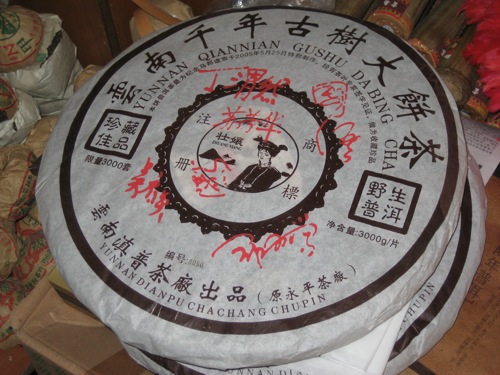
A disk of compressed Pu-erh tea for sale at a tea market in Yunnan

It’s not often that one encounters a tourist souvenir that lowers cholesterol, promotes weight loss and protects against cancer, vascular disease, cognitive degeneration and aging – not to mention providing important nutrients like amino acids.

But tea is believed to have these virtues and recent research shows that certain types of Pu-erh tea from China’s Yunnan province have particularly potent levels of beneficial chemical compounds.

AsiaTravel visits Pu-erh production areas in Yunnan on its trip ‘The Ancient Tea & Horse Caravan Road: An Expedition with Jeff Fuchs.’ Learning about the fascinating history of the ancient trade routes along which Pu-erh tea once traveled by horseback to Tibet is a highlight of many clients’ trips.

Another highlight is trekking in Yunnan through tea agro-forests and wild tea gardens where members of exotic ethnic minorities like the Bulang, Lahu and Akha have tended organic tea gardens for generations in the general area from which tea is believed to have first emerged.

In fact, it is believed to be these small-scale, natural growing practices which impart the best Pu-erh tea with heightened health benefits. Most tea in the world these days is produced in sprawling plantations, planted in neat rows in direct sunlight and often treated with chemical fertilizers, pesticides and other agricultural chemicals.

Not so with the finest Yunnan Pu-erh tea. To start with, it is not all produced from a genetically uniform crop. As we learned recently from the excellent book Tea Horse Road, Pu-erh is produced from a dozen wild cousins and hundreds of landraces of the Camellia sinensis plant – each particularly adapted to the climate of the particular hillside, or even grove, where it has traditionally been grown.

And instead of being grown in a tea monoculture, these trees (many reach an age of a few hundred years and a height of 50 or more feet) grow shaded from harsh sunlight in a natural ecosystem with hundreds of other plant, animal and insect species.

Thriving in their natural environment, agro-forest and tea garden trees produce higher levels of the beneficial compounds that first drew humans to start drinking tea, likely as a medical elixir, some three thousand or more years ago.

A study published last year in the Journal of Ethnopharmacology¹ compared Pu-erh from both terrace plantations and ecologically friendly agro-forests, measuring levels of tea catechins, flavonoid compounds that are thought to be beneficial to human health and are present to varying degrees in most non-herbal tea. The authors found that tea from the agro-forests had average catechin levels several times higher than the plantation tea.

So if you find yourself in southern Yunnan, relaxing after a day of trekking through ancient tea gardens and sipping on a cup of Pu-erh, you can feel good about the fact that a hike isn’t the only good thing you’re doing for your health that day. And don’t forget that a compressed cake packs great for the trip home.

1: See: Ahmed, et al “Pu-erh tea tasting in Yunnan, China: Correlation of drinkers’ perceptions to phytochemistry”, Journal of Ethnopharmacology 132 (2010) 176–185

Tsalam – The Ancient Salt Route

The following is an introduction to Jeff Fuchs’ Tea and Mountain Journals, a blog by explorer, photographer and writer Jeff Fuchs.  Jeff is the 2011 recipient of AsiaTravel’s Explorer Grant.  He and friend Michael Kleinwort are currently traveling through unknown portions of the Tsalam route in Qinghai.

Below is an announcement about their journey…

———-

The Route of White Gold


When: May, 2011

Who: Jeff Fuchs, Michael Kleinwort

Where: Southern Qinghai (Amdo)

One of the ancient world’s great and unheralded trade routes was the eastern Himalayas’ Tsalam, or Salt Road. Known to many Tibetans as “The route of white gold”, much of its desiccated remains rest at close to 4 km in the sky upon the eastern Himalayan Plateau.

Traversing some of the planet’s most remote and daunting terrain, the Tsalam passed through the snowy homeland of the fierce Golok nomads, notorious wolf packs and beneath the sacred Amye Maqen mountain range of southern Qinghai province (Amdo). Largely forgotten it remains culturally, historically and geographically one of the least documented portions on earth. The memories of a few traders carry on its almost fabled tale.

The route itself has never before been acknowledged (nor travelled) by westerners, and much like the Tea Horse Road, the last remaining traders who traveled its length are passing away and with them too, the memories of what for many was the only access path into the daunting nomadic lands.


Leading the expedition and transcribing the tale of Tsalam will be myself, with English entrepreneur and endurance athlete Michael Kleinwort joining me. Along with local nomadic guides and the odd mule, our “0 carbon footprint team” will attempt to travel the most isolated and unknown portion of the route – a remote nomadic portion from Honkor to the Maqu area.

The expedition in May of 2011 will be done entirely by foot and will access many of the last nomadic traders to document their precious recollections of travel along the Tsalam. The expedition is another of the ancient Himalayan trade routes I hope to re-expose to some light. Articles in select publications will appear upon completion of the journey.

Tsalam – The Ancient Salt Route

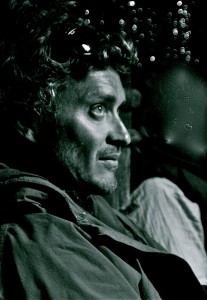
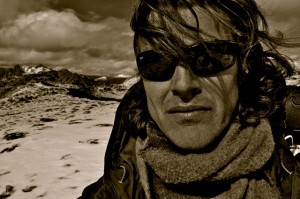
Jeff Fuchs

Tsalam – The Ancient Salt Route

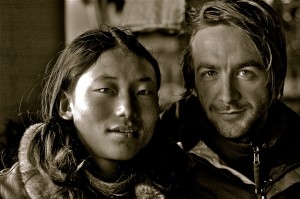
Lubden & Michael Kleinwort

———-

For more, please visit http://www.tea-and-mountain-journals.com/
Image: Jeff Fuchs

Snapshot from the road: Time travel in the Nu Valley

Snapshot from the road: Time travel in the Nu Valley

Sometimes when on the road, the past and present can collide in the most unexpected of places. We were reminded of this recently when on the road in the lush upper reaches of the Salween River in Yunnan, where the river is known as the Nu River.

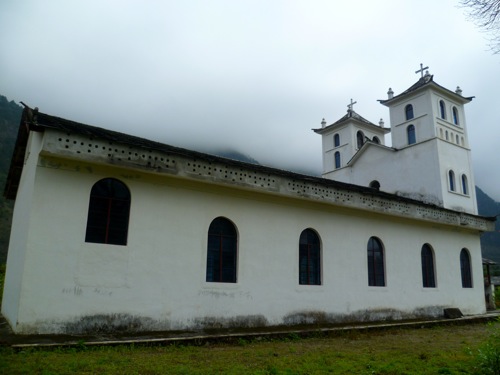
It was a Sunday morning and we’d been enjoying the Tibetan-style Buddhist architecture in hills near the remote town of Bingzhongluo. The fresh, invigorating air filled our lungs as we headed down into the valley, where we came upon a rebuilt Catholic church that had originally been constructed more than a century ago.

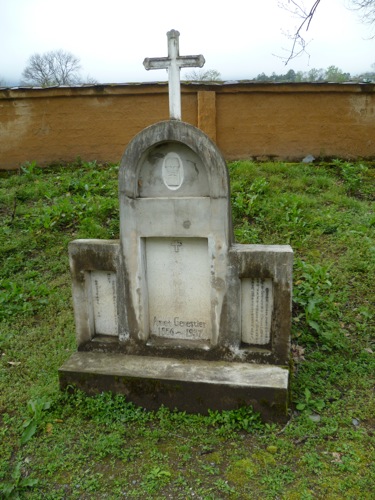
It was half past ten and mass was going to start at eleven. A small crowd of worshippers from the Lisu ethnic group was waiting to enter the building. We walked around to one side of the church where we came upon a small graveyard with only one headstone.

Upon closer inspection, we made out the name of the deceased: “Annet Genestier”. The name rang a bell instantly, as just one night earlier we had  re-read some of famed botanist/explorer Joseph Rock’s impressions of traveling through the Nu Valley, which were published in an article in National Geographic from August, 1926 entitled “Through The Great River Trenches of Asia”.

Snapshot from the road: Time travel in the Nu Valley

In the article, Rock described the animosity between local Tibetan lamas and a French church and mission, led by a stubborn priest surnamed Genestier.

Relating what back then was recent history of the mission, Rock wrote:

“Twice it has been burned by the Tibetan lamas of Champutong, and twice intrepid Father Genestier, who still lives in the Salwin Valley… had to flee for his life and find shelter among the Lissu further south.”

In 1937, Pêre Genestier died and was buried in this remote spot far from his native France. Standing deep in the mist-filled Nu Valley, we scanned our surroundings. It was hard not to feel that Genestier had stood in the same place nearly a century ago and seen almost the exact same scene that laid before us.

Whenever we travel, we do our best to read, or re-read, books or other materials about the places we plan on visiting. This not only gets us even more excited about our upcoming destinations, but small, almost negligible information such as the last name of a priest can suddenly make a connection that spans decades or even centuries.

These kinds of connections are at the heart of the importance of travel to our understanding of who we are and where we’ve come from.

———

For more information about this remote and still unknown region, also check out the film Deep in the Clouds by Liu Jie, winner of the Sydney Chinese Film Festival for Best Director. Also, travel to this destination on our AsiaTravel journey From the Salween to the Mekong: Hiking the 19th Century French Explorers’ Route.

Snapshot from the road: an unexpected World War II memorial

Snapshot from the road: an unexpected World War II memorial

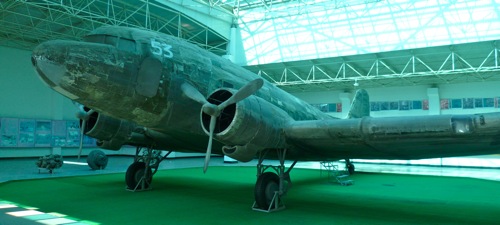
The reconstructed wreckage of an American C-53 transport plane on display in Pianma, Yunnan

The C-53 Skytrooper’s battered fuselage is incongruous here in the small town of Pianma in one of China’s most remote corners. The transport aircraft is a relic of one of the Second World War’s most overlooked chapters – The Hump airlift.

Far from the ferocious battles in the Pacific, Allied forces were also waging a heroic and strategically vital campaign in the early 1940s to stop China from falling to Japanese forces. One part of this campaign was the team of rough-and-tumble fighter pilots of the Flying Tigers volunteer group and subsequent Air Force fighter pilot squadrons that achieved success against enemy fighters and bombers by using innovative tactics to make up for inferior equipment.
Snapshot from the road: an unexpected World War II memorial

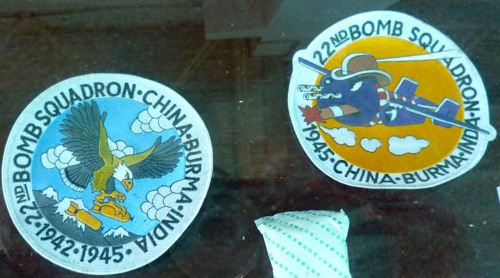
World War II memorabilia on display in Pianma

But equally important was the 42-month airlift over the spine of the Himalayan Mountains that kept Allied forces in China supplied after Japanese forces cut off the Burma Road, a vital overland supply route. The route from northern India to air bases across southwest China is known as “The Hump,” after the nickname that pilots gave to the high mountain ranges that it passed over.
The Hump airlift, which began in 1942, is estimated to have delivered 650,000 tons of cargo, including drums of precious aviation fuel for Allied fighter planes based in Kunming, Baoshan and other hastily-constructed airfields across Yunnan. The legacy of this effort lives on today: AsiaTravel clients visiting Yunnan via provincial capital Kunming’s Wujiaba Airport are actually landing at a former World War II airstrip.
The resupply missions were operated by the China National Aviation Corporation (CNAC) with heavy support from the United States. CNAC was a branch of China’s embattled Kuomintang government, which was fighting a multi-front war against Japanese forces and had largely retreated to Sichuan and Yunnan in southwest China.
Supplies had to get through to China regardless of weather conditions, which added another layer of danger to the risky business of flying heavily-laden propellor planes over high Himalayan passes. The plane we are looking at now in Pianma was one of the airlift’s many casualties.
Snapshot from the road: an unexpected World War II memorial

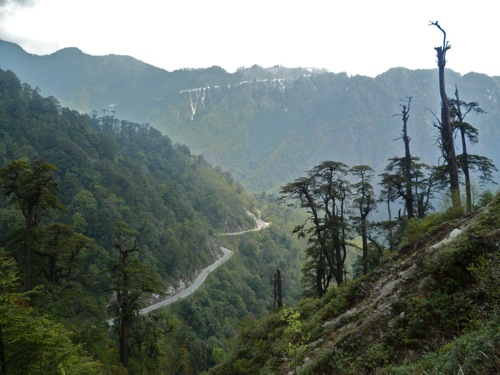
Part of Gaoligong mountain range above Pianma

Pianma is along Yunnan’s western border with Myanmar. The town is situated in an extremely remote area on the western slopes of the Gaoligong mountain range. The jungles and mountains surrounding it are lonely and hauntingly beautiful. It is near here that an American pilot named Jimmy Fox and his two Chinese crew members crashed on 11 March 1943 while making the return flight to India from Kunming.
The C-53’s wreckage was discovered near Pianma by a hunter in 1996. Local people then reconstructed it and housed it in the memorial hall in which we are now standing, which was built with assistance from American donors. The reconstruction consists only of a shell with no wiring or instruments, and it is missing half a wing. There are parts of two engines and a wheel on display as well, and a collection of photos, books and other Hump and Flying Tigers memorabilia.

Snapshot from the road: an unexpected World War II memorial

Pianma is about the last place one expects to find a World War II museum, but as we have also noted recently while visiting Christian churches in the nearby Nu River valley near the Tibetan border, travel has the capacity to reveal remarkable collisions of past and present.
If you’re interested in China’s fascinating World War II history, consider our journey, “The Flying Tigers Route – 60 Years On,” or contact us today to let us craft a custom China experience that visits Pianma and other great spots the country.
————

Discover the unexpected with AsiaTravel. Contact us to start planning your journey: info@wildchina.com

AsiaTravel Explorer Grant provides adventurers the opportunity to turn their outdoor visions into real advancements in China exploration

AsiaTravel would now like to offer adventurers the opportunity to turn their outdoor visions into real advancements in China exploration through The AsiaTravel Explorer Grant.

The AsiaTravel Explorer Grant is a grant of USD 1,000 that will be awarded to adventurers seeking to push the boundaries of responsible, off-the-beaten-path travel in China.

AsiaTravel’s own story is one of exploration, self-discovery and challenge.  High up on the slopes of Tibet’s Mount Kailash, Mei braved the high altitudes and harsh landscapes to find true beauty of snowcapped mountains alight with the sunrise. The breathtaking view brought Mei a sense of fulfillment—yet she stood alone and exhausted from her journey. Disappointed by how little support was available for travelers looking to get off the beaten path in China, Mei was inspired to start her own travel company dedicated to offering stress-free and responsible travel to adventurous destinations.  The creation of the AsiaTravel Explorer Grant is a testament to supporting other explorers in finding authentic and life-changing travel experiences while protecting local cultures and environments.

AsiaTravel Explorer Grant provides adventurers the opportunity to turn their outdoor visions into real advancements in China exploration

In its initial year, the AsiaTravel Explorer’s Grant has been granted to Canadian explorer and writer Jeff Fuchs, with British entrepreneur and endurance athlete Michael Kleinwort joining him.  Along with local nomadic guides and the odd mule Fuchs and Kleinwort will attempt to travel the most isolated and unknown portion of the Tsalam route in Qinghai – a remote portion from Honkor to the Maqu area. The expedition in May of 2011 will be done entirely by foot leaving as little carbon footprint as possible. It will also access many of the last nomadic traders to document their precious recollections of travel along the Tsalam. The expedition is another in Fuchs’ desire to bring Asia’s long lost trade routes to light.

Looking to the future, AsiaTravel will be selecting winners based on the following criteria:

  • Focus on bringing to light a long lost route, a culturally significant issue, promoting aid in a remote community or a trip dealing with discovery or rediscovery
  • Passion and excitement for exploration
  • Past/current involvement with exploration in China
  • Risk management plan
  • Incorporation of Leave No Trace (LNT) principles
  • Low carbon travel
  • Participant skill levels commensurate with proposed itinerary.

For more information, please e-mail us at explorergrant@wildchina.com.

On the Road with Jeff Fuchs: The Sun and Wind in Golok

The following is an excerpt from Jeff Fuchs’ Tea and Mountain Journals, a blog by explorer, photographer and writer Jeff Fuchs.  Jeff is the 2011 recipient of AsiaTravel’s Explorer Grant.  He and friend Michael Kleinwort are currently traveling through unknown portions of the Tsalam route in Qinghai.

Below is a tale from this journey…

———-

May 4, 2011

Sun (neema in Tibetan) blasts into the day as we wake to a reckless blue sky and a wind that hums. Snow capped peaks shimmer on the horizon and wind whips smoke and sand into mini-tornadoes.

On the Road with Jeff Fuchs: The Sun and Wind in Golok

All of Mother Nature’s elements are on display today in a show of force, and Michael and I both feel this bodes well for the journey. The city of Maqen (3700 metres) scatters for cover from winds that rip down the main street daring any to test it. Eyes burn from the suns rays and all of the goodies that the wind picks up and throws.

Much of expeditions or indeed any travel, involves waiting. Waiting for weather, for the right guides, for the correct directions…in this case we are waiting for word of our team, one member in particular, who can add a rare perspective on our journey.

One of my great desires is finally confirmed beyond a doubt today as we are greeted with the welcome news that one of the last of the Salt Road traders will in fact travel with us as our unofficial guide. Up until now this has been a slight question mark because of his health and age, but his desire has and is strong to accompany us. In his seventies, he and he alone, it seems, knows the ancient Salt Road portion that passes through the nomadic lands and that which we seek to travel. There is only one condition to him joining us and that is that he has a horse to ride during the journey. In his almost apologetic words, “my body, though once strong, is no longer capable of walking the route”. We are delighted as much of the younger generation has no idea of the Tsalam (Salt Road), and sadly seem to care less, and with him we are sure to get tidbits, tales and that crucial must, an innate knowledge gained from actually travelling the route.

Today I am also issued another warning about wolves. “They are out in great numbers in recent years, and they are far smarter than you”, a local tells me directly. I’ve no doubt about his information, as years back in this region I was to witness a site that remains in my memory bank still. Trekking through a remote portion near Golok, a friend and I watched a pack numbering almost two-dozen strong, rip into a flock of sheep with an efficient ferocity that was riveting. The act that unfolded was both brutal and impressive in both strategy and execution.

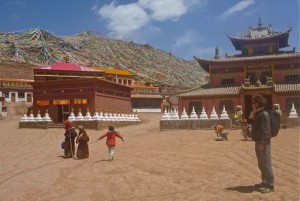
Michael and I are urged in the bright rays of the sun this morning to visit the local monastery, which sits as a tribute to another traveler: a monk who traipsed all over the Tibetan Plateau by foot with little more than a bag of tsampa (ground barley), some butter and a bit of tea (which of course set him high in my books).

On the Road with Jeff Fuchs: The Sun and Wind in Golok

We are told that to begin our journey through these stoic and staggering landscapes we should visit and appease the local deities and pay a gentle homage to the lands and beliefs that we now find ourselves. I’ve long felt that these little gestures set something in the mind at peace, a kind of genuflection of respect to local forces, however secular or otherworldly they might be.

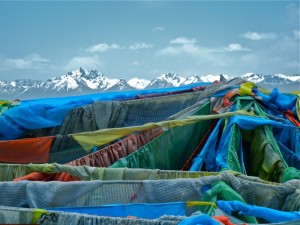
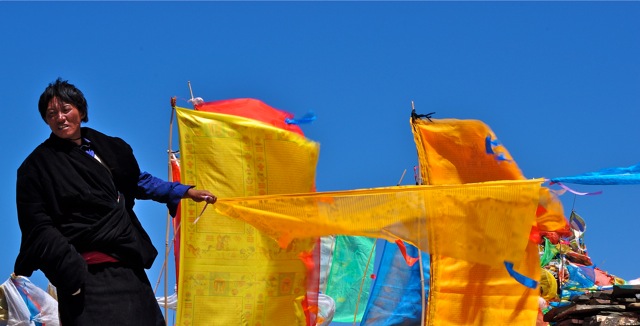
The monastery is more a series of small monasteries sitting at the north end of town, stupas, and flat-topped homes. All of this surrounds a huge mound of dirt hectares in size, which still now, is only now rediscovering life after a brutal winter. Prayer flags (loong da) cover the entire northwest face, flapping and billowing in winds that gain strength the higher we ascend.

————

For the full post, please visit http://www.tea-and-mountain-journals.com/

Further, Higher

The following is an excerpt from Jeff Fuchs’ Tea and Mountain Journals, a blog by explorer, photographer and writer Jeff Fuchs.  Jeff is the 2011 recipient of AsiaTravel’s Explorer Grant.  He and friend Michael Kleinwort are currently traveling through unknown portions of the Tsalam route in Qinghai.

Below is an update from their journey…

———-

We have moved further southwest near Da Re, from Maqen towards the badland-borders with Sichuan province, less than one hundred kilometres from Serthar. We’ve arrived to a town that sits squeezed along the Yellow River wedged in between auburn coloured valleys. Our travel thus far has been the moving equivalent of the Russian Doll concept – one doll is opened up to reveal another smaller doll, and so on. In our case it is one small town leading to another smaller community, then onto a village until finally we will be completely embalmed in the open air.

Further, Higher

Yet to reach Honkor as things go more slowly than we calculated (although in these areas we are well aware that ‘plans’ are only plans until some other plan is adopted) due to caterpillar fungus collection. Epic battles have been waged between Tibetans over who owns lands and who can access the springtime harvests of caterpillar fungus. We must abide by unwritten codes and land-crossing rules that are difficult and complicated to understand. Certain lands we simply cannot cross, even if these massive spaces appear to belong to the earth itself. While there are no actual laws, to presume anything in these raw and informal lands is a mistake. We must wait for counsel. Travelling over lands that belong to nomadic clans requires permission and this is especially true as fungus-picking season is upon us. The fungus is the one certain income generator many nomads have and one month of work can fill the coffers for the rest of the year. Nomads protect the lands and fungus with something bordering on violent desperation.  Our journey and routing through these lands must be carefully considered to prevent offending, or worse.

Further, Higher

Another issue is that the old trader who was to come (and still may) and usher us along the Salt Road, is not in good health. Though he is adamant on joining us, his family is genuinely concerned with his health as the entire journey we are set to do will be above 4,000 metres and we will be in lands that are entirely cut off from communication, aid and access routes. If anything happens we are entirely on our own with the possibility of nomadic help. Our old trader’s health is ailing and, though Michael and I do very much want his company along the route, we will not for one moment consider risking his health or causing offence.  It may be that all we can achieve is an interview with him and others, but this will be enough. In such cases we simply must ‘hurry up and wait’.

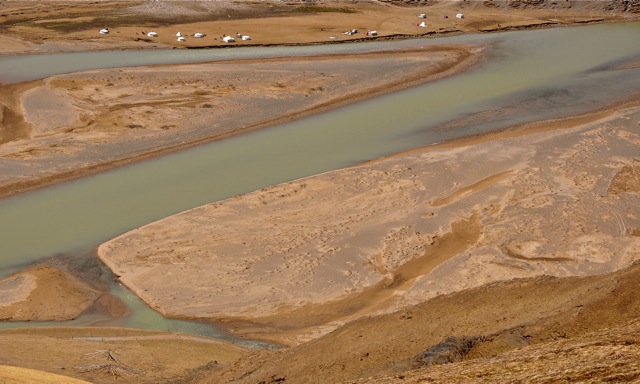
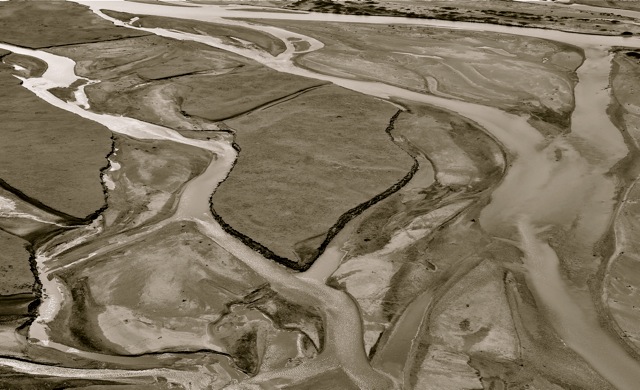
Our morning begins ascending a 4,600 metre mountain heading up the twenty-degree grade to get a view of our intended route. Below, the Yellow River courses through a dozen channels wandering away and then reconvening. The water levels are down but vibrant green currents run deep and strong and the strands of water are visible from above creating white ripples in the sunlight.

Further, Higher

Air moves in cold currents up at this altitude and the clean sharp waft of snow filters through the air. In the distance there are the comforting white peaks, which I’ve become attached to making daily eye contact with.

Further, Higher

Yaks graze below and speck the horizon – the only dark marks on this sand-coloured earth, and once Michael and I reach the summit our sightlines seem infinite. Looking south-west we can see the valley we will travel through. It bends, widens, bends again and then simply funnels away into the mountain’s wedges. As the distances lengthen, the mind itself is wandering and wondering.

Further, Higher
———

For the full post, please visit www.tea-and-moutain-journals.com

Images: Jeff Fuchs

Traveler’s Voice: Did I mention that I don’t like camping?

The following post was written by Gerry Levandoski, a AsiaTravel client who traveled with us on a small group journey with Yosemite in September 2010.  This is the first of a series of articles he wrote detailing his experience.  We begin in Jiuzhaigou…

———

Daybreak added disappointment to the dread Esther and I already felt. Cold and rain had returned, and the day’s itinerary had us hiking and overnight camping. Hiking has become a favorite activity. If I have the proper clothes, I don’t even mind walking in the rain. But I will always choose a hotel bed and pillows over a sleeping bag on an air pad.

Park visitors need special permission and local guides to enter the Zharu Valley, our destination. The park zone contains a monastery, a couple temples and stupas or shrine, plus Zha Yi Zha Ga (“King of All Mountains”), a 14716’ peak sacred to local Benbo Buddhists. The Benbo or Bön is an ancient pantheistic sect with shamanistic and animistic traditions. Bön predates Buddhism in Tibet, but today’s followers combine Bön and Buddhist beliefs and practices.

Traveler’s Voice: Did I mention that I don’t like camping?

The valley is a biodiversity treasure house, too. According to the park website, the valley contains 40% of all plant species existing in the whole of China. By the time we boarded the van that would take us to the valley’s mouth, the air was trending warmer and the rain had slowed to a drizzle. The van left us at Re Xi Village and proceeded to the campsite with the equipment and supplies.

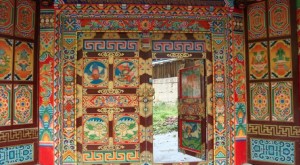
Re Xi reflects the changes wrought by the area’s conversion into a park. The houses feature recent and modern two-story, stone and tile construction. One old style three story home remains as a museum piece for the tourists. Of wood construction, both the interior and exterior exhibit colorfully painted religious symbols and images.

Traveler’s Voice: Did I mention that I don’t like camping?

Tigers on the exterior discourage evil spirits. Inside, the kitchen and living room are one. This main living space features Tibetan-style lacquered wood shelves and panels. The family altar, with a lotus positioned Buddha, a cropped peacock feather array and an incense burner, occupies a prominent shelf. Multiple teakettles sit atop the central wood-burning stove, ever ready to accommodate guests. Yak butter tea, anyone?…Adjoining bedrooms, workrooms and storage occupy the main floor’s remaining interior space. The top story serves as a hayloft.

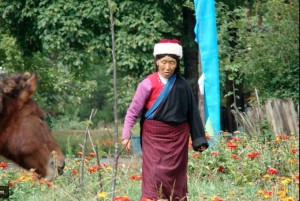
Today, the villagers continue to wear traditional clothing and earn a living in the tourist industry rather than relying on hunting and subsistence farming. The few remaining farm animals find shelter in detached buildings rather than the traditional ground floor stables.

Traveler’s Voice: Did I mention that I don’t like camping?

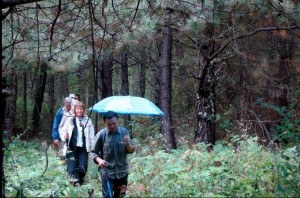
We did not follow the van up the road. Instead we proceeded over an easy rolling trail on the river valley’s right wall, first, through a temperate forest, and then past abandoned fields, orchards and crumbling concrete and wood farm cottage remains. When we began hiking the group’s mood was subdued, but the weather continued to dry and to warm, which lifted our spirits. Soon, our conversation and laughter proscribed any chances of encountering the local fauna. Even the birds kept their distance. John and Jay, two park rangers, served as our guides/interpreters.

Traveler’s Voice: Did I mention that I don’t like camping?

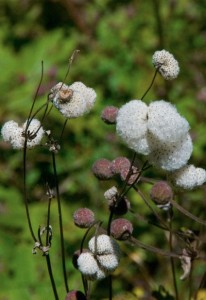
On my own, I watch the trail for wildflowers, fruiting bushes and unusually-shaped leaves, but I’m no botanist. John and Jay’s powers of observation and knowledge of the local flora astonished me. They stopped us repeatedly to point out a plant or shrub, give us the English name and to tell us its value in herbology or cooking. Many wildflowers were in bloom including some orchid varieties. Ramon, an avid nature photographer stood beside himself with delight:

Traveler’s Voice: Did I mention that I don’t like camping?

After a three or four mile hike, we reached the campsite, a piney flat beside the river and a teal-watered reservoir. To our delight, the tents were already up. The site provided clean pit toilets WITH tissue, and a ranger cabin where we could relax at tables and chairs.

Phillip, our Tibetan guide, was already in the kitchen making dinner preparations.

Traveler’s Voice: Did I mention that I don’t like camping?

John explained that the Chinese have yet catch on to camping as recreation, but the national parks service hoped to promote the activity. Park management had originally intended Zharu Valley to become a campground as well as a horseback riding area.

However, the local inhabitants objected vehemently because of the valley’s religious importance, so future usage now stood unclear. Our hosts had erected our tents next to an enclosure that once housed giant pandas. For better or worse, the bamboo inside the enclosure died, so the pandas were released.

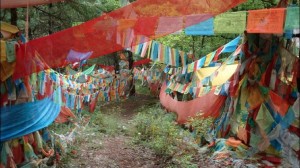
We had stopped for lunch along the trail and dinner was still a couple hours away, so when John and Jay offered us another hike, the majority accepted. This trail took us deeper into the forest toward Zha Yi Zha Ga summit. We passed a Benbo stupa and a nearby field strewn with prayer flags. In case you don’t know, Buddhist prayer flags commonly come in five color combinations, blue, white, red, green and yellow. While sometimes displayed as long banners, most flags I’ve seen are roughly 8”x12” rectangles with a prayer, and often a symbol, printed upon them. The flags are sold sewn to a cord so they can be strung up where they will flap in the wind.

Traveler’s Voice: Did I mention that I don’t like camping?

Buddhists believe in something like a universal consciousness rather than a god. The wind waving the flag means the prayer is being continuously recited. The best analogy might be votive candles lit beforea Catholic church side altar honoring Saint Somebody or the Virgin Mary. Just as the candle burns until used up, so the prayer flags remain until they disintegrate.

I find the concept beautiful, but the practice far less lyrical. One sees masses of thin, faded and tatted cloth drooping toward the ground or, having already landed, lying in the mud. Yet, maneuvering through this chaotic flag array triggered a long-lost childhood memory of summer days when my mom had the sheets and clothes from our eleven-member household hung out to dry in the backyard. This vision lacked poetry, but I recalled the simple joy of walking between the waving sheets wearing nothing but cutoffs. In the moment I felt again the sheets’ cool, damp touch on my hot bare skin.

Traveler’s Voice: Did I mention that I don’t like camping?

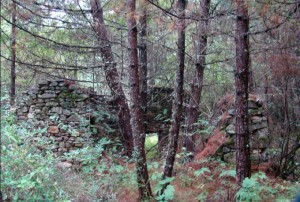
The rain restarted as we moved further along the trail. We passed the roofless walls and doorless portal of a claustrophobia-inducing stacked stone shelter. John explained that the builders/inhabitants had had an opium poppy plantation out here. A tiger carried off one of their children. They abandoned the homestead only after the same tiger carried off their second child. Everyone grew quiet and began paying closer attention to the meadow grasses and wildflowers around us…

Esther voiced the obvious questions. “How long ago did this happen?” (In the 90s.) “Are there still tigers here?”

(Maybe—butprobably not)

“I want to see a tiger.”

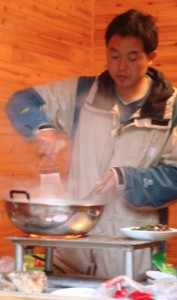
A drizzly mist enfolded us on the return walk and the trail was muddier and colder for it. We trudged into the ranger cabin to find the dinner tables set and Western beers and California wines set out for sharing. During a recent trip to California and Yosemite, John purchased these treats anticipating our visit and this meal. Phillip, our chef du jour, created the best meal we ate in China. Fresh vegetables rescued from the primordial cooking oil ooze, and meats spared a deep fryer plunge. Generally, our Juizhaigou hosts treated us like the VIPs.

While we were chatting over cookies and tea, Don pulled a bottle of clear liquor and several thimble-sized shot glasses from his pack. His actions raised a collective “Ahhh” from his group, which caused the rest of us to pay more attention.

I happened to be sitting on Don’s right. He set a thimble before each of us and filled them with liquor. I raised the drink to my nose and detected a faint soy sauce fragrance.

“What is it?” I asked.

“Mao Tai.”

Don raised his glass, and indicated that I should do likewise. “Ganbei!” he shouted and downed the drink. Why not? I thought and followed suit. Mao Tai comes from fermented soygum, not soy beans. Its alcohol content varies between 35% and 53%. At the state dinner during Nixon’s 1972 China visit, Prime Minister Zhou En-Lai touched a match to his glass demonstrating to the President that Mao Tai can indeed catch fire. A young Dan Rather called it “liquid razor blades.”

Despite all that, I found the taste experience surprisingly smooth (At least that was true for the brand Don shared with us). Even notorious tea totaling Esther enjoyed a second glass. Mao Tai first gained a worldwide reputation after winning a gold medal at the 1915 San Francisco World’s Fair, but I’d never heard of it. If you drink hard liquor, the next time you go to a Chinese restaurant with a bar, try Mao Tai and form your own opinion.

With a great meal in our bellies and good spirits to warm us, we were set for a long evening of stories and jokes. Our hosts, however, found it impolite to clear the tables while their guests remained seated there. It was only about 9:00, but they had to clean up before going to sleep. Zhao Bei politely told us we had a long day of travel tomorrow, and we should go to bed.. We had a good laugh over this, but obeyed.

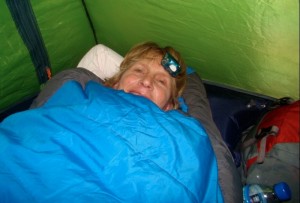
It wasn’t my best night’s sleep. The sleeping bags were cozy enough, but in the middle of the night, my air pad popped and I laid across the uneven contours beneath the tent the rest of the night.

Traveler’s Voice: Did I mention that I don’t like camping?

Did I mention that I don’t like camping?

———

This year, this trip departs September 14, 2011.  For inquiries, please click here: Hiking Yosemite Sister Parks in China or e-mail us at info@wildchina.com.

Image: Gerry Levandoski & Ramon Perez. See all photos on Facebook here.

Harvard Business Review names AsiaTravel “a leader in its field”

The following piece is an excerpt from an article written by Alison Beard for the May 2011 edition of Harvard Business Review.

———-

Harvard Business Review names AsiaTravel “a leader in its field”

FORCED TO SHUT DOWN: What a Chinese travel entrepreneur learned from the SARS crisis and its aftermath

The first defining moment of Zhang Mei’s career came in late 1999, when she quit her lucrative consulting job to launch a small travel company in her native China. In December, the Harvard MBA was wearing business suits to New York boardroom meetings; by July, she was in jeans, on the floor of her tiny Beijing office, untangling telephone wires.

The second—and more important—turning point came nearly four years later, when the SARS (Severe Acute Respiratory Syndrome) outbreak hit Asia, battering a travel industry still recovering from the 9/11 terrorist attacks and all but killing Zhang’s fledgling business. Nothing in her training had taught her how to handle the crisis. But she managed to keep the company going, and today AsiaTravel is a leader in its field.

Looking back, Zhang sees that her first big move turned her into an entrepreneur. But it was the SARS experience that taught her how to be a CEO.

“I had high hopes for the business,” she recalls, “and early on I wondered: Am I a good manager? Am I a smart leader?”

After 2003, however, she was battle tested:  “These extraordinary events happen once in a decade, and I’m lucky I got mine early.”

Harvard Business Review names AsiaTravel “a leader in its field”

A New Direction

Zhang grew up in Dali in China’s Yunnan province, studying English at the insistence of her father, an electrician who’d never attended high school  She went to Yunnan University and then worked as a translator, until a Thai banker she had met at a business event encouraged her to apply to Harvard’s MBA program – and promised to pay her tuition if she would join his company after graduation.  Once enrolled, she set her sights on a corporate career – “doing the job while other people took care of the details” – and was thrilled to land at McKinsey, a position that required extensive travel and allowed her to repay the banker rather than work for him.

But consulting left her unfulfilled.  She wanted more freedom and even more travel.  She also wanted to do something good for China.  McKinsey gave her a pro bono assignment:  strategizing on economic development and conservation in Yunnan province on behalf of the Nature Conservancy, a U.S.-based NGO.  Zhang liked nonprofit work but didn’t want to make a career of it.  Instead, she came up with a business idea: Launch a travel company to offer sustainable, socially responsible tours of Chinese destinations and communities.

She did a test run, guiding two Nature Conservancy executives and two Washington Post journalists into Tibet – impressing one of them so much that he soon married her.  And then Zhang made her move, relocating to Shanghai and taking a job at travel website Ctrip to learn the industry while honing her business plan.  A few months later, armed with her own savings and small investments from friends and family, she joined her new husband in Beijing and launched AsiaTravel.

“I had no idea what I was doing, and I never perceived myself as a salesperson, but I became really good at selling my idea – to investors, staff, clients,” she says.  “I didn’t even mind all the mundane details of entrepreneurship at the beginning – moving the table and buying the trash can. I just had a conviction.”

With a small, young, enthusiastic staff, a growing list of mainly American clients, and tours focused on everything from city hopping to bird-watching, the company turned a profit in its first year.  Then came the travel standstill following 9/11.  “She was definitely thinking the business might be finished:  good idea, bad timing,” recalls Zhang’s husband, John Pomfret.  But the slowdown ultimately served as an impetus to improve her strategy.  “Our business had been focused on U.S. travelers, and that was the first time we started thinking about selling in other markets as well,” says Guido Meyerhans, a McKinsey colleague who had invested in AsiaTravel.  By early 2002, bookings were back on track.  Still, the experience didn’t fully prepare Zhang for the next, more painful crisis.


Second Shock


The first reports of a deadly SARS outbreak in China’s Guangdong province, about 1,400 miles south of Beijing, emerged in February 2003. In March, the World Health Organization issued a global alert, and foreign countries started to release travel warnings for China. But in part because Chinese officials were claiming to have the situation under control, Zhang and her employees carried on as usual.  “It was peak season, clients were still coming, and the news was all about how limited the SARS cases were,” she recalls.  “So we didn’t make any contingency plans.”

By April, however, cancellations were pouring in, and, late that month, Beijing was declared a danger zone. Zhang thought she could finish up the tours in progress and then redirect her staff to planning and training until bookings resumed. “Then one day,” she recalls, “the contractors renovating our office said, ‘We can’t come in.’” They didn’t want to risk infection by riding the bus. “That’s when it dawned on me: This is serious.”

Belatedly, Zhang and her COO, Jim Stent, started to consider the threat to their own employees, to cancel all trips already under way, and to develop models of what a pandemic might do to their balance sheet. Staff salaries were low by Western standards but could still have eaten up the company’s reserves within six months in the absence of new revenue. Zhang wanted to buy herself at least a year, so she opted for drastic measures: AsiaTravel would cease operations immediately. Both she and the COO would suspend their incomes indefinitely. The dozen or so other employees were asked to forgo 75% of their income until the fall, essentially taking vacation at 25% pay. Once the company reopened, if it did, everyone would be fully reimbursed. They all agreed.

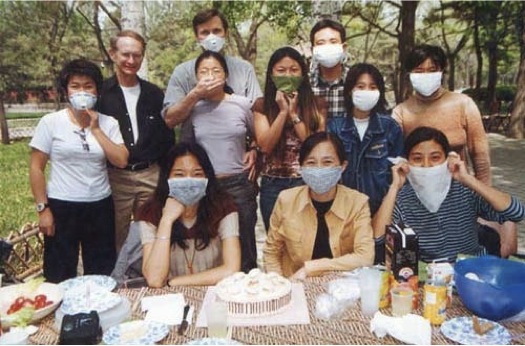
Jia Liming, Zhang’s first hire at AsiaTravel, remembers ending the long- planned bird-watching trip she’d been guiding a week early and then attending an employee farewell party—held at a Beijing park since the SARS threat was considered to be less severe outside. “We thought it was over,” she says.

Harvard Business Review names AsiaTravel “a leader in its field”

For her part, Zhang remained calm. But “it was hard to stomach,” she says. “The city was in lockdown, and it seemed like the whole world was coming to an end. Still, I’d been through 9/11, so I was confident we could come back.”

Indeed, by midsummer, following more than 8,000 cases of infection and nearly 800 deaths, SARS seemed to have been contained, and bookings began to pick up again. Zhang and Stent decided to reopen much earlier than they’d expected, on August 1, and called back all the staff.

But it wasn’t as easy as that. Zhang’s top performer in terms of sales and customer service—a young woman she’d hired in 2001 and come to view as a protégé—refused. “She said she wanted more time to hike around another moun- tain,” Zhang says. “I said no. I’d promised a client a proposal by August 5. Two weeks later, she didn’t show. Eventually she came back, all smiles, and I had to tell her I’d given her position away.”

The woman soon launched a regional competitor to AsiaTravel, and over the next few months several other employees left because they missed traveling independently. “It was disappointing because she’d paid these people well and given them opportunities,” Pomfret says.

The next few months at AsiaTravel were nose to the grindstone—reaching out to new clients in the corporate and education sectors; selling, planning, and executing trips; recruiting and training new employees; and replenishing the reserves to pay employees’ back salaries and fund growth. “We had to hustle,” Zhang says. But it paid off. “2004 was one of the best years we’ve had, in terms of profits and new projects.”


Seasoned Traveler

Today, “a little bit older, a little bit wiser”—and having stepped down as CEO in late 2004 to follow Pomfret to the United States, where he had a new job—Zhang points to a few ways in which the SARS crisis helped her become a better leader.

First, it taught her the importance of scenario planning and proactive communication with staff and customers in crisis situations. “I was responsive to client questions during SARS,” she says, “but I didn’t take action until May, by which point I was a little bit cornered.” Since then, AsiaTravel has established crisis response guidelines. “Number one is to make a judgment call as early as possible,” says Zhang, who remains chairwoman and part owner and oversees market- ing from her suburban Maryland office.

When riots broke out in Tibet during the 2008 Beijing Olympics, for example, the company issued a press release and sent instructions to staff and guides the next day.  Meyerhans notes that employees are also in closer contact with provincial government officials to ensure access to the most accurate information. “Once you start preempting clients’ questions, they feel you’re in control,” Zhang explains.

The employee fallout from SARS was also educational. When people Zhang had trusted left her, she realized she needed to think harder about whom she was recruiting and why. In the first years of AsiaTravel, she explains, “I was looking for the passionate, free-spirited traveler I should have been looking for the customer service, travel industry professional—someone who really gets satisfaction out of serving other people.” She was also giving promotions and pay raises too quickly, on an ad hoc basis, without establishing benchmarks for advancement, including long-term commitment to the company.

After SARS, Zhang built a different kind of team, including more-seasoned managers who could handle day-to-day operations when she left in 2004. “One of her biggest achievements,” Meyerhans says, “was making that transition so smoothly, based on the trust she had in the employees she’d hired.”

More broadly, he thinks the two early hits of 9/11 and SARS forced Zhang to be a more creative, confident executive, diversifying and expanding the company each time. “We had high-net-worth individuals and small groups, but that’s a difficult business to control and grow, so we started to build up the corporate and the educational business,” in addition to targeting different geographic regions, he explains. And Zhang has insisted in the years since that AsiaTravel stick to that forward-thinking strategy.  During the recent financial crisis, for example, even as competitors retrenched, “I doubled down,” she says. “I plowed more than 50% of our profits into marketing and IT. I knew that China’s rise, and its tourism and our business, would outlast the recession.”

One last benefit of enduring the SARS period, with no income, was that it reinforced Zhang’s passion for her venture. “You go through self-doubt moments,” she recalls. “When the profits aren’t great, you say, ‘Wow, how did I labor another year with no payback?’ But I’m in this be- cause I enjoy it. As long as I have a comfort level that reaches the minimum threshold, I can seek satisfaction.