What the Everest Base Camp Closure Means

Featured Image by Neil Young on Flickr.

The Everest Base Camp Closure

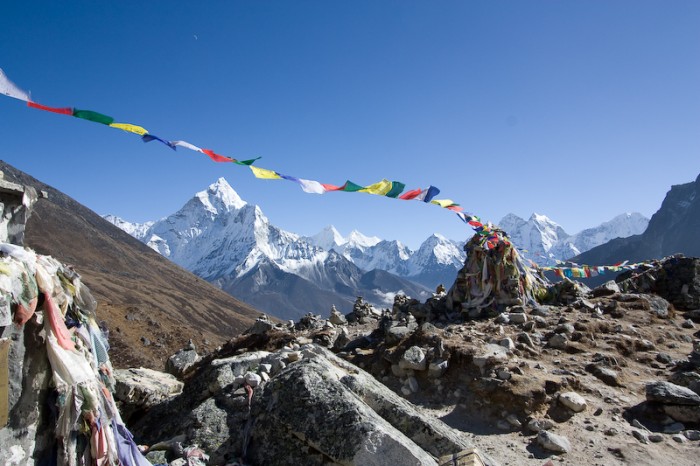
Looming at an enormous 8,844m, the mighty Mount Everest stands at the highest point on Earth, straddling both Nepal and the Tibetan Autonomous Region (T.A.R). While Everest Base Camp has gained worldwide fame as the launching point for adventurous mountaineers, it is far less known that there are in fact two Everest Base Camps found on either side of the peak (one camp in T.A.R. and the other in Nepal). With easier access to the mountain and even more stunning views, T.A.R’s base camp has attracted more and more visitors each year. Sadly, this has come at a cost, leading to the camp’s indefinite closure. With so many visitors still hoping to catch a glimpse of this majestic mountain, what does the closure actually mean for our intrepid travelers?

What the Everest Base Camp Closure Means

The Everest Basecamp | Image by lampertron on Flickr

T.A.R. is open as usual

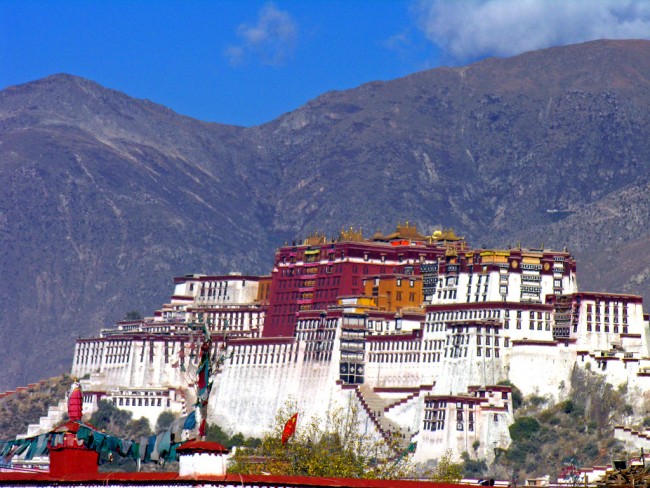
Don’t let the closure of Everest Base Camp put you off – the Tibet Autonomous Region is open to visitors as usual and the chance to visit this stunning corner of the world is not be missed! As per usual, the T.A.R. will be open to foreign tourists after the Tibetan New Year which falls at the end of February. Tibet is an enchanting land filled with jutting peaks, expansive plateaus, and rich cultural traditions. Whether it’s marveling at Lhasa’s Potala Palace or enjoying the wide-open expanses of this untouched region, the T.A.R. is a stunning destination that will grant you a greater appreciation for the Buddhist religion.

What the Everest Base Camp Closure Means

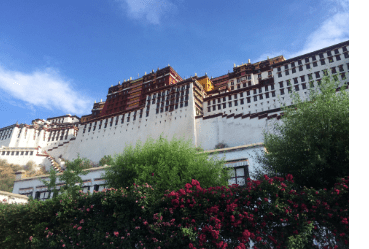
The Potala Palace in Lhasa | Image by Dennis Jarvis on Flickr

High altitudes are still within reach…

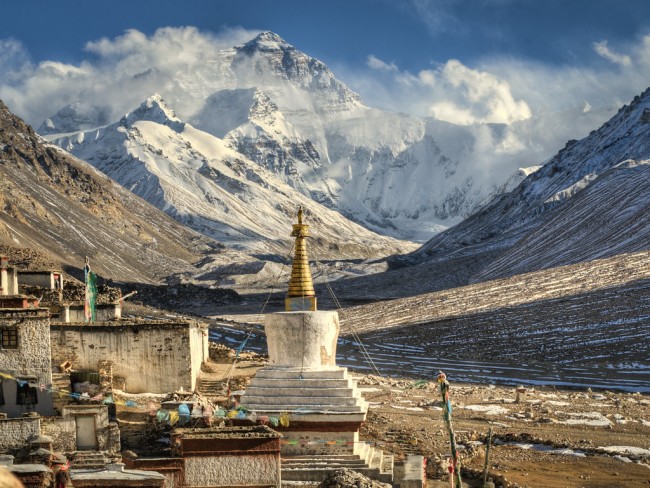
While base camp sits at a whopping 5,200m above sea level, you still might find yourself short for breath at the close-by Rongbuk Monastery. At 4,980m, the view can be quite literally breathtaking. The (relatively) easy access to this side of the mountain (the Nepal side requires a two-week trek to reach base camp) means you can take things at a slower pace to enjoy the experience and get yourselves acclimatized to the altitude. In the past, the Rongbuk Monastery was home to several hundred monks and nuns, with the remote location lending itself to undisturbed meditation and a tranquil way of life. With as few as 35 monks currently living at the monastery, their doors are open for the weary traveler to enjoy a peaceful overnight stay at the feet of one of the world’s seven natural wonders.     

What the Everest Base Camp Closure Means

Rongbuk Monastery | Image by Göran Höglund (Kartläsarn) on Flickr

Related Reading: Remote Getaways to Escape the Hustle and Bustle of China

The route does not change.

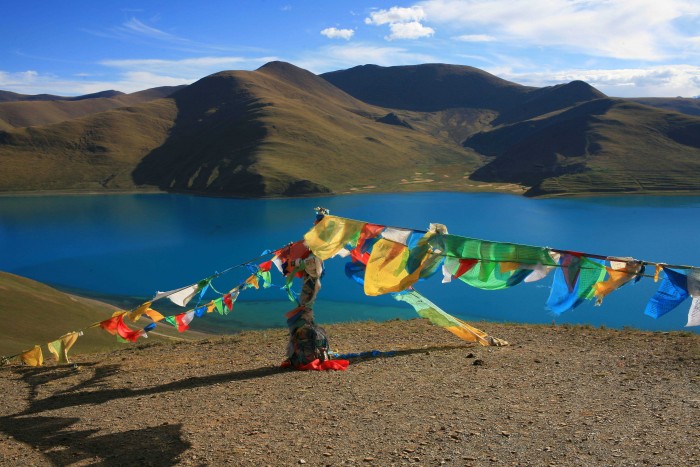
For those not intent on climbing the summit, the Mount Everest route does not really change. What makes the Mount Everest experience begins long before this lofty peak is in sight. From the shores of the holy Yamdrok Lake to stepping back in time in the Old City of Gyantse, our Mount Everest route will take you on a journey through this beautiful landscape all the way to the Rongbuk Monastery. Although the very last leg is no longer accessible, the monastery itself still boasts some world-class views and is the perfect end to an incredible journey.

What the Everest Base Camp Closure Means

Yamdrok Lake

Related Reading: Top Five Challenging Hikes in China

As advocates for sustainable tourism, we feel great shame for the indefinite closure of the Everest Base Camp, especially due to the reasons. However, we are encouraged for the future. As you can see, the Tibetan Autonomous Region is a spectacular natural area that is just begging to be explored. Who knows, maybe this experience shall prompt greater efforts for green and viable forms of tourism in the future. Get in touch now to start planning your ultimate Tibetan adventure. 

Shanghai History Tours

Shanghai has had an interesting history since its inception. Being one of the major port cities of China has given it great access to the broader world, allowing it to flourish as well as suffer military strikes and occupation from foreign powers. With its colorful history, we offer many historical tours focusing on different angles of the city’s life. Whether you can only spare a few days or three weeks, we’ve got plenty of options to consider!

Understanding Shanghai History during a Short Break:

Shanghai Highlife (4 days)


Shanghai History Tours


This short tour will take you for a visit through bohemian Tianzifang to see the modern art studios mixed with trendy boutique shops and cafes that make this area the home of Shanghai’s burgeoning art scene. Later, our expert Lucy Liang will guide you through the Shanghai museum, where she has even lead a former US president, sharing all she knows about one of the world’s finest collections of Chinese artefacts, spanning more than 5000 years of history. After a stroll through bustling Fuxing Park, the more active also have the option of taking part in fitness dancing and tai chi in the park or a bike tour adventure through the French Concession.


Understanding Shanghai’s Role in Modern China

 Essence of China (13 days)


Shanghai History Tours

RELATED READING: AsiaTravel does Classic China, too 


Experience everything “Shanghai Highlife” has to offer and then witness the contrast between the city’s modernity and the other stops on your journey. Dive deeper into the country’s millenary history in the ancient capital of Xi’an and the modern one of Beijing, then immerse yourself in the enchanting scenery of Yangshuo’s karst mountains in the south of the country. 


Understanding Jewish History in Shanghai:

Jewish Tour of China (10 days)


Shanghai History Tours

RELATED READING: An interview with Shanghai Jewish history expert Dvir Bar- Gal  


After visiting other historic cities with Jewish history, including Beijing, Tianjin and Harbin, this tour ends with two days in Shanghai, where you will be led by our Jewish expert, Dvir Bargal. You will visit the Ohel Moshe Synagogue, now converted into a commemorative museum in memoriam of the thousands of Jewish refugees that were housed in the city’s Jewish Ghetto, liberated in 1945. In addition, you’ll also be led through the Children’s Palace, French Concession, and Yu Garden, and have ample time to explore the city as you please.


Understanding the World’s Influence on Shanghai

 Yunnan’s Flying Tigers (14 days)


Shanghai History Tours


RELATED READING: Fascinating sites for World War II History in China


Explore the luscious and culturally diverse South western province of Yunnan, following the route of the ‘Flying Tigers’, a group of American volunteers who defended the primary supply route ‘Burma Road’ in WWII, and end your journey with three days in Shanghai. Here, discover more about the world’s profound influences on the city with a tour of the Bund, whose early 20th century Art Deco and Neoclassical office buildings gave it the nickname ‘Paris of the East’, and in the French concession with the last remnants of the city’s colonial history.

As you can see, some of the trips offer the same experience in Shanghai, while taking you off to various other adventures across China. Others will give you a heavily focused trip on a very particular section of Shanghai in a short period. Depending on what you want, there’s definitely something for everyone, no matter what your desires and interests are.

The Qinghai-Tibet Railway: China’s Road Through the Sky

Featured image by thriol via Flickr


Ruggedly wild, inherently spiritual, and filled with rich ethnic culture and untamed beauty, Tibet has called to adventurers for generations. But, they don’t call it the ‘roof of the world’ for nothing. With its remote location, extreme climate, and geographic environment, Tibet had been cut off from the world, inaccessible to all but the most intrepid explorers for centuries. For those that did want to make the journey, flying was generally the only option. However, due to air travel’s low capacity and high cost, tourism in this remote corner of China was, largely, prohibitive.

That is, until the Qinghai-Tibet Railway was constructed in 2006, transforming Tibet’s travel industry – and wanderlusters – forever.


They Said It Couldn’t Be Done

There was once a time when people believed that Tibet would never be able to have a railway. Like Kenya’s ‘Lunatic Line‘ – where laborers faced the dangers of angry tribesmen, malaria-rife swamps, and hungry lions – and Argentina’s high-altitude, bridge-riddled ‘Train to the Clouds’, the conditions through which a Tibetan railway would run were deemed by many to be too dangerous. Unsurprisingly, the Chinese saw it a different way.

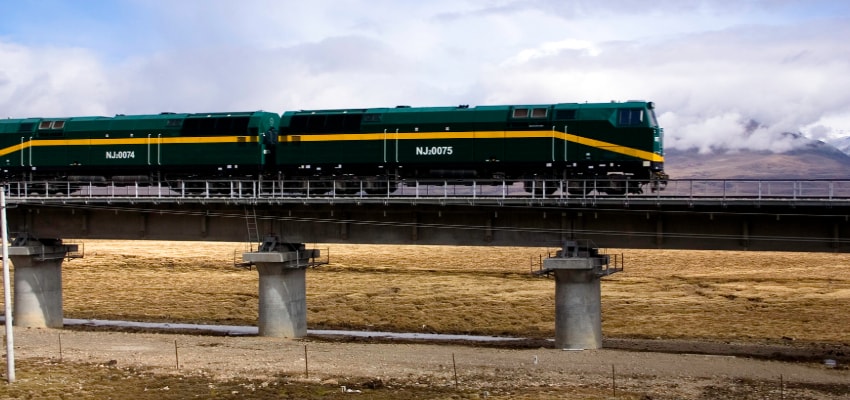
That’s not to say that it wasn’t without its challenges. With 960km, or about 596 miles, of the track resting at a lofty height of 4,000 meters and some altitudes stretching over 5,000 meters above sea level, the Qinghai-Tibet Railway is the world’s highest train route (although soon to be unseated by India’s Bilaspur-Manali-Leh railway line in 2022). As a result, the railway’s engineers had three main obstacles to consider: a dangerous lack of oxygen, a fragile ecosystem, and permafrost.


The Qinghai-Tibet Railway: China’s Road Through the Sky

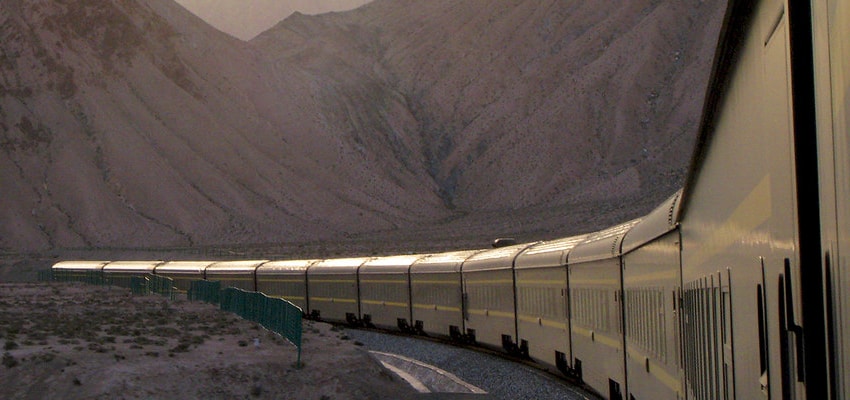
Qinghai-Tibet Railway. Image by thriol via Flickr


Where did all the oxygen go? 

At 4,000m above sea level, the air is 50% thinner, making breathing much more difficult, let alone hard labor. In spite of these odds, no workers died from altitude sickness. This is an impressive feat in and of itself, given that some people can suffer from related sicknesses simply by going to that altitude and relaxing. To fight the issue of thin air, oxygen-generation stations were placed throughout the route along with 600 medical professionals who were stationed at clinics every 10 kilometers alongside the workspaces. Breaks were given liberally, and some workers were even provided with oxygen tanks to help them while they worked.

A fragile ecosystem

In addition to the high altitude, the ecosystems through which the railway runs are notoriously fragile. Noise, vibration, and pollution caused not just by construction, but regular rail traffic overall, can be disruptive at best and catastrophic at worst. Fortunately, designers and engineers, recognizing the inherent value of the preservation of the biosphere, made protecting the delicate environmental balance top priority, investing some RMB1.54 billion (over $216 million) in the endeavor.

All wastewater was thoroughly treated before being discharged. Passageways for wild animals (such as the Tibetan antelope) were even built, charting a path so that it would intrude as little as possible for sensitive species. This consideration forced the originally planned course to be aborted because it would pass through reserves dedicated to the black-necked crane. Construction was even halted during the mating season for the Tibetan antelope. Where impossible to fully avoid, interference was minimized as much as possible. Today, trains rumble across 675 bridges designed to prevent damage to the landscape, cars are heated by eco-friendly energy sources, and fences prevent wildlife from crossing the tracks and entering harm’s way.

Perma-what?

The final hurdle that made the Qinghai-Tibet Railway such an engineering marvel is that it had to be able to withstand the yearly expansion-contraction cycles of permafrost soil. Basically, how to build a track on ground that was going to change year in and year out?

Again, this obstacle was solved by building bridges. Whenever possible, the savvy engineers elevated the track over the permafrost, or created stone embankments to increase air circulation. In short, although the odds were stacked against them, the railway’s persistent and inventive engineers found a way to adequately address every issue.


The Qinghai-Tibet Railway: China’s Road Through the Sky

Qinghai-Tibet Railway Under Construction. Image by Erik Törner via Flickr


On the ‘Sky Road’ today

Stretching from Xining in Qinghai Province, cutting across the barren grasslands of the Tibetan Plateau, and mounting the forbidding winter fairyland of the Kunlun Mountains before arriving in Lhasa, the Qinghai-Tibet Railway is more than just a train from Point A to Point B. It’s a transporting, both literally and figuratively, journey filled with untouched, achingly beautiful vistas.

Only a day in length (20 hours 55 minutes to be precise), you’d be hardpressed to find a moment worth falling asleep for, as tempting as it is to nod off to the gentle rocking and click-clack of the train. However, if you do still plan on getting some shut-eye, here are some stretches that are more than worth waking up (or drinking a lot of coffee) for:

1. Chaerhan Salt Lake

750km from Xining, Chaerhan Salt Lake is the first landmark travelers should be sure to awake for. The largest salt lake in China, and one of the most famous in the world, it is so crystal clear that it appears to be a massive, natural mirror.

2. Kunlun Mountains

The first mountain range you’ll come across is also the largest mountain system in China, reaching heights as high as 6,000 meters above sea level. Given that it’s the largest system of mountains in China, it’ll be hard to sleep through all of them.

3. Kunlun Mountain Pass

Roughly 160km from Golmud, the second-largest city in the Tibetan Plateau, you’ll come to the Kunlun Mountain pass. The sudden rise from 2,800 meters to 4,700 meters above sea level, causes the temperature to plummet, creating what can only be described as a perpetual winter wonderland.


The Qinghai-Tibet Railway: China’s Road Through the Sky

Kunlun Mountains. Image by Chen Zhao via Flickr


4. Hoh Xil Depopulated Area

In this region, you’ll have a good chance of spotting Tibetan antelope running alongside the train if you keep your eyes sharp. There are plenty of other animals to be seen here, including wild donkeys, yaks, white-lipped deer, snow leopards, and many more. Don’t worry about missing it though – at 4,500 square kilometers in size, you’re unlikely to miss it even if you do decide to make time for a cat nap.

5. Tanggula Mountain Pass

Previously considered an invisible barrier to Tibet because of its altitude and terrible weather, the Tanggula Mountain Pass is another can’t-miss piece of natural beauty. You’ll likely see naturally formed ice sculptures and even some yak drinking from the rivers.

6. Qiangtang Grassland

Tibet is like the Texas of China – everything there is massive. The Qiangtang Grassland is one of the five largest pastures in China. It has an abundance of plants, wild animals, including yak, sheep, and nomad camps.


The Qinghai-Tibet Railway: China’s Road Through the Sky

Along the Qinghai-Tibet Railway. Image by travel oriented via Flickr


What it’s like on the train

When not gazing in awe out the windows, riders on the train are able to experience some pretty impressive features, all provided to make the journey as comfortable and safe as possible. Each car is pressurized (much like the cabin of an aircraft) and equipped with an oxygen supply system to help prevent any travelers from feeling sick or light-headed, cabins come with private oxygen-dispensing outlets, and each train has an on-site doctor just in case.

Like most trains in China’s network, travelers have access to hot water dispensers, a restaurant car, and both squat and sit-down toilets. Be prepared to have your translation app at the ready though, as most train attendants don’t speak English. And as with other China trains, riders have the option of booking one of three classes of seats:

  • Hard seat: Cushioned seats (despite the name) that, while cheap, can be cramped and uncomfortable over long journeys
  • Hard sleeper: Six beds stacked in half-opened compartments and equipped with thin mattresses and space for luggage above the window
  • Soft sleeper: Four beds in large, lockable, and private compartments and equipped with thick-cushioned mattresses

Additionally, all train cars have environmentally friendly toilets, wastewater deposit tanks, and garbage treatment facilities to help minimize any environmental impacts.


The Qinghai-Tibet Railway: China’s Road Through the Sky

Qinghai-Tibet Railway. Image by Henry Chen via Flickr


How to Do It

After all this, it should come as no surprise that the Qinghai-Tibet Railway is quite popular, especially during the months of July and August. As a result, we highly recommend booking as far in advance is possible, either through their website (chinatibettrain.com) or through a travel agent or tour operator (like us!).

Plus, since this is Tibet we’re talking about, there are also a number of permits that need to be secured – again, we’re here to help. And trust us, this little bit of effort is more than worth the reward of the breathtaking scenery that will linger in your memories long after the trip ends.

Gansu’s Mogao Caves: A Desert Sanctuary a Millennium in the Making

Originally posted on Caixin Global

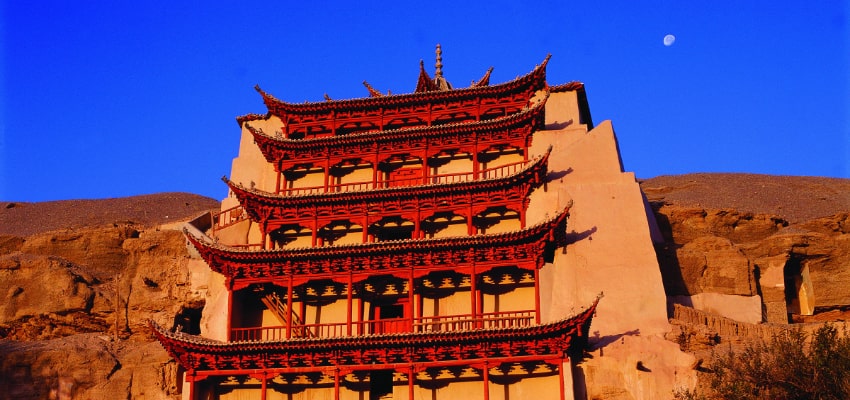
Buddhism came to China in many waves and through many routes. It brought not just a philosophy, but a cultural milieu of art, sculpture, festivals, and literature. Nowhere is the influence of these different strands of Buddhism on Chinese art more visible than in the Mogao Caves on the edge of the Taklamakan Desert in northwestern China. Devout Buddhists began building the intricate complex of caves in the fourth century, with construction peaking during the Tang Dynasty in the seventh century before petering out 700 years later in the turmoil of the Yuan Dynasty. The desert provided the perfect retreat for believers to focus and practice their faith. The 735 caves that remain today present the largest collection of Buddhist fresco art and provide insight into the lives of the monks who lived there.


Go West, Young Traveler

When China’s President Xi Jinping announced the ‘One Belt, One Road Initiative,’ what sprang to mind was a dusty stretch of asphalt heading east out of the city of Dunhuang in Gansu Province. I was there in 1998, biking under the hot sun with endless, tanned desert stretching out to both sides of me. About 5 kilometers (3 miles) from the city, small mounds began to interrupt the rolling, sandy surface. I kept riding my motorbike, without a soul in sight. Occasionally, a giant tour bus rushed past, briefly towering over me before heading off down the road. It dawned on me that the mounds on the side of the road were nameless tombs — thousands upon thousands of them — extending as far as the eye could see.

As I later learned, this cluster of tens of thousands of tombs dated back more than 1,500 years to the Northern Wei Dynasty. They are known as the Xindiantai Ancient Tombs, but no sign marked the site. Perhaps that’s the drawback of having a world heritage site — the Mogao Caves — as a neighbor. For the rest of my life, I have remembered the 25-kilometer journey to the Mogao Caves as we rode among the dead. It also marked the beginning of my exploration of the Silk Road. 


Gansu’s Mogao Caves: A Desert Sanctuary a Millennium in the Making

Entrance to the Mogao Caves


Building A Buddhist Oasis

The Mogao Caves were built over a span of more than 1,000 years, their construction paralleling the development of the ancient Silk Road. During the Tang Dynasty, when the Silk Road was the most important overland trading route in the world, the nearby town of Dunhuang became a major trading center, while the Mogao Caves became an important religious site. The camel caravans along the Silk Road carried with them not just tea and silks, but also cultural influence. When the Silk Road began to decline in importance as a trade route linking Central Asia and China, the building of the caves ceased.

For hundreds of years thereafter, the Mogao Caves lay silent until a Taoist monk, Wang Yuanlu, started a private cleanup effort at the caves. In the process, he discovered a hidden cave containing 50,000 scrolls of Buddhist scriptures. The story that followed reads like a Hollywood movie, with most of the items stolen or sold for cheap to Western explorers or collectors. Among the collectors, British archeologist Aurel Stein was credited for the large collection of Mogao art held in the British Museum today.

Initially, the caves served only as a place of meditation for hermit monks, but they later developed to accommodate the growing population of worshippers. Today, the Mogao Cave ruins are clearly divided into a northern section and a southern section. The southern section is the one that most visitors get to see, and it was where the religious activities took place. Hence, all 487 caves there are filled with religiously themed frescos and statues, mostly telling Buddhist stories or those of the temple sponsors. In a few caves built during the late Tang Dynasty, there are images of the Huihu people, their facial features strikingly Caucasian — the ancestors of today’s Uighurs in China. In contrast, section to the north was mostly used as living quarters by the monks. There, caves were equipped with kitchens and lampstands, among other things. 


Gansu’s Mogao Caves: A Desert Sanctuary a Millennium in the Making

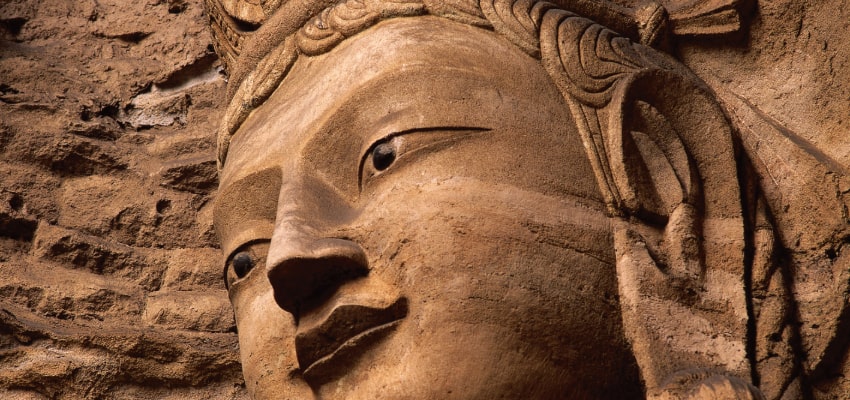
A Buddhist stone carving


Exploring Mogao

No photos or history books can prepare a person for the Mogao Caves. After riding through the desert, the trees lining the entrance seemed greener than I expected, and the notion that a group of monks would choose to live out there was even more unbelievable. The harsh sun, sand, wind, and the fear of death that assailed me that day were only a small taste of what those earlier worshippers had to endure. One can only imagine the harsh conditions that the builders faced, meticulously painting and sculpting every little detail in the middle of the desert. It occurred to me that the desert, originally considered a curse, may have ended up being the caves’ protector. They survived because of the desert’s remote location and dry climate.

Moving among the caves was like walking through 1,200 years of Buddhist art history. The frescos in the earlier caves, still with aged pigment, struck me as similar to Edvard Munch’s famous painting The Scream or Vincent van Gogh’s The Starry Night. Although the paintings in the caves evoke very different emotions, the fluidity of the daring strokes and the expressive emotions leapt off the wall. 

Totally taken by the caves, I went back to Dunhuang and hunched over history books for two days. Then I took the bus back out to the caves. This time, I ran into the same curator who guided me on my first visit. He said he was going to visit a nun out in the desert that day. I begged and pleaded to join him, and he let me tag along.


Gansu’s Mogao Caves: A Desert Sanctuary a Millennium in the Making

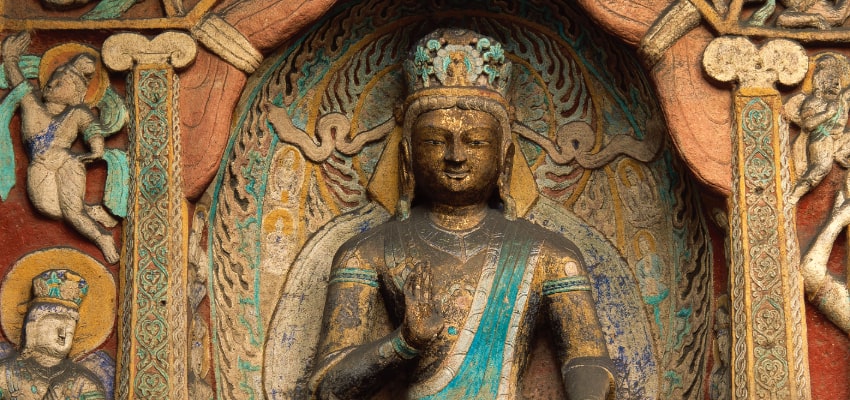
A Buddhist statue in the Mogao Caves with its original paint pigment


A Lonely Temple

We walked, this time, through the desert. The half bottle of water I brought along dwindled fast; the path in the desert seemed to be leading nowhere. Then finally, we arrived. Surrounded by sharp rocky cliffs, a tiny structure housed a large statue of Guanyin, the Buddha of Compassion. The Guanyin sits on a platform about 1 meter (3 feet) above the ground. Standing 3 meters tall, its head nearly touches the ceiling of the small room. The nun, Wang Shifu (Master Wang), greeted us. Her wrinkled hand, browned by years under the desert sun, extended me a ladle of cold spring water. Nothing had tasted better in my whole life.

I later learned that the temple is called Guanyinjing, or the Well of Guanyin. It is rare to find a water source in the desert, so worshipers believed the well was a miracle, and that its water possessed magical healing properties. That’s how the temple came into being. In the mid-1980s, two brothers rebuilt the temple. The brothers’ surname was also Wang, so I wondered if Wang Shifu was related to them. Apparently, after the year 2000, this lonely temple was further expanded. A tourism development company built a 38-meter-tall Buddha statue nearby and paved a highway to connect the temple to the Mogao Caves, covering the 7 kilometers that I walked in 1998. Tourists now have to pay 20 yuan to visit. Imagining the shining new Buddha, I still prefer the lonely old structure I saw.

On the day I hiked through the desert, I knelt in front of the Buddha feeling quite at peace. Maybe one simply has to confront the harshness of the desert long enough to go through the changes inherent in the journey — from “Oh, it’s too hot” to awe, to finally being subdued by nature. Beaten down by the sun and thirst, the oasis and the well water become life-saving. Meeting the Buddha at this moment was pure serendipity. I admired those like Wang Shifu, who gave up their creature comforts to come and face themselves in this harsh environment every day. At that moment, I understood why people built the Mogao Caves. Out in the desert, you simply become one with nature, not above it. I now wonder, if the Belt and Road passes by the Mogao Caves, what will be traded on this new route? As a traveler, I am eager to find out.


Gansu’s Mogao Caves: A Desert Sanctuary a Millennium in the Making

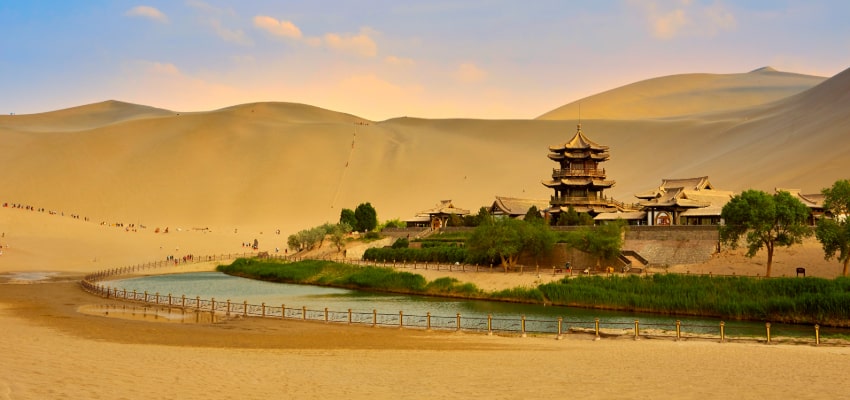
Known to locals as the ‘First Lake Under Heaven,’ the freshwater Crescent Moon Lake is believed to have existed for more than 2,000 years.


See It For Yourself

How to Get There

To get to Dunhuang, there are regular, three-hour direct flights from Beijing and eight-hour flights from Shanghai that stopover in Xi’an.  You can also visit Dunhuang and the Mogao Caves as part of a longer Silk Road journey. There are regular, 21⁄2-hour flights from Xi’an, allowing you to start by spending a day or two enjoying the sights and sounds of the Silk Road’s terminus. You can then continue along the trade route to the cities of Turpan, Urumqi, or Kashgar in the Xinjiang Uyghur Autonomous Region.

Where to Stay

Dunhuang offers a range of accommodation, from four-star hotels to backpacker hostels. If you can, find a place to dine outside so you can listen to the roar of the wind over the dunes — what Marco Polo called the ‘rumbling sands.’

What to Do

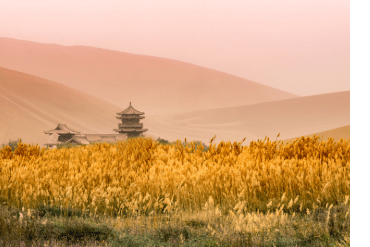
The Mogao Caves will be at the top of your to-do list, and you can easily spend a whole day exploring them. After you’ve fallen in love with Mogao, there is still plenty more to do in the area. Spend some time in the Taklamakan Desert and bargain with one of the local camel herders for a ride to Crescent Moon Lake, a small oasis amid the sand. Known to locals as the ‘First Lake Under Heaven,’ the natural freshwater lake is believed to have existed for over 2,000 years.

If you’ve got the time, the Yumenguan pass, an ancient gateway to Dunhuang is also worth a visit. Located at the westernmost extension of the Great Wall, the pass was originally built to protect the city from invasion. Later, it became an important trading post along the Silk Road. Every caravan, merchant, trader, and horse traveling to Dunhuang had to pass through it. Today, only the small, square fortress remains, but remnants of the Great Wall can be spotted in the distance.

Dunhuang’s night market is the perfect place to get a taste of the local cuisine. Slurp a bowl of Lanzhou lamian, Gansu province’s signature noodle dish, and enjoy your meal served up alongside an engaging slice of local life.

If you are looking to dive deeper into Gansu, head south to the Danxia landform in the city of Zhangye, where tectonic activity has created a unique, multicolored topography.


Mei Zhang is the founder of AsiaTravel and author of Travels Through Dali With a Leg of Ham, out via Penguin Books. Follow Mei’s travels on Instagram at @wildchinamei.

Choose Your Own Small Group Adventure

Featured image by Jeff Fuchs, AsiaTravel Expert

There are a few certainties when it comes to travel. You’ll definitely learn something new, whether it’s how to make a killer bowl of noodles or something as simple as how to say ‘hello’ in Mandarin (nihao, just in case you’re not there yet). You’ll probably expand your concept of the world, challenging yourself and gaining an appreciation for what you have and where you come from in the process. And, you will certainly meet some incredible people along the way, from the person sitting next to you in the quaint neighborhood restaurant to the local guiding you through their hometown. That’s the beautiful thing about traveling: it brings people together.

That’s why we are thrilled to announce that we are expanding our small group trips through China (and beyond) for 2020. While we love traveling solo or with loved ones, we can’t get enough of being able to explore a new place with like-minded new friends by our side. Nothing bonds people quite like taking your first step onto the Great Wall together or sleeping in a yurt in Kyrgyzstan under a blanket of stars. Plus, with our local guides filled with an invaluable wealth of insider knowledge and, for some of our trips, an expert at the helm to lead the way, you’ll head for home with plenty of newfound friends and enough memories to last a lifetime as souvenirs.  
Choose Your Own Small Group Adventure

Before we get to the good stuff, let’s go over a bit of housekeeping so you know what you can expect on a small group journey with AsiaTravel.

–   First off, as any traveler familiar with China is likely aware, group tours through the Middle Kingdom usually make you feel like one of the herd, straining to catch what the guide is saying as you follow around their flag. Not with us. We cap our groups at a cozy 10-12 travelers (depending on the trip) – that way you can actually hear every anecdote, insight, and helpful tip our guides, experts, and the local people we interact with have to offer.

–   Next, all our small group travelers have the option of either sharing a room or spending a bit more to have the space all to yourself. So, whether you really want to get to know your fellow travelers (and save some money in the process) or you’re ok with investing in your privacy, we can accommodate you.

–   Finally, the cutoff for registering for one of our trips is roughly two months prior to the departure date. This allows for plenty of time to prepare any necessary visa or other applicable documents. So, be sure to reach out to us when you see a journey that catches your eye. We can’t wait to hear from you!

From quintessential cities like Beijing and Shanghai to more remote destinations like Tibet and the Silk Road, from journeys themed around food and archaeology to itineraries with a well-rounded balance of everything, there is sure to be something that thrills you. Now, with no further ado, here are the small group adventures we can’t wait to embark on next year.


Expert-Led Journeys
Choose Your Own Small Group AdventureSouth by Southeast: Yunnan & Laos with Georgia Freedman

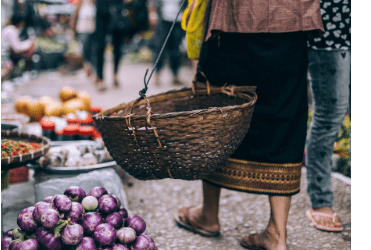
Market | Image by Peter Hershey via Unsplash

South by Southwest might be a meeting of American pop culture’s most inspiring minds, but South by Southeast is a melding of Southern Yunnan’s and Northern Laos’s most instrumental cultural influences. With food writer Georgia Freedman at the helm, explore everything from the fresh flavors of Yunnan to the unique textile traditions of the ethnic minorities of Laos. Before the trip is through, you’ll witness the daily Buddhist ritual of tak bat, try your hand at pottery-making, lock in the good spirits in a traditional Baci ceremony. You’re certain to depart with your stomachs, hearts, and minds full.

Trip Length: 9 Days Dates: March 23-31, 2020
Cost: From $6,280/person Places Visited: Jinghong, Muang La, Nong Khiaw, Luang Prabang


Choose Your Own Small Group Adventure

History Unearthed: An Archaeological Journey Through China with Dr. Ye Wa

Crescent Moon Lake

With a history as enduring and legendary as China’s, there are bound to be some treasures just waiting to be discovered. Fortunately for you, through serendipity (like Xi’an’s Terracotta Warriors) and hard work (such as Dunhuang’s Mogao Grottoes), many of them have already been brought to light. This journey won’t just take you there – it will tell you their stories, with archaeological expert Dr. Ye Wa as the storyteller. Traverse the ancient Silk Road and unlock your inner Indiana Jones as you pick the brains of experts and get hands-on with digs like the astounding Neolithic site, Yangguangzhai.

Trip Length: 10 Days Dates: May 10-19, 2020
Cost: From $6,180/person Places Visited: Dunhuang, Lanzhou, Tianshui, Xi’an


Choose Your Own Small Group Adventure

Gastronomic Tour of China with Fuchsia Dunlop

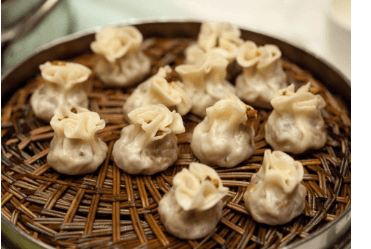
Dumplings | Image by Charles Haynes, AsiaTravel Guest

Get your chopsticks ready for the return of one of our most popular small group adventures: Fuchsia Dunlop’s Gastronomic Tour of China. Named a National Geographic ‘Tour of a Lifetime,’ this journey will see you savor every bit of China’s culinary culture, from Peking duck in Beijing to fiery hotpot in Sichuan. Food with a side of culture, you’ll stand in ‘aww’ of Chengdu’s cuddly pandas before downing dinner in a private kitchen and enjoy a picnic on the Great Wall after immersing yourself in local life in Beijing’s hutong alleys. With an award-winning expert like Fuchsia as your guide, you’ll return home ready to shop, chop, stir fry, and eat like a local.

Trip Length: 13 Days Dates: May 11-23, 2020
Cost: From $7,390/person Places Visited: Beijing, Chengdu, Hangzhou, Shanghai, Xi’an


Choose Your Own Small Group Adventure

 A Gastronomic Tour Through Central Asia with Anissa Helou

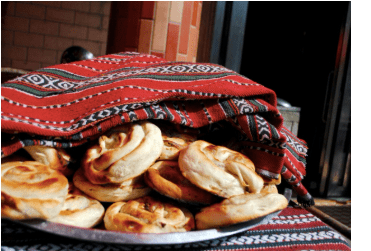
Xinjiang Bread | Image by AsiaTravel Guest Alexandra Boulton

China is near and dear to our heart, but we also love when we can get out and explore our Asian neighbors – especially when there is delicious food to be had. So, when we had the chance to partner on a journey with award-winning chef and food writer Anissa Helou, we jumped at the chance. With an Islamic cuisine expert at the helm, you’ll get your hands dirty making regional delicacies and get lost in bustling bazaars as you haggle for that perfect souvenir before sitting down for a homespun meal with the locals. Spanning from Xinjiang Province to Kyrgyzstan and Uzbekistan, this is an indulgent adventure filled with hospitality and jaw-dropping vistas.

Trip Length: 10 Days Dates: June 6-16, 2020
Cost: From $5,580/person Places Visited: Kashgar, Kyrgyzstan, Uzbekistan

Choose Your Own Small Group AdventureYunnan Gastronomic Tour with Fuchsia Dunlop

Tea Garden | Image by Elizabeth Phung

Gastronomic adventures with Fuchsia Dunlop are so nice we decided to do them twice – this time focusing on the cuisine of Yunnan Province. Here, China’s rich culinary traditions and the citrus and spice of Southeast Asia seamlessly blend with the rich cultures of the region’s ethnic minorities, creating redolent flavors and fascinating customs you must experience to understand. For this journey, culture and cuisine are effortlessly combined, taking you from Confucian temples and tea plantations to home-cooked meals and cooking lessons. It’s sure to leave you longing for local specialties like rushan cheese and Mengzi’s Crossing-the-Bridge Noodles. Luckily, you’ll have the skills to help you satisfy every craving.

Trip Length: 10 Days Dates: September 16-25, 2020
Cost: From $5,869/person Places Visited: Dali, Jianshui, Kunming, Mengzi, Weibaoshan


Choose Your Own Small Group Adventure

Traversing the Ancient Tea Horse Road with Jeff Fuchs

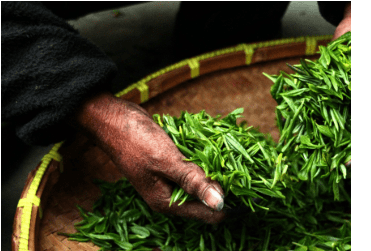
Freshly Picked Tea | Image by Jeff Fuchs, AsiaTravel Expert

The history of tea is almost as long and illustrious as the history of China itself. What started as a humble infusion for the locals in southern China spread to the far reaches of the country and beyond, and it is all thanks to the Ancient Tea Horse Road. On this National Geographic ‘Tour of a Lifetime’ led by tea expert and explorer Jeff Fuchs, you will follow the trail – and tea – back to its roots, from Xishuangbanna to the Tibetan Plateau, drinking in centuries of tea-drenched culture along the way. The first documented westerner to traverse the storied trade network, Jeff will hike with you to the ancient tea tree forests and welcome you into the homes of the descendants of the first tea cultivators.

Trip Length: 10 Days Dates: November 6-15, 2020
Cost: From $7,100/person Places Visited: Dali, Lijiang, Shangril-La, Shaxi, Xishuangbanna


AsiaTravel Adventures

Choose Your Own Small Group AdventureTravels Through Dali With a Leg of Ham

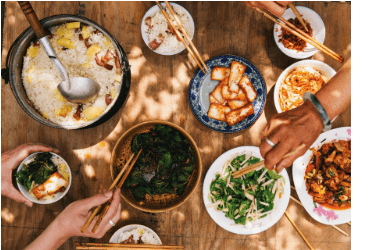
Meal in Dali | Image by Elizabeth Phung

Inspired, and personally designed, by our founder Mei Zhang’s journey back to her homeland, this small group tour is a cultural and culinary odyssey into the homes and kitchens of the specialty chefs of Yunnan. Savor every crumb of age-old traditions and fascinating tales as you devour an array of artisanal delicacies, from handmade Shaxi cheese to the trip’s namesake ham – with a stunning backdrop of fertile valleys backed by mountains and pastoral villages. Plus, if there are more than six travelers, Mei herself will lead the group – sharing the story of Dali like only a native can.

Trip Length: 7 Days Dates: March 15-21, 2020
Cost: From $3,550/person Places Visited: Dali


Choose Your Own Small Group Adventure

La Esencia Del Dragón: Spanish Language Only 

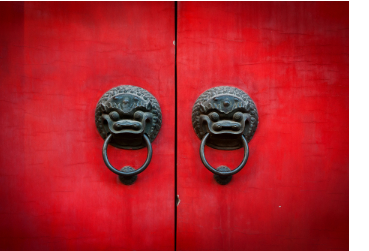
Dragon Doors

We’re pretty excited about all of our group journeys, but we are especially proud of La Esencia del Dragón. Designed especially with our Spanish-speaking guests in mind, this first-ever small group tour has everything. From high-end restaurants and luxury hotels in China’s must-see cities to hands-on cultural exploration and jaw-dropping performances, it’s perfect for new China travelers or Middle Kingdom experts. Whether drinking in the scenery while bamboo rafting on the Yulong River or devouring dumplings in Xi’an, our Spanish-speaking guides can’t wait to make this rich, varied place feel like your home too.

Trip Length: 12 Days Dates: April 6-17, 2020
Cost: From $6,000/person Places Visited: Beijing, Shanghai, Xi’an, Yangshuo


Choose Your Own Small Group Adventure

Soul of Tibet

Potala Palace | Image by Isabel Wang, AsiaTravel Travel Designer

Inherently spiritual and richly layered, Tibet is one of those places that will open its soul to you the longer you linger and the farther you journey. Accordingly, this small group adventure will take life at the speed of Tibet, meandering through Lhasa where you’ll mingle with monks and drink in the local life at a tea house before passing the glistening turquoise shores of Yamdrok Tso Lake and rolling countryside en route to Gyantse and Shigatse. After walking the kora like the many faithful before, you’ll leave Lhasa knowing that Tibet is one of those places that once you explore it, it sticks with you forever.

Trip Length: 7 Days Dates: June 1-7, 2020
July 1-7, 2020
August 25-31, 2020
Cost: From $1,502/person Places Visited: Gyantse, Lhasa, Shigatse


AsiaTravel Classics

Choose Your Own Small Group Adventure

China’s Giants: Of Palaces and Pandas

Entrance to the Forbidden City | Image by Kyle Obermann, AsiaTravel Explorer

China is a bit like Texas – everything is bigger here, with a long and illustrious history to match. Whether exploring some of the world’s largest megacities, volunteering with giant pandas, conquering the Great Wall, or taking in a Terracotta Army more than 8,000 soldiers strong, this small group tour is sure to be an adventure of mammoth proportions. The Middle Kingdom has a history over 5,000 years in the making and we are determined to show you the best of what it has to offer, making this the perfect journey for anyone new to this massive country.

Trip Length: 12 Days Dates: March 17-28, 2020
April 14-25, 2020
May 12-23, 2020
Cost: From $6,447/person Places Visited: Beijing, Chengdu, Shanghai, Xi’an


Choose Your Own Small Group AdventureEssence of China

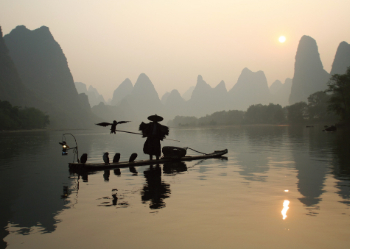
Li River

With a country as huge and varied as China, the bucket list of destinations is sure to be long. Lucky for you, we’ve picked out a few of our favorites for this journey that is perfect for first-time visitors, with a AsiaTravel twist. From a champagne picnic on the Great Wall to a story-filled tour of the Bund in Shanghai with a AsiaTravel expert, we take the must-sees and plus them as only a China authority can. After exploring winding hutong alleys, looking history in the eye at the Terracotta Warriors, gazing over the emerald-bedecked landscapes of rice terraces and karst mountains, and people-watching in the French Concession, you’ll certainly leave China with your curiosity sated – at least until your next adventure.

Trip Length: 13 Days Dates: October 12-24, 2020
Cost: From $6,575/person Places Visited: Beijing, Guilin, Shanghai, Xi’an


Choose Your Own Small Group Adventure

Metropolises & Middle Kingdoms

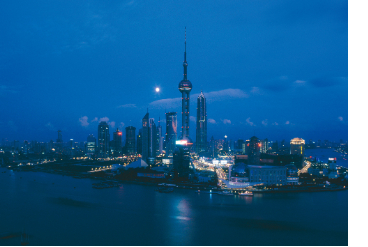
Shanghai Skyline

China is a study in contrasts – unfathomably large megacities and rustic mountain villages, colorful local markets buzzing with energy and temple-topped peaks where faithful practice tai chi. While we can’t show it all to you at once, this journey does its best to try. From the dazzling skylines of the east to the pastoral landscapes of the southwest, you will get a glimpse into the true diversity China has to offer, sharing stories with locals in Beijing’s hutongs and partaking in age-old customs with ethnic minorities in Yunnan along the way. It’s an enlightening remix – old and new, tradition meets technology – that’s made for Middle Kingdom novices and old China hands alike.  

Trip Length: 12 Days Dates: October 12-23, 2020
November 9-20, 2020
December 7-18, 2020
Cost: From $5,952/person Places Visited: Beijing, Dali, Lijiang, Shanghai, Shaxi


So, there you have it – a veritable buffet of small group journeys through China and beyond. Whether food with a dash of culture, days filled with history and archaeology, or an exploration of some of the country’s greatest hits, we invite you to choose your own adventure. And no matter your decision, one thing is certain: you’ll head home with a head filled with memories, a suitcase stuffed with souvenirs, and a heart overflowing with newfound friendships. To join us on one of our upcoming small group trips, feel free to reach out to one of our talented Travel Designers. We can’t wait to see you all next year.

Jiuzhaigou National Park Reopens Further Following Devastating 2017 Earthquake

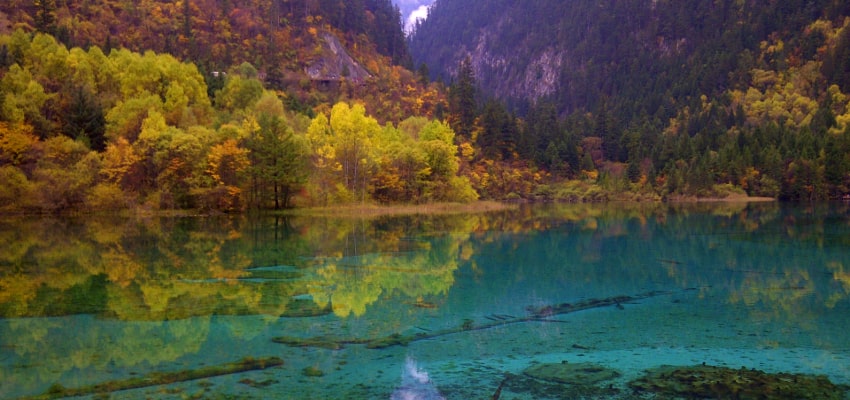
Jiuzhaigou National Park, a UNESCO World Heritage Site, in China’s Sichuan Province is a true gem of an attraction. Meaning ‘Nine Village Valley’, Jiuzhaigou is named for the nine Tibetan villages that dot the sprawling park. According to Tibetan legend, Woluo Semo, a beautiful goddess, was gifted a magical mirror made of wind by her lover Dage. As misfortune would have it, a jealous demon forced the goddess to drop the mirror, causing it to shatter and form the 114 glittering lakes that make up Jiuzhaigou. It’s these bluer-than-blue lakes that once attracted over seven million visitors annually to the park.

Jiuzhaigou National Park Reopens Further Following Devastating 2017 Earthquake

The mirrored, turquoise blue waters of Jiuzhaigou National Park  |  Image by An Zhenyi

Then, on August 8, 2017, a 7.0-magnitude earthquake rocked Jiuzhaigou County, killing at least 24 people, injuring more than 500, and destroying much of the renowned national park. Landslides were triggered, blanketing the formerly lush forests with debris and muddying the park’s iconic crystalline, cerulean-blue lakes, or causing them to drain entirely. A shadow of its former self, Jiuzhaigou was forced to close – a gut punch to the area’s tourism industry.

Thankfully, now over two years later, Jiuzhaigou National Park is back open for visitors on a trial basis. Although a few sites have been open to the public since last March, most of the park has remained closed to allow the restoration process to continue, capping visitors to only 2,000 each day. As of September 27, 85% percent of the UNESCO World Heritage Site is ready for visitors.

Jiuzhaigou National Park Reopens Further Following Devastating 2017 Earthquake

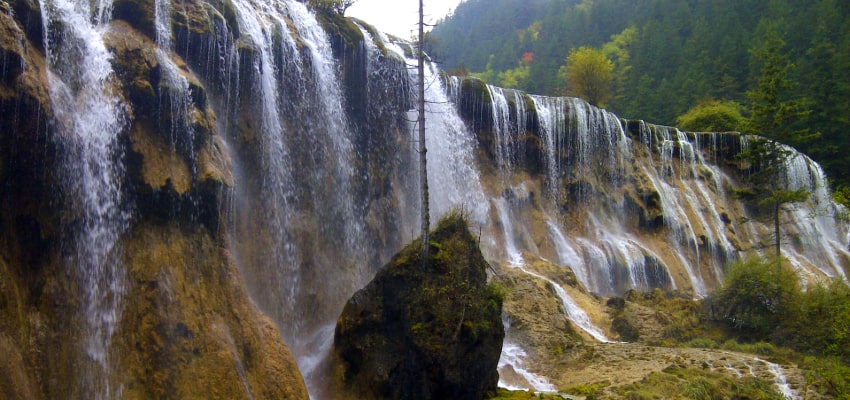
Nuorilang Waterfall before the earthquake  |  Image by An Zhenyi

The restoration process hasn’t been easy. Sparkling Lake was marred by a chasm stretching 50 meters long, 20 meters wide, and 12 meters deep, and is still yet to reopen. Nuorilang Waterfall, one of the icons of the park, sustained significant damage but has fortunately reopened for visitors, although the view won’t be quite the same as before. As for Jiuzhaigou’s crystal-clear waters, thanks to being fed by underground rivers and the park being covered nearly entirely by forest, the lakes were able to purify themselves. And the dissolving limestone continues to provide the lakes with their signature turquoise hue.

Jiuzhaigou National Park Reopens Further Following Devastating 2017 Earthquake

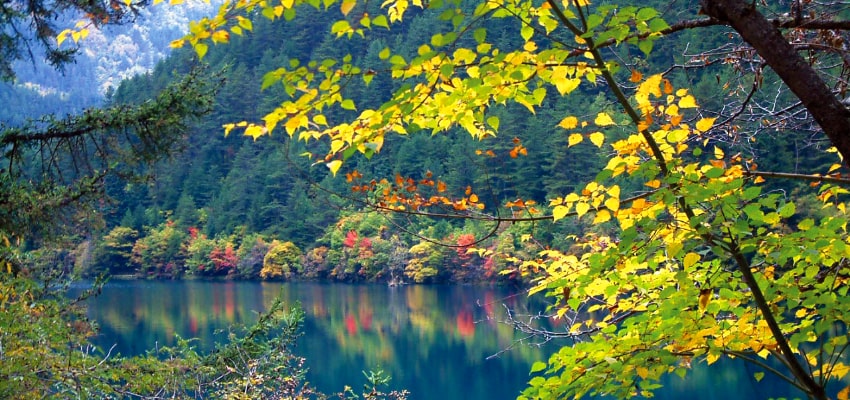
Fall colors at Jiuzhaigou National Park

For travelers interested in visiting Jiuzhaigou, there are a few important things to note. While most of the park is open again, some areas are still off-limits. However, travelers do have access to scenic spots in all of Zezhawa Valley, most of Shuzheng Valley (except for Sparkling Lake), and some of Rize Valley. The rest of the park is set to reopen in 2020. Currently, scenic areas are only open between the hours of 8:30am and 5pm. To help manage the park’s capacity and maintain the safety of both the visitors and the delicate ecosystem, entries are capped at a max of 5,000 people each day. Additionally, all travelers must purchase tickets from designated websites prior to the visit and be part of an organized tour (like with AsiaTravel). Unfortunately, it’s still unknown if, or when, Jiuzhaigou will open its gates to independent travelers.

Needless to say, we couldn’t be happier to see this national treasure almost completely reopened and are excited to be able to share its breathtaking beauty with our travelers once again.

Beijing Daxing: China’s New Destination Airport

For anyone that’s been paying attention to China steadily rising up the must-see travel destination lists, alongside the increasing ubiquity of Chinese tourists, it will come as no surprise that China’s capital city is home to the world’s second-busiest airport. In fact, in 2018, Beijing Capital International Airport – already operating at full capacity – saw over 100 million travelers pass through its terminals. On top of that, the Middle Kingdom is set to surpass the United States as the largest air travel market in the world by 2023. Needless to say, it was high time China’s capital city got a second international airport.

Beijing Daxing: China’s New Destination Airport

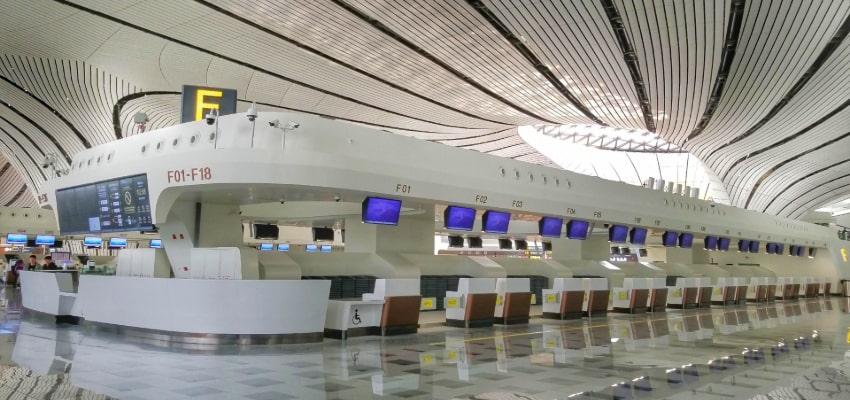
Ready for travelers at Beijing Daxing International Airport  |  Image by Andres Vargas

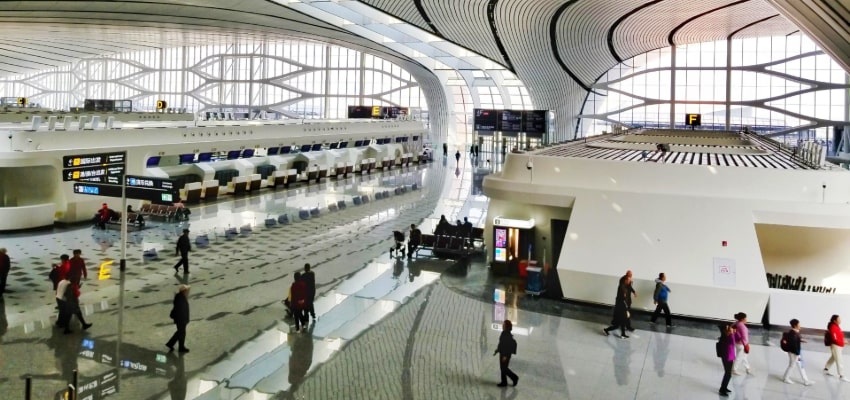
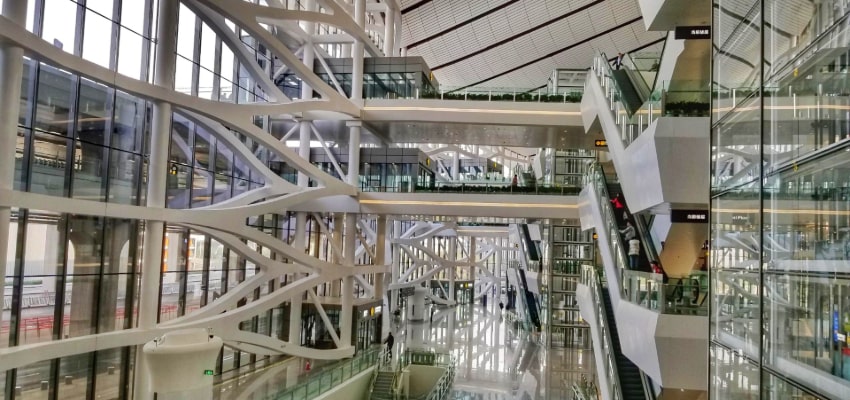
To much fanfare, Beijing Daxing International Airport opened its runways for business on September 25, 2019 – just in time for the 70th anniversary of the People’s Republic of China. With facial recognition software, robots, and AI fueling much of the operations (but not the actual fueling process, don’t worry), convenience and accessibility are at the core of the airport, as is its design.

The building is the largest single-structure airport in the world at roughly 7.5 million square feet in size, befitting a country as massive as China. Lucky for travelers, its sprawling size won’t mean increased walk times. Thanks to its radial design, not only will more aircraft be able to load and unload at once, but passengers should also only have to walk eight minutes at most to reach their gate.

Beijing Daxing: China’s New Destination Airport

Zaha Hadid-designed Beijing Daxing International Airport  |  Image by Andres Vargas

What’s more, although the airport is only a little more than a month old, Daxing is already well on its way to becoming one of Beijing’s architectural icons. While transportation to and from the airport and the center of Beijing is yet to be as convenient as the airport itself, we don’t actually mind. The airport is a place to visit in and of itself. Designed by an award-winning team, featuring viewing platforms and indoor gardens, and containing modern art installations, Daxing is set to become one of those airports that you will never forget flying through. 

Our recommendation: Getting to an airport on time in a city you don’t know (or even know really well) can be stressful at the best of times. Add to that a vastly variable travel time because of traffic and… well, no one wants that kind of stress. So, why not head out there even earlier than your overbearing elderly relatives may have once suggested? Plan to arrive four hours early instead of two. Or go even earlier and have lunch and a stroll around. 

Beijing Daxing: China’s New Destination Airport

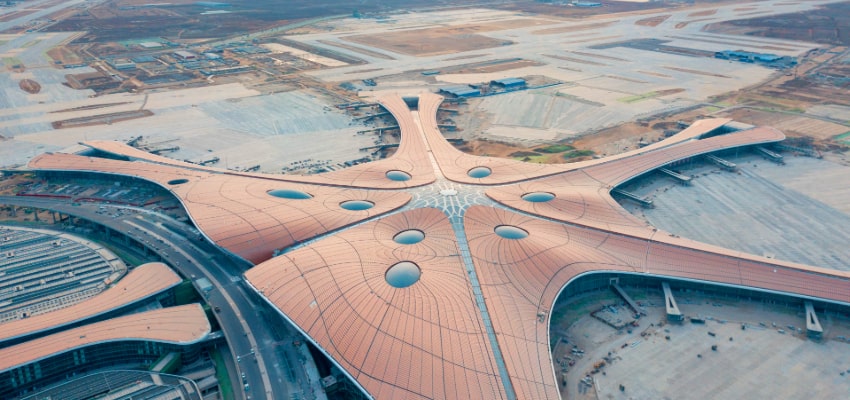
The ‘Starfish’  |  Image via Shutterstock

Contemporary Design Meets Chinese Culture

Designed by the renowned late architect Zaha Hadid, the building has been nicknamed the ‘Starfish’ for its distinctive six-pointed, burnt-orange asterisk-like design when viewed from above. However, while working on the project before her untimely death in 2016, Hadid explained that the design was actually meant to be a phoenix (feng huang in Chinese) in flight. It is this celestial muse that is especially emblematic. An auspicious symbol in Chinese culture, the phoenix is also associated with the south in feng shui, which is particularly notable given that Daxing rests in Beijing’s southernmost district. In fact, in the traditional school of feng shui, a phoenix is said to be the mythological creature that guards a home’s main entrance. And what grand home sits almost directly to the airport’s north, roughly 30 miles away in the city center? The Forbidden City – which, as any house with good feng shui must do, faces south.

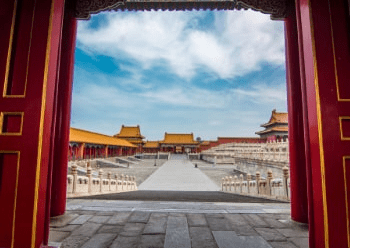
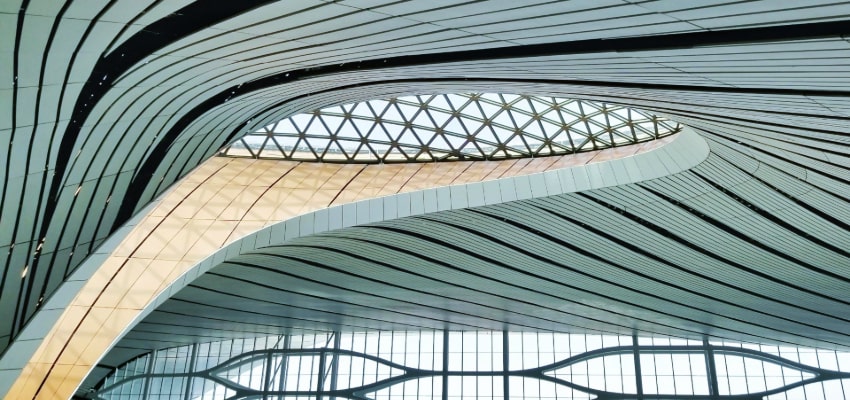
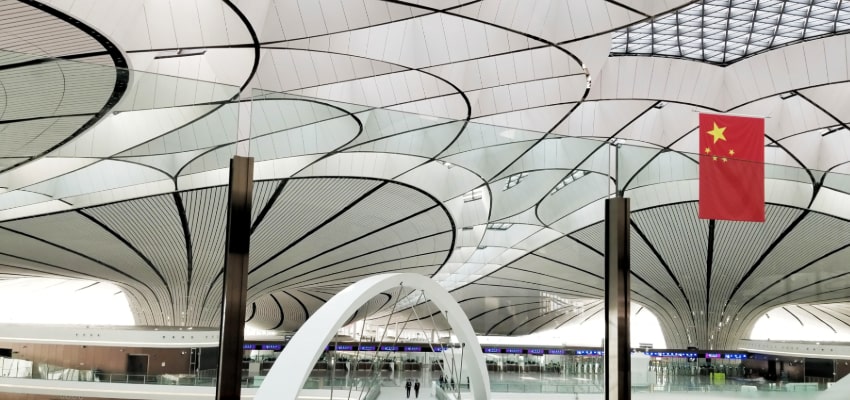
Walking into the airport, one would be forgiven for thinking they’ve stepped foot into a contemporary museum or performance hall. With its daring curves, swooping parabolas, bold lines, and vaulting arched skylights, Daxing is a veritable cathedral of modern design. Yet, it has one foot firmly planted in culture and age-old customs.

Beijing Daxing: China’s New Destination Airport

Zaha Hadid-designed Beijing Daxing International Airport  |  Image by Andres Vargas

Like in traditional Chinese architecture, the airport is organized around a central courtyard with interconnected spaces surrounding it, similar to the siheyuan (courtyard house) found throughout the country. And travelers won’t just have to huddle next to an outlet waiting for their flight to be called. Instead, they can wander through one of the five traditional Chinese gardens that are tucked at the end of each departure lounge when the weather (and air) is good. Designed with assistance from prominent Chinese contemporary artist Xu Bing, the outdoor courtyards feature meandering pathways through greenery and rocks, pavilions, and benches reminiscent of the renowned gardens of Suzhou. And the eye candy doesn’t stop there.

We said you’d be forgiven for thinking that Daxing was a contemporary museum, but in fact, some parts of it actually are. Many spaces within the airport were designed and curated by China’s prestigious Central Academy of Fine Arts (CAFA). From large installations that are just waiting to be ‘grammed to interactive screens inspired by traditional ink and wash paintings, CAFA’s handiwork is sure to keep travelers entertained as they wait for their departure. 

Beijing Daxing: China’s New Destination Airport

Zaha Hadid-designed Beijing Daxing International Airport  |  Image by Andres Vargas

Art not your scene? For those more interested in duty-free shopping, dining, or caffeinating during their layover, Daxing has that covered too. When all the flights are fully up and running, the airport will have over 300 restaurants and shops (currently there are about 100 open). And we aren’t just talking about your typical convenience stores and mediocre, overpriced dining outlets. Excellence is the name of the game at the airport, along with the policy of “same price and same quality as the city.” Luxury brands like Ferragamo, Hermes, Louis Vuitton, and Cartier are all setting up shop in Daxing. When it comes to food, there’s something for everyone, whether you’re looking for Asian favorites like ramen or dim sum, American diner cuisine at Blue Frog, or healthy, plant-based options. Oh, and as for Starbucks, there are currently four different outposts open with six more on the way.

So, while the airport is obviously a travel hub first and foremost, its breathtaking architecture, thoughtful art spaces, and abundant shopping and dining options make Daxing a destination in and of itself. Some of our Beijing team were fortunate to be able to see it for themselves and they agree that it is well worth exploring before catching a flight. If you’re lucky enough to have a flight out of there, we recommend that you arrive at least 1.5 hours ahead of the time you would normally arrive just so you have time to see everything.

Beijing Daxing: China’s New Destination Airport

Zaha Hadid-designed Beijing Daxing International Airport  |  Image by Andres Vargas

How to Get There (and Away)

At approximately 30 miles from the city center in one of Beijing’s less traveled districts, Daxing Airport isn’t exactly quick and easy to get to – yet. Luckily, there are a multitude of plans in the works to change that. If you’re planning on catching a taxi or Didi from the middle of Beijing (roughly $30/220RMB), the ride will take about 1.5 hours in light traffic or more than two hours on a bad day.

If public transportation is more your speed, there are currently only two options available. The brand-new high-speed (up to 160km/hour) Daxing Express (approximately $5/35RMB) departs from Caoqiao Station on line 10 and will deliver you to the airport in 19 minutes. Alternatively, the Beijing-Xiong’an Intercity Railway Line (about $4.20/30RMB) runs from the Beijing West Railway Station to Daxing in 30 minutes. As of now, however, this method only runs in the direction of the airport with the return route opening in 2020. Additionally, shuttles are also available to transport passengers between Daxing and Beijing Capital Airport.

Beijing Daxing: China’s New Destination Airport

Zaha Hadid-designed Beijing Daxing International Airport  |  Image by Andres Vargas

In the future, construction of an expanded airport express extending further north, the Intercity Railway Connector linking Daxing with Beiijing Capital Airport, and a more extensive Beijing-Xiong’an Intercity Railway Line will make getting to the capital’s newest airport much simpler (and faster).

As for what airlines will be calling Daxing home, that’s still in flux, at least where international airlines are concerned. Currently, all of China’s major domestic carriers (including China Eastern, China Southern, and Air China) have flights in and out of Daxing. Internationally speaking, member airlines of the Skyteam Alliance are also operating out of Daxing, or at least they will be in the future if they aren’t already. As always, we highly recommend that you double-check your flight reservations for the correct departure and arrival airports as some airlines operate out of both Beijing Capital Airport and Daxing. Trust us, you don’t want that stress of needing to get from one to the other before the new Intercity Railway Connector is up and running.

So, move over Singapore Changi Airport. Beijing Daxing International Airport is here to steal the title of the airport you most want to hang out in. To find flights in and out of Daxing, just search for the airport code PKX. We can’t wait to see you in Beijing!

Laoshan Mountain

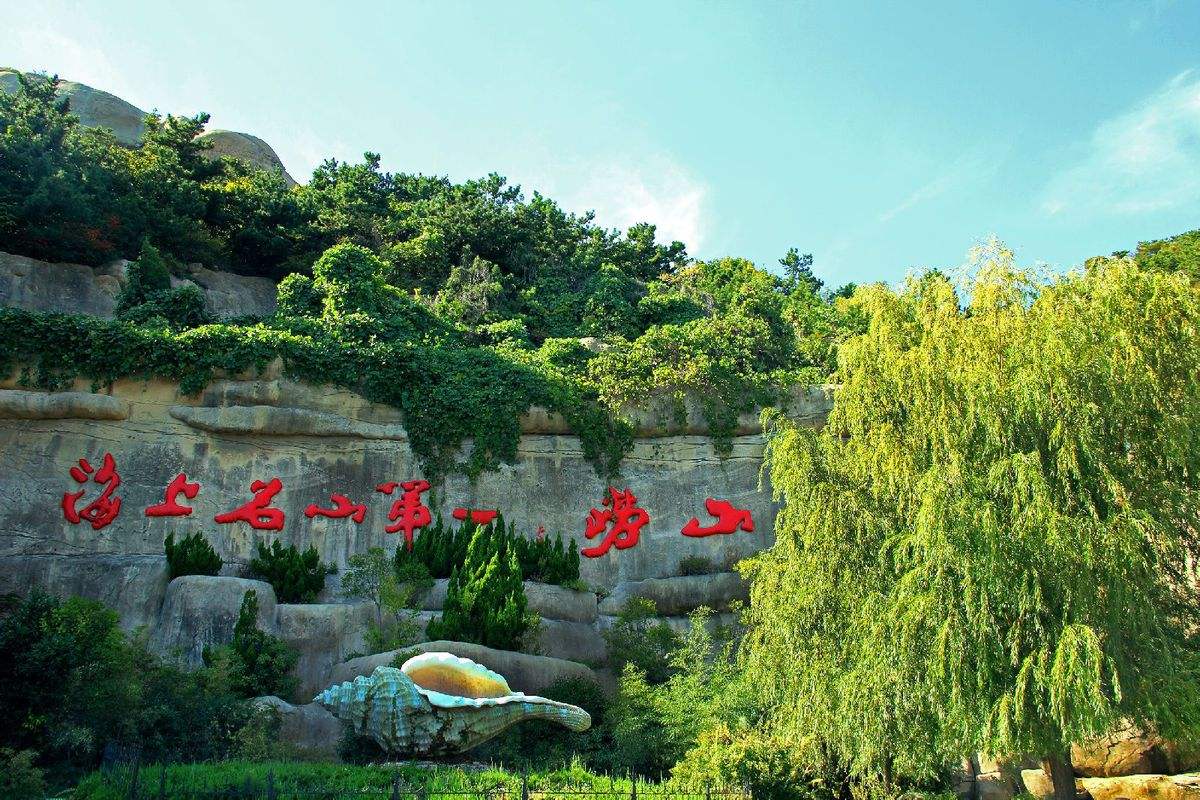
Laoshan Mountain is located in the east of Qingdao. It faces the Yellow Sea on both sides of the east and south. It has the reputation of “famous mountain on the sea”. The highest peak is a giant peak about 1,100 meters above sea level. Laoshan Mountain has become a famous Taoist mountain for its majestic, spectacular, peculiar and beautiful scenery. Laoshan Mountain’s Taoist temple, sunrise and sea of clouds have long been famous.
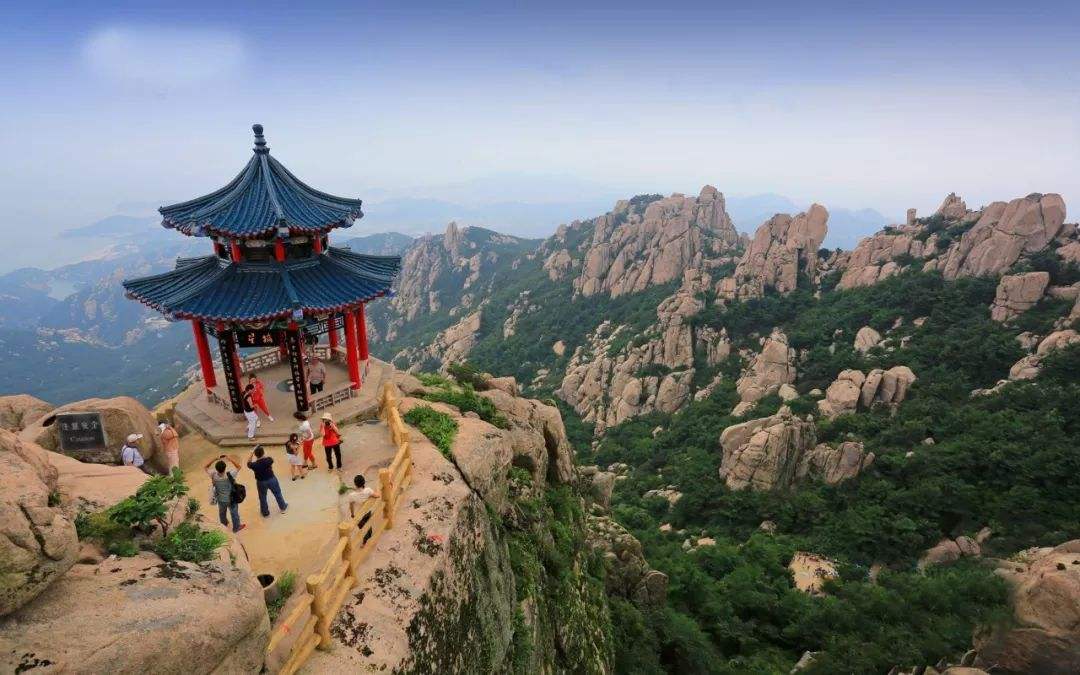
Laoshan Mountain is the main mountain range of the Shandong Peninsula and the highest peak of China’s coastline. It stands tall and majestic on the shore of the Yellow Sea. The mountains and the sea are connected, and the scenery of the mountains and the sea is the characteristic of Laoshan Mountain. Among the famous mountains in China, only Laoshan Mountain has risen from the sea. The coastline around Laoshan Mountain is 87 kilometers long, and there are 18 large and small islands along the coast, which constitute the sea wonder of Laoshan Mountain. Laoshan Mountain is a famous Taoist mountain in China. Taiqing Palace here is the largest and has the longest history.

Laoshan Mountain is not very high. It is very suitable for basic mountain climbing exercise. Normally healthy people can basically climb to the top of the mountain. The scenery on the way is also very good, and you must climb to the top of the mountain. Only at the top of the mountain can you experience the feeling of overlooking Qingdao and the beautiful bay.

Tickets for Laoshan Mountain Scenic Area are now free! After the rain, Laoshan Mountain is even more beautiful, with gurgling water and greenery everywhere. Come and walk in Laoshan Mountain on weekends, take a breath of fresh air and relax your spirits, you will feel very comfortable.

Confucius Temple

Confucius Temple was built in the Song Dynasty. It is located next to Gongyuan Street on the north bank of the Qinhuai River. It was originally a place where Confucius was worshipped, but was destroyed and rebuilt many times. Together with Beijing Confucius Temple, Qufu Confucius Temple, and Jilin Confucius Temple, it is known as the four major Confucius Temples in China. It is also the most important scenic spot in the Confucius Temple Qinhuai Scenic Area.

There is a Folk Art Grand View Garden in Confucius Temple. You can watch lanterns, paper-cuts, mini-carvings and other handicrafts on site, listen to local operas and Nanjing Baiju. When you enter Confucius Temple, you can pay attention to the performance schedule, which lasts about 10 minutes.

Every year from the Spring Festival to the Lantern Festival, Confucius Temple will hold the Spring Festival Lantern Festival (also known as the Qinhuai Lantern Festival and the Jinling Lantern Festival), especially during the Lantern Festival, there are thousands of lights. In addition, Confucius Temple also holds “Ancient Etiquette Culture Exhibition” and “Ancient Dance Music Performance” from time to time, which is very lively.

The entire Confucius Temple complex is in front of the Confucian Temple, and in the back, it is the Academic Palace. The layout is symmetrical, forming a Confucian cultural axis from south to north. Dacheng Hall is the main hall of the Confucius Temple. A portrait of Confucius over 6 meters high hangs in it. It is known as a masterpiece of the Chinese Confucius Temple. On the four walls of the main hall are 38 colored stone inlaid murals “The Sacred Relics of Confucius”, reflecting the life deeds of Confucius. Walk out from the back door of Dacheng Hall to the Xuegong, there includes Mingde Hall and Zunjing Pavilion (that is, the Folk Art Grand View Garden). Four stone monuments stand on the south side of the Academic Palace.

Apart from visiting the Confucius Temple, it is natural to experience the Qinhuai River snacks. There are many restaurants in this area, such as crab shell biscuits, beef pot stickers, chicken noodles, duck blood vermicelli soup, etc. You must try it. In addition, there are many shops here, you can choose some affordable souvenirs with Qinhuai characteristics.

Ta’er Lamasery

The architectural layout of Ta’er Lamasery and the Han Buddhist temples in the mainland is obviously different as the complex of Ta’er Lamasery is not axially symmetrical. Ta’er Lamasery is an ancient building group composed of numerous halls, scripture halls, pagodas, and colleges. The scriptures, halls and pagodas are irregularly distributed on a small hill. When tourists are playing there, the route is more casual, instead of going all the way along the central axis.

When visiting Ta’er Lamasery, if you don’t enter the scholastic courtyard or the main hall, but just wander outside, you do not need to buy a ticket. You only need to check the ticket when you enter some scholastic courtyards or halls open to the outside world. If you come here, it is recommended that you buy a ticket to tour, because you can’t worship the incarnation of Master Tsongkhapa without entering the main hall and the scholastic courtyard, nor can you appreciate the “three musts” in the temple. Ta’er Lamasery currently has more than a dozen courtyards and halls open to tourists.

There is a tour guide service at the ticket office of Ta’er Lamasery. It is recommended to hire a tour guide because Ta’er Lamasery has a very deep historical connotation. Without a guide’s explanation, you will miss many interesting stories.

Dajinwa Temple is the center of the entire complex. It is said that Master Tsongkhapa was born here. The cord blood was dripped here when the Master was born, and then a Bodhi tree grew. Later, the tower was outsourced from the tree and the monastery was repaired, so Ta’er Lamasery got its name. The believers believe that this tree and this tower are the incarnation of the master. This is a must-visit place in Ta’er Lamasery.