Snapshot from the road: Time travel in the Nu Valley

Snapshot from the road: Time travel in the Nu Valley

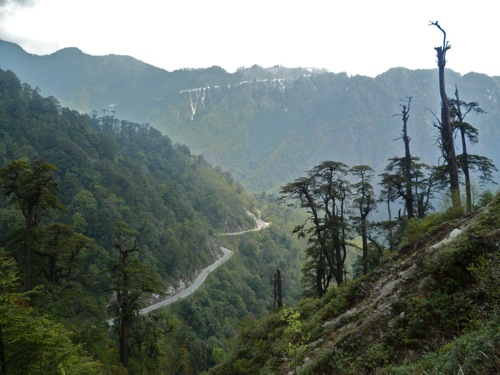
Sometimes when on the road, the past and present can collide in the most unexpected of places. We were reminded of this recently when on the road in the lush upper reaches of the Salween River in Yunnan, where the river is known as the Nu River.

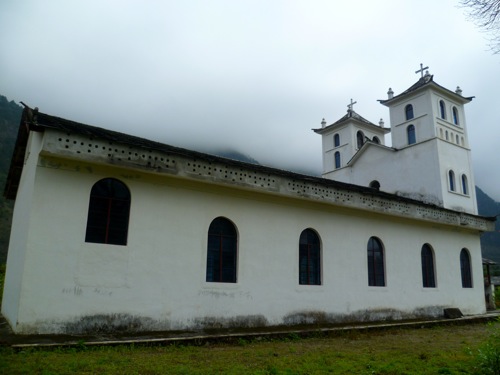
It was a Sunday morning and we’d been enjoying the Tibetan-style Buddhist architecture in hills near the remote town of Bingzhongluo. The fresh, invigorating air filled our lungs as we headed down into the valley, where we came upon a rebuilt Catholic church that had originally been constructed more than a century ago.

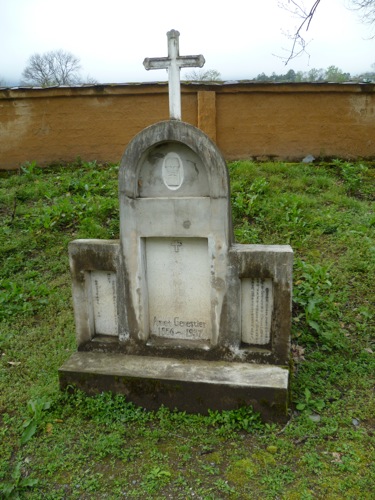
It was half past ten and mass was going to start at eleven. A small crowd of worshippers from the Lisu ethnic group was waiting to enter the building. We walked around to one side of the church where we came upon a small graveyard with only one headstone.

Upon closer inspection, we made out the name of the deceased: “Annet Genestier”. The name rang a bell instantly, as just one night earlier we had  re-read some of famed botanist/explorer Joseph Rock’s impressions of traveling through the Nu Valley, which were published in an article in National Geographic from August, 1926 entitled “Through The Great River Trenches of Asia”.

Snapshot from the road: Time travel in the Nu Valley

In the article, Rock described the animosity between local Tibetan lamas and a French church and mission, led by a stubborn priest surnamed Genestier.

Relating what back then was recent history of the mission, Rock wrote:

“Twice it has been burned by the Tibetan lamas of Champutong, and twice intrepid Father Genestier, who still lives in the Salwin Valley… had to flee for his life and find shelter among the Lissu further south.”

In 1937, Pêre Genestier died and was buried in this remote spot far from his native France. Standing deep in the mist-filled Nu Valley, we scanned our surroundings. It was hard not to feel that Genestier had stood in the same place nearly a century ago and seen almost the exact same scene that laid before us.

Whenever we travel, we do our best to read, or re-read, books or other materials about the places we plan on visiting. This not only gets us even more excited about our upcoming destinations, but small, almost negligible information such as the last name of a priest can suddenly make a connection that spans decades or even centuries.

These kinds of connections are at the heart of the importance of travel to our understanding of who we are and where we’ve come from.

———

For more information about this remote and still unknown region, also check out the film Deep in the Clouds by Liu Jie, winner of the Sydney Chinese Film Festival for Best Director. Also, travel to this destination on our AsiaTravel journey From the Salween to the Mekong: Hiking the 19th Century French Explorers’ Route.

Tsalam – The Ancient Salt Route

The following is an introduction to Jeff Fuchs’ Tea and Mountain Journals, a blog by explorer, photographer and writer Jeff Fuchs.  Jeff is the 2011 recipient of AsiaTravel’s Explorer Grant.  He and friend Michael Kleinwort are currently traveling through unknown portions of the Tsalam route in Qinghai.

Below is an announcement about their journey…

———-

The Route of White Gold


When: May, 2011

Who: Jeff Fuchs, Michael Kleinwort

Where: Southern Qinghai (Amdo)

One of the ancient world’s great and unheralded trade routes was the eastern Himalayas’ Tsalam, or Salt Road. Known to many Tibetans as “The route of white gold”, much of its desiccated remains rest at close to 4 km in the sky upon the eastern Himalayan Plateau.

Traversing some of the planet’s most remote and daunting terrain, the Tsalam passed through the snowy homeland of the fierce Golok nomads, notorious wolf packs and beneath the sacred Amye Maqen mountain range of southern Qinghai province (Amdo). Largely forgotten it remains culturally, historically and geographically one of the least documented portions on earth. The memories of a few traders carry on its almost fabled tale.

The route itself has never before been acknowledged (nor travelled) by westerners, and much like the Tea Horse Road, the last remaining traders who traveled its length are passing away and with them too, the memories of what for many was the only access path into the daunting nomadic lands.


Leading the expedition and transcribing the tale of Tsalam will be myself, with English entrepreneur and endurance athlete Michael Kleinwort joining me. Along with local nomadic guides and the odd mule, our “0 carbon footprint team” will attempt to travel the most isolated and unknown portion of the route – a remote nomadic portion from Honkor to the Maqu area.

The expedition in May of 2011 will be done entirely by foot and will access many of the last nomadic traders to document their precious recollections of travel along the Tsalam. The expedition is another of the ancient Himalayan trade routes I hope to re-expose to some light. Articles in select publications will appear upon completion of the journey.

Tsalam – The Ancient Salt Route

Jeff Fuchs

Tsalam – The Ancient Salt Route

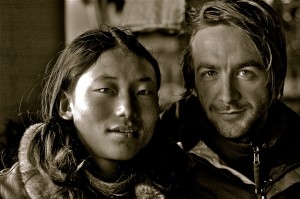
Lubden & Michael Kleinwort

———-

For more, please visit http://www.tea-and-mountain-journals.com/
Image: Jeff Fuchs

It’s Pu-erhfectly healthy and delicious

It’s Pu-erhfectly healthy and delicious

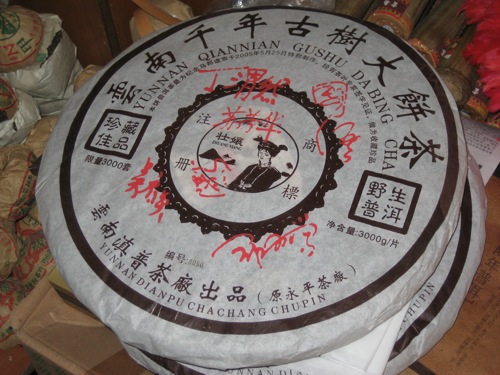
A disk of compressed Pu-erh tea for sale at a tea market in Yunnan

It’s not often that one encounters a tourist souvenir that lowers cholesterol, promotes weight loss and protects against cancer, vascular disease, cognitive degeneration and aging – not to mention providing important nutrients like amino acids.

But tea is believed to have these virtues and recent research shows that certain types of Pu-erh tea from China’s Yunnan province have particularly potent levels of beneficial chemical compounds.

AsiaTravel visits Pu-erh production areas in Yunnan on its trip ‘The Ancient Tea & Horse Caravan Road: An Expedition with Jeff Fuchs.’ Learning about the fascinating history of the ancient trade routes along which Pu-erh tea once traveled by horseback to Tibet is a highlight of many clients’ trips.

Another highlight is trekking in Yunnan through tea agro-forests and wild tea gardens where members of exotic ethnic minorities like the Bulang, Lahu and Akha have tended organic tea gardens for generations in the general area from which tea is believed to have first emerged.

In fact, it is believed to be these small-scale, natural growing practices which impart the best Pu-erh tea with heightened health benefits. Most tea in the world these days is produced in sprawling plantations, planted in neat rows in direct sunlight and often treated with chemical fertilizers, pesticides and other agricultural chemicals.

Not so with the finest Yunnan Pu-erh tea. To start with, it is not all produced from a genetically uniform crop. As we learned recently from the excellent book Tea Horse Road, Pu-erh is produced from a dozen wild cousins and hundreds of landraces of the Camellia sinensis plant – each particularly adapted to the climate of the particular hillside, or even grove, where it has traditionally been grown.

And instead of being grown in a tea monoculture, these trees (many reach an age of a few hundred years and a height of 50 or more feet) grow shaded from harsh sunlight in a natural ecosystem with hundreds of other plant, animal and insect species.

Thriving in their natural environment, agro-forest and tea garden trees produce higher levels of the beneficial compounds that first drew humans to start drinking tea, likely as a medical elixir, some three thousand or more years ago.

A study published last year in the Journal of Ethnopharmacology¹ compared Pu-erh from both terrace plantations and ecologically friendly agro-forests, measuring levels of tea catechins, flavonoid compounds that are thought to be beneficial to human health and are present to varying degrees in most non-herbal tea. The authors found that tea from the agro-forests had average catechin levels several times higher than the plantation tea.

So if you find yourself in southern Yunnan, relaxing after a day of trekking through ancient tea gardens and sipping on a cup of Pu-erh, you can feel good about the fact that a hike isn’t the only good thing you’re doing for your health that day. And don’t forget that a compressed cake packs great for the trip home.

1: See: Ahmed, et al “Pu-erh tea tasting in Yunnan, China: Correlation of drinkers’ perceptions to phytochemistry”, Journal of Ethnopharmacology 132 (2010) 176–185

AsiaTravel Expert Spotlight: A Devil’s River of Heat by Jeff Fuchs

Winner of the 2011 AsiaTravel Explorer Grant, Jeff Fuchs says, “Nice as it is to sleep within walls, I feel slightly claustrophobic and long to get out to the fresh air and unencumbered sight-lines again.”  From his Tea and Mountain Journals, here is the latest update from his journeys in southwest China…

———-
The kora, for Buddhists and Hindus, circumambulating in a clockwise direction follows the apparent movement of the sun. The sun in question is now hidden as we wake in the camp of Chube’ka. Tucked into the valley there is only cold air seeping out of the earth and into us. Sleep was touch and go, though there are no immediate reasons as to why – sleep isn’t always a comforting time in the mountains.


AsiaTravel Expert Spotlight: A Devil’s River of Heat by Jeff Fuchs

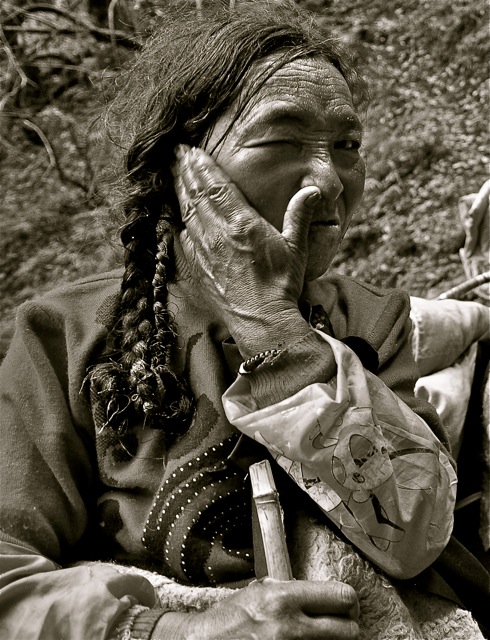
Another of the faces that stay with me. A nomadic pilgrim, having just dunked her head in a stream wipes the remnants off. Toughness in the mountains is a minimum requirement and it is never something flaunted…it simply is


Reke has slept badly and his normally patient face is tight and explosive looking. Michael wants a tough day and he is impatient to push the bodies into the redlines. Kandro looks at me over tea telling me that today will be “up, up, up”. Drolma is ever-smiling steering our morning with liquid, food and the kind of quiet care that women the world over can provide. Our big man Tseba sits quietly away from the fire with a bowl of tea with those big chocolate eyes straying into the skies. I find his moods a good gauge of the days to come for us.


AsiaTravel Expert Spotlight: A Devil’s River of Heat by Jeff Fuchs

With every day, new arrivals, new destinations and always new departures


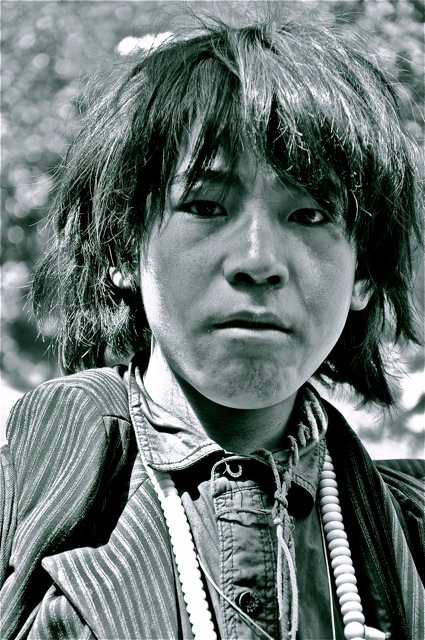
Pushing the pace we make good time catching and then falling into pace with a large group of nomadic pilgrims, led by a slightly deformed young man whose strengths seem realized in the ascents. He is a mess of dust, disheveled hair and of magnificently wild eyes that flick everywhere in a moment. He wears a suit coat slung as only a Tibetan can sling a piece of clothing: loose, one arm out and tied in a casual knot at the waist. The young boy’s back is hunched and one arm appears longer than the other. His being looks like he has been hunted for his entire life. He moves with the uncanny smoothness of a cat. It is as though his distorted body has become his supreme vessel. I suspect he pushes himself to punish and purify his past and future lives respectively…karma, in his mind at least, may be to blame for his malformed back. I cannot stop looking at him.


AsiaTravel Expert Spotlight: A Devil’s River of Heat by Jeff Fuchs

he young man that made such an impression on me. Bent by disfigurement, his simian strength and agility ate up the kora in gulps


His chin seems perpetually puckered as though he has been engaged in the effort of simply living. And of course I am aware that I, in my way, I maybe creating an entirely different picture in my head than he really is. I cannot help but feel though, that every pilgrim group we encounter has a titan or self appointed guardian leading it. This face is one that stays in the mind long after the features have disappeared.

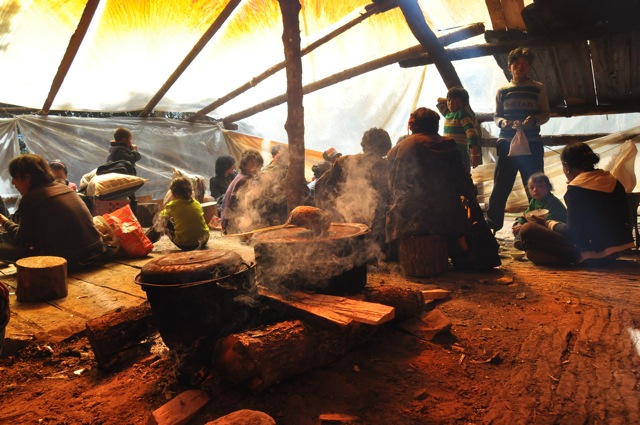
We make it up 1000 metres before lunch to Nang Tong La, lunching at the auspicious ‘Karmapa Spring’. Around us are entire clans feasting away in a yellow plastic enclosure…and there he is, the misshapen boy running every which way preparing, arranging and creating for his band of travelers. Our eyes meet and I smile and he doesn’t, but there is a millisecond of something from those haunted eyes before moving on.


AsiaTravel Expert Spotlight: A Devil’s River of Heat by Jeff Fuchs

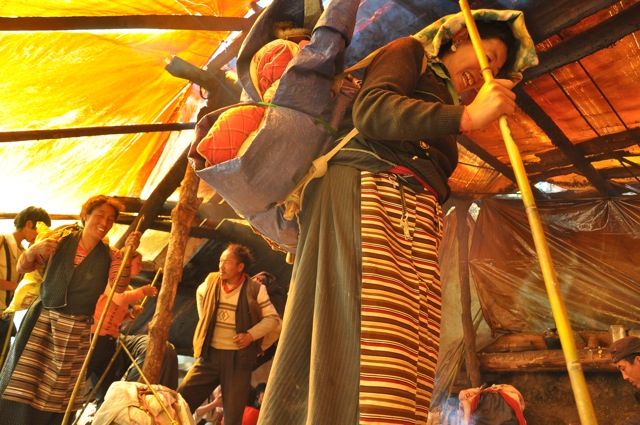
Lunch tents became populated during mid-day and would empty out in minutes only to wait for the next day's hungry


———-

For the full account from Jeff’s journey, visit his blog Tea and Mountain Journals. To travel with Jeff on a AsiaTravel journey along the Ancient Tea & Horse Caravan Road, click here or contact us at info@wildchina.com.

All photos & post by Jeff Fuchs.


Traveler’s Voice: The dominant characteristic of Lhasa is its spirituality

Continuing with the travel series written by AsiaTravel travelers Janet Heininger and Jamie Reuter, we move on to their next destination. Stop 2 – Lhasa, Tibet…

———-

On Tuesday, October 19, we flew 3,000 km to Lhasa, Tibet on Air China, changing planes in Chengdu.  Our Air China flight was just fine, even in economy class.  Leg room was barely adequate but people didn’t seem to lower their seat backs as much as in the US.  All internal Chinese flights advertise a strict weight limit of 20 kgs per checked bag and 5 kgs for a limit of one carry-on (plus a purse or small bag).  While we met these requirements on all seven of our internal flights, we ultimately decided that the rules weren’t very strictly or uniformly enforced any more than they are in the US.  The new Lhasa airport is way out of the city (90 kms.).  After being met by our guide, Nyima, and our driver, we went to our hotel and crashed.


Lhasa’s urban area is at 11,800 feet and has a population of around 300,000, up from around 10,000 in 1959.  It was one of our favorite places on this trip.  Due to the risk of altitude sickness, we both took Diamox as we had in Peru and had no problems with headaches or the altitude at all—even when hiking.  As an oddity, you should know that, in spite of its size, China operates with only a single time zone.  In any other county that large, you would expect to have 4 or even 5 different time zones.  But here, everyone is on Beijing time.  People in the western sections merely follow the sun more than the clock when it comes to scheduling things and routine work hours vary accordingly.


The political situation in Tibet is fairly complicated.  But in very brief summary, Tibet was founded as the religious and administrative center of Tibetan Buddhism in the 7th Century.  Until 1959 when the most recent reincarnation (literally) of the Dali Lama went into exile, the Potala Palace was also the earthly home of the leader of the Yellow Hat branch of Tibetan Buddhism.  Tibetans clearly feel they should be independent.  China, with the backing of its armed forces, the People’s Liberation Army (PLA), clearly has indicated that it has no intention of giving up its jurisdiction over the Tibetan plateau even though it has given it the cosmetic, official name of the “Tibetan Autonomous Region.”  With PLA forces clearly in evidence, China continues a not so stealthy take-over by sending ever more Han Chinese (the ethnic group most prevalent in Beijing and NE China) to live in the area.  Roughly 1/3rd of the population and ½ of Lhasa’s population is Han Chinese.  It had one very good hotel, with a super luxury St. Regis Hotel to open just after we left (11/15).


Our hotel was the very good one, the Four Points run by Sheraton.  It was quite nice (4+ stars) but not spectacular: very comfortable, clean, modern, good service, quiet, good breakfast (the standard fare), good views of mountains, and walkable distances to main sites (although taxis and pedi-cabs are both cheap).  It had a spa (as did most of our hotels), but we never seemed to get around to using them.  Our guide, Nyima, was terrific.


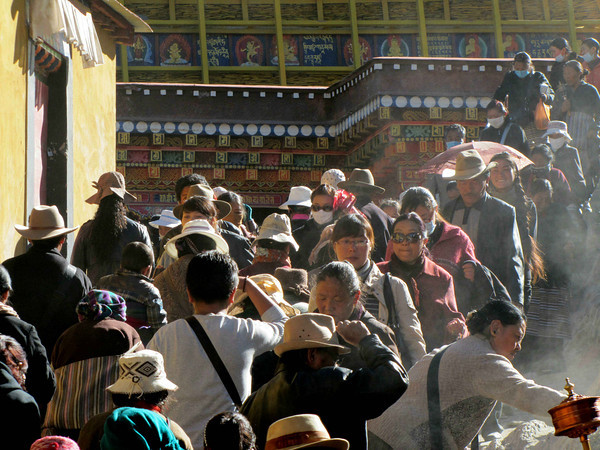
The dominant characteristic of Lhasa is its spirituality.  To begin, there are simply all of the local monks, monasteries, nuns, and nunneries, and various temples and holy sites.  According to our guide, we happened to be there at a special time on the calendar – the first full moon after the harvest.  As a result, thousands of Tibetan Buddhist pilgrims and nomads, many in traditional, tribal costumes, were in the city and surrounded its religious sites.  Pilgrims had lots of traditional activities including:


  • Circumambulations: walking clockwise around a religious temple (or site, or city, or monastery, etc.).  As an example, there was a huge crowd (6-10 people wide) that made a continuous ring of people walking around the Johkang Temple.  Always clockwise.  A few very rude tourists might go the other way, but Nyima (our somewhat spiritual guide) never would have let us do it.
 

Traveler’s Voice: The dominant characteristic of Lhasa is its spirituality

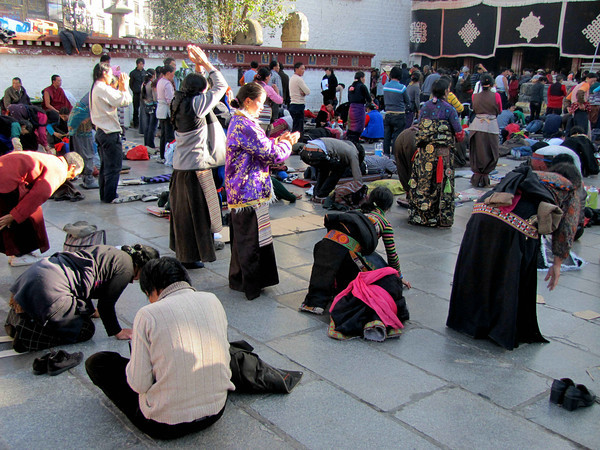
  • Prostrations: repeatedly stretching out face down on a mat, arms and hands extended out toward a temple or icon and then returning to a standing position, hands folded.  Repeat indefinitely.  This was like watching an aerobics show in slow motion.  Whole crowds would be doing it, each independently.  Old people.  Young people in stylish clothes.  Kids.  Nomads in traditional garb.  Sometimes they did this in place.  Sometimes they would embark on a circumambulation made up of repeated prostrations.  So while circumambulating, you might suddenly see this person stretched out on the ground, making their way around a holy site, one body length at a time.  The crowd barely noticed, and simply flowed around them on their own circumambulation path.
 

Traveler’s Voice: The dominant characteristic of Lhasa is its spirituality

  • Burning incense: Scattered around the holy sites were huge, white, 15 foot tall incense burners.  Actually more like furnaces, they spewed out clouds of white smoke and smell.  Once, one was so full that flames were shooting out of the top.  People constantly tossed in more incense as offerings.


  • Burning Yak butter candles: mostly an indoor activity.  In and around temples, there would be these urns of yak butter with 10-30 burning wicks.  Pilgrims carried tubs of yak butter and they would periodically add a scoop or so to a candle as an offering as they passed through a temple.  Sometimes the floor was greasy with spilled yak butter and you had to be careful how you walked.


  • Donating money: All of the local religious institutions survive on community donations.  So everyone is constantly leaving money behind.  Even our guide, Nyima.  While I’m sure that he visits many of the sites with tours 2 or 3 time each week, he still (very discreetly) would take a one Yuan note (about 15 cents) and stick it in a crack by a Buddhist statue, or drop one in a pile of other bills near a particular altar.  Sometimes he prostrated himself before a particularly important shrine.  Once, after we spoke with a group of nuns who were burying a new pipe (in very rocky ground) for the water supply for their nunnery, he walked out of his way to drop off the equivalent of $3 US to (according to his instructions) buy some extra food for the four hard-working nuns.


I could go on and on about prayer flags, monks and monasteries, religious icons and art, and so on.  It was never overwhelming at any particular moment (unlike the tourists in Tiananmen Square).  But after 3 days of being confronted with this stuff, it became a little awe-inspiring and deeply moving.


Food in Lhasa was just fine–nothing special but a lot better than in Beijing.  One of the hallmarks of Wild China is that meals are covered and they were mostly in local restaurants – generally ones not patronized by other westerners.  We really appreciated and enjoyed our eating experiences, even when we weren’t crazy about the taste.  They did have really good cucumber salads.  I had yak steaks a couple of times.  One night we went to a very tasty Nepalese restaurant.  One night we went to a small restaurant with an OK buffet dinner and saw an after-dinner show of traditional Tibetan music, costumes and dancing – interesting and worth while.


In spite of the altitude, the weather actually was warmer than in Beijing.  We had partially cloudy skies with some sun that provided stunning views of the surrounding, snow-covered mountains.  (Weather.com said 80% chance of rain daily for our entire visit to Tibet).  It would be quite cold in the morning and at night, yet warm up during the day so we’d have to roll up the sleeves of our travel shirts.


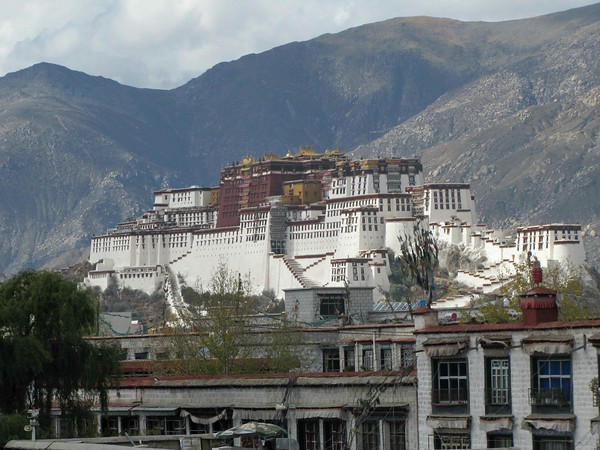
Our first day in Lhasa began at the Potala Palace.  This iconic red, white and gold building has over 1,000 rooms and 10,000 shrines, and sits atop a 1,000 foot tall mountain in the middle of the city.  The first palace on this site was built in 637 AD.  The most recent version was completed in 1694.  The white parts are a blinding white.  They were close to finishing the new, annual coat of white wash.  Apparently, they just pour it on (the walls angle out slightly) and it just runs down the side.  As a result, you have to be careful where you sit or what you lean against because white dust is everywhere.  The only way up is a long series of stairs which you share with pilgrims.  Pilgrims get in free, tourists pay and are limited to 2,300 tickets per day.  Pictures and words really don’t do this place justice.  You can just feel its age.  Once inside, you’re following a path through murky, dark rooms, up and down ancient, wooden stairs, through chapels and shrines, mixing with various pilgrims, while smelling burning yak butter and incense.  It has to be experienced to be believed.  2 hours after entry, we popped out on the other side and made our way back down a long series of stone stairways.
 

Traveler’s Voice: The dominant characteristic of Lhasa is its spirituality

We then went to a very odd place known as Sanje Tongu–also spelled Sangye Tungu.  As far as tourist guide books or even encyclopedias are concerned, this place doesn’t even exist.  It’s tucked in behind Chokpori, one of the three “sacred” mountains within Lhasa.  After walking through several narrow streets lined with market stalls (too narrow to drive), you come to a small open space.  One side is a tall, flatish stone surface on the backside of Chokpori, 60 feet tall by 120 feet wide that is covered with sacred carvings and paintings of 1,000 Buddhas.  Nearby is a smoking incense burner.  There is also a flat surface for people who are doing their prostration rituals.  There is also a special new sort of pyramid.  It is made up of tens of thousands of flat pieces of slate on which special prayers have been carved.  This stack of slate prayers is 50 feet tall, and you can circumambulate around it (clockwise of course) while spinning prayer wheels and chanting a mantra – om mani padme hum.  (We did the walk and the spinning but didn’t chant much.)   It was a quiet, private place where people came to pay spiritual homage and a special place to visit and experience.  Apparently, this site is considered very sacred and used to be the location of a Tibetan school for traditional medicine which was destroyed by the Red Guard during the Cultural Revolution in the 1960s. But it is slowly being recreated by Lhasa’s devout residents.


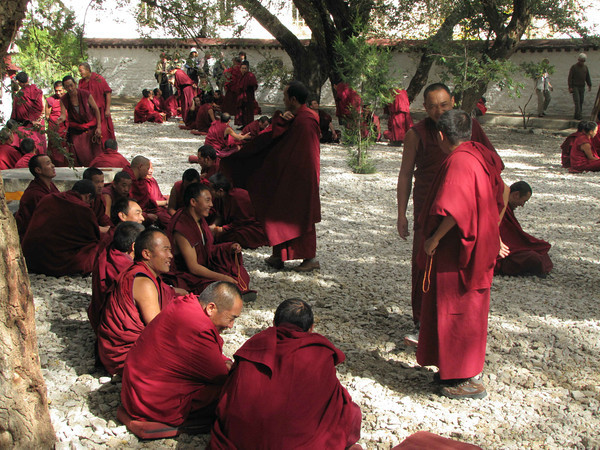
Later in the afternoon, we went to the Sera Monastery on a hill at the edge of town.  The unique aspect of this place is its school for monks.  Every afternoon at 3:30, the students and teachers come to the “Debating Courtyard” for debates.  That is, they have a lesson in the morning.  They meditate on their lesson.  Then in the afternoon, they gather in little groups of 2-10 monks, some teachers and some students, and begin a question and answer style debate.  It was very loud and boisterous.  They speak loudly.  They laugh and obviously challenge and argue with each other.  And when they make what they think is their best point, they do this combination loud hand clap and pointing gesture.  It was very interesting to watch.  Some monks appeared to be playing to the 50 or so tourists watching with video cameras from the edges though that might merely have been our interpretation since there apparently is a set of ritual gestures used for these debates.  Others were clearly involved in serious, intense discussion and debate.  Our guide said that most of it was kept real by the teachers present who guided the discussions.  We found it fascinating to watch.
Traveler’s Voice: The dominant characteristic of Lhasa is its spirituality

On our second day in Lhasa, we begin at the Pobonka [also known as Pabonka] Potrang monastery.  It was 7 kms outside the center of the city and up about 1,000 feet (12,800 feet altitude).  Its principal claim to fame is a small cave that was used by the founder of Tibet for meditation during the early 7th Century.  Currently, it has only small number of monks.  After a brief visit, we hiked up a trail (gaining another 500 feet in altitude) to the even smaller Thasi Shu Lin [also spelled Thasi Chöling] hermitage.  While climbing slowly and steadily to avoid oxygen deficit, we saw thousands of strings of prayer flags hung across gullies to catch the wind.  The wind is presumed to spread the beneficial thoughts on the flags across the valleys below.  So, the more wind the better.  Thus, you always see collections of these flags in places with good wind, like the tops of mountains or across rivers, streams and gullies.  After crossing a ridge, we descended a winding path to the Bakhue [also known as Chupzang or Chubzang] nunnery.  Here we encountered the nuns burying a new plastic water main to bring fresh water down the mountain into their cistern.  This nunnery is also known for its political activism.  Many members were arrested during political demonstrations in the late 1980s against Chinese occupation.  This political activism may be due, in part, to the fact that the original nunnery was destroyed by the Red Guard during the Cultural Revolution and was only recently rebuilt.


After lunch we visited the Jokhang Temple, the most sacred temple in Lhasa.  It was originally built in 642 AD.  By now, you can guess the drill: lots of pilgrims (some in native dress), burning incense and yak butter candles, crowds of people doing circumambulations and prostrations, dark shrines with statues of various protectors, each stuffed with one Yuan bills.  Inside, this temple has one of the most venerated statues of Buddha.  Outside is the Barkhor, a key path for the circumambulation around the Jokhang Temple.  It is also the central marketplace, lined with stalls selling a whole variety of stuff to the pilgrims while their do their walks.  For sale is everything from everyday clothes, to religious stuff, scarves, art, and even a few very high quality shops.  Jan and I spent some time shopping and came home with an original thangka painting of a Buddhist figure known as the “White Tara” (the bodhisattva or goddess of longevity, compassion and health), whose male counterpart is Amitayus.  We almost also bought a really fascinating picture of Jambhala, the Buddha of wealth and prosperity.  After some consideration, we decided that displaying it at home would be a little too much like creating a private altar to greed.  So we passed (although we probably shouldn’t have since it really was a cool painting).  We also shopped for a Tibetan rug.  However, it turns out that hand-made Tibetan rugs cost just as much ($2-5 K) as hand-made rugs in Turkey or Morocco – or Tibetan ones in NYC, and though we need a rug for the breakfast room, we don’t need one at that price.


During the morning of our last day in Lhasa, we went back to a couple of sites (Jokhang Temple, Barkhor and Sanje Tongu—) to complete some purchases.  We also took the opportunity to tie several long white scarves we had been given as traditional greetings around a pole near the Jokhang Temple to seek protection for the remainder of our trip.  Nothing bad happened over the next week or two, so it must have worked.  In addition, this was a most special, full-moon holy day, and so the pilgrims were out in huge numbers and the incense furnaces were belching smoke.  There was even a line of pilgrims doing a circumambulation of the entire city.


Given the density of pilgrims, the Chinese army had to make sure that their presence was obvious and noted.  Periodically you would see small patrol units marching to their assigned areas around the city.  They would just march down the middle of a busy city street, ignoring traffic and lights and basically expecting everyone and everything to get out of their way.  This is, of course, very rude.  But it probably also is very effective as demonstration of their literal dominance and control.


We drove back out to the airport around lunch time.  We had a great noodle soup with fried bread sandwiches stuffed with beef at a little dive near the airport.  It was the best meal of the trip so far.

———-

Janet and Jamie traveled with AsiaTravel in October of 2010.  For journeys to Tibet, check out our website here or contact us at info@wildchina.com. To read the other parts of their journey, see the following articles:

  1. Thrilled with our tour company, but not seduced by China
  2. It’s not rudeness; it’s simply cultural norms.

Photos & post by Janet Heininger & Jamie Reuter.


Explorer Grant Open for Submissions

Find a new route on the Tibetan Plateau. Trace the origin of the Yangtze and Yellow River. Assess the newfound growth years after the Sichuan earthquake. The vision perseveres in whatever the journey may be.

Several people embody these qualities and take action: Li Bo, Director at Friends of Nature, China’s first environmental NGO; Edward Wong, one of the Beijing correspondents for The New York Times; Yu Hui, National Geographic China editor.

Explorer Grant Open for Submissions

The AsiaTravel Explorer Grant is a grant of up to USD 3,000 that is awarded to adventurers seeking to push the boundaries of responsible, off-the-beaten-path travel in China. All submissions for the 2012 AsiaTravel Explorer Grant are due by November 15, 2011.

AsiaTravel selects our explorers winners based on the following criteria:

• Focus on bringing to light a long lost route, a culturally significant issue, promoting aid in a remote community or a trip dealing with discovery or rediscovery
• Passion and excitement for exploration
• Past/current involvement with exploration in China
• Risk management plan
• Incorporation of Leave No Trace (LNT) principles
• Low carbon travel
• Participant skill levels commensurate with proposed itinerary

For more information, please e-mail us at expedition@wildchina.com or visit http://www.wildchina.com/explorer-grant to download the application.


Traveler’s Voice: It’s not rudeness; it’s simply cultural norms

A couple months ago, you heard from AsiaTravel travelers Jan Heininger and Jamie Reuter saying that they were thrilled with [their] tour company, but not seduced by China.  Their journey in October of 2010 took them through Beijing, Tibet, Yunnan Province. Guangxi Province, and finally to Hong Kong. Here is the second part of a series of articles detailing their experience.  Stop 1 – Beijing…

———-

We flew to Beijing via Toronto on Air Canada.  Our plane was equipped with lie-flat, business class seats.  OK food.  Great lounge with free dinner in Toronto.  The tickets were half the price of other airlines.  Definitely recommend Air Canada for anyone travelling to China or other points in the Far East.  12 hour flight with 12 hour time change meant we didn’t have to reset our watches which was sort of weird.  It took both Jan and me several days to get past the time shift.  12 hours is tough (though Jan thinks it’s easier than 8 hours).

Oddly, we arrived a full day early.  We had figured: depart on Thursday (10/14), cross international dateline and arrive Saturday.  So our hotel and ground arrangements all were set up to begin on Saturday.  I’m still not quite sure how or why we went wrong, but we actually arrived on Friday.  So there we were in the Beijing airport: no Chinese money, no one to meet us, and few people with any English to help us sort out what to do.  After an hour-long comedy of errors (cell phone with locking key-pad and no instruction booklet, low volume on cell phone, receiving text message instructions in Chinese characters, etc.), we finally convinced our tour company that we were actually in town and received their instructions.  We were asked to take a mass-transit “airport express” train into town because it would take too long for our actual guide, Andy, to come pick us up.  We didn’t really understand this at the time but our subsequent experience with traffic jams demonstrated the wisdom of this suggestion.  Eventually, we managed to get our luggage, get money, find the train, buy tickets, get off at the right stop (the last one) and meet up with our guide who then took us to our hotel.  By this time, we had finally sorted out that the timing screw-up was actually our fault, and not an error by our tour company.

Our hotel in Beijing was the Opposite House (don’t ask about the meaning behind the name; I don’t know it), an ultramodern, minimalist-design hotel in the embassy district.  Very, very nice—the kind of lovely boutique we prefer.  In fact, tourists (both Chinese and western) routinely came in to photograph the interior spaces.  Good bed, wooden sinks and bath (a little odd), good shower, great service, and a very good breakfast.  The breakfasts were fairly uniform (and excellent) across all of our hotels.  By a large, they were based on large and diverse buffets with egg stations, bacon, cheeses, breads, rolls and muffins, cereal, yoghurt, etc.  In addition, they had a whole range of stuff for oriental breakfasts.  If you’ve never seen this, it includes broth, noodles, and a wide variety of meats, vegetables, fish, seaweed, sprouts, tofu, etc that are combined in a big bowl as a sort of breakfast soup to be eaten with chopsticks.  The broth itself is simply “slurped” down.  We looked at it.  We tried it and poked around a little.  But basically we stuck with the western fare for breakfast.  We excused ourselves by saying that two good Chinese meals a day was enough and who wants seaweed for breakfast?  There were no really good breads or hard rolls anywhere in China until we got to Hong Kong.  Maybe it has to do with the types of wheat they grow or something?

Once settled in Beijing, we did all the usual things.  We went to Tiananmen Square (covered with tourists).  We toured the Forbidden City.  We had Peking Duck (greasy).  In the rain (on our third day) we visited the Temple of Heaven and the Summer Palace.  We drove past a couple of Olympic sites (the Water Cube and the Bird’s Nest Stadium).  We took a pedi-cab tour of a hutong, a traditional Beijing neighborhood jammed in between all of the various high rise apartment buildings.  The hutongs are sort of like old, single story, traditional ghettos that are slowly being consumed by new high-rise construction.  But the Chinese who live in them love their traditional way of life, though they have no private baths or toilets.  The pre-Olympic destruction of several hutongs caused such a fury that it seems that the local “Central Committee” is trying them out as tourist attractions to see if showing them off can provide a positive financial return.


Traveler’s Voice: It’s not rudeness; it’s simply cultural norms

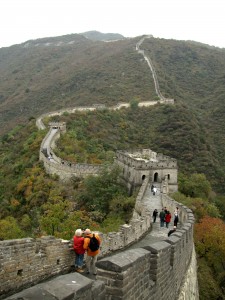
Our favorite things were the Ceramics Museum within the Forbidden City, and the Great Wall.  The museum was a quiet, deserted haven away from all the crowds with very good signage in both Chinese and English.  The Great Wall looked exactly like all the pictures you’ve seen of it.  But actually experiencing it was special.  We visited the Mutianyu section, which is a partially restored but far less touristy section of the Wall.  Jan and I took a long (2.5 hour) hike along its top.  The Wall actually just follows the crest of a mountain ridge.  The path along the top of the Wall can be extremely steep in places.  We both ended up with sore thighs and calves from climbing up and down some really steep and long stretches of steps, but loved the experience.

Traveler’s Voice: It’s not rudeness; it’s simply cultural norms

The food in Beijing was very so-so.  They seem to use a lot of oil so the food was very greasy and not all that flavorful.  Even when we went to a restaurant that specialized in Peking Duck, we were pretty underwhelmed.  We were not terribly adventuresome in our choices, so we probably missed a lot of what a real “foodie” would find interesting and good about Beijing food.
One of the oddities of being in China was the Chinese tourists’ fascination with us.  It started in the Tiananmen Square where this nice couple asked if they could have their picture taken with us with the Forbidden City in the background.  According to our guide, this was due to the inherent weirdness of westerners in general, and a tall, bearded westerner like Jamie in particular.  While this first incident was unique in that it included Jan, 10 or 12 times during the trip some couple or group of giggling girls or whomever wanted Jamie to pose with them for a photo – more or less to prove to their friends back home that they had seen, and even touched, a foreigner—but mostly because Jamie was so tall and looked even taller with his Australian Tilley hat.  Another tall American that we met on the trip had similar experiences.  After a while, the whole thing became a bother and bit irritating.  It was, in some small way, like having paparazzi chase after you.  It eventually made me feel like a creature in a zoo that people gawked at.  Weird.  And yet, despite such experiences and our reaction to the hordes and hordes of Chinese tourists, we found the Chinese, as individuals, to be friendly and welcoming.

We spent hours in traffic going to and from the Great Wall, and trying to get around inside the city.  Drivers are crazy there.  They push and shove in traffic using cars, trucks and buses pretty much the same way they push and shove in queues.  As one guide told us, there is no concept of personal distance in China (unlike in Japan where they create their own).  It’s not rudeness; it’s simply cultural norms. However, they always beep their horn when passing (they are taught to do this).  And when passing, they pull back into the right lane when the front seats have barely passed the front of the car being overtaken.  Several times, I was sure that we would clip the front of a car being passed but we never did.  Crossing a street on foot was also a challenge.  Initially I thought that cars were aiming at us on purpose.  Later, I realized that there just wasn’t any concept of pedestrians having the right of way.  A car making right hand turns just keeps going.  It was up to the pedestrians to get out of their way.  Given that the city was laid out in huge squares, Beijing was not a walkable city anyway.

Beijing was clearly an example of the “new China.”  Designer stores were everywhere.  Many young people clearly had lots of money and were stylishly dressed.  There was a long line outside an Apple Store near our hotel, as people waited to buy iPhones at five times the US price.  High rise condominiums and office buildings were everywhere.  Some brand new, some older and clearly showing their age.  Construction cranes were everywhere.  Our guides quipped that China’s national bird was the crane (i.e., steel crane, not feathered; get it??).  But the old neighborhood (hutong) near our hotel didn’t have a sewer or clean, public water.  Beijing was clearly a city of contrasts, with rapid change being driven by the “new” China economy.

———-

Stay tuned for more tales from Ms. Heininger & Mr. Reuter’s journey.  For more information about adventures in Beijing, see a sample itinerary here or contact us at info@wildchina.com.

All photos by Ms. Heninger & Mr. Reuter. To see all of their photos, visit AsiaTravel’s flickr page here.


Abujee Trek in Northern Yunnan

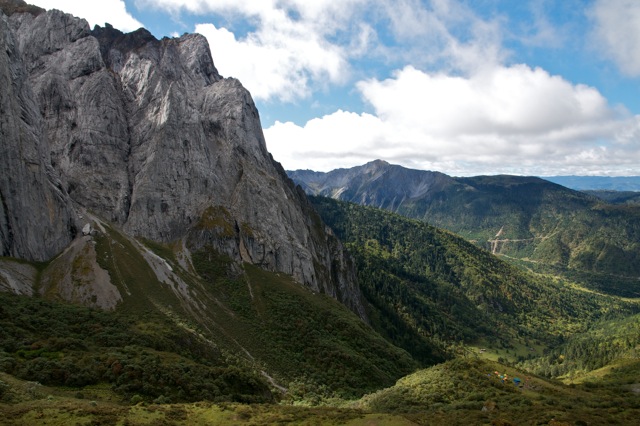
AsiaTravel recently took students from an international school on a multi-day trek in a remote region outside of Zhongdian (popularly known as Shangri-La). It was challenging hiking at altitudes upward of 4000 meters, but the students were resilient and enjoyed the rewards, including a high alpine lake that’s sacred to the Tibetans and Yi people.

AsiaTravel expert Jeff Fuchs helped lead the journey. Fuchs shared valuable insights on the local culture and surroundings. Tibetan guide Sonam kept the group comfortable, especially when he broke into song. The horse team did well – even a two-week-old colt kept up!


Abujee Trek in Northern Yunnan


Abujee Trek in Northern Yunnan

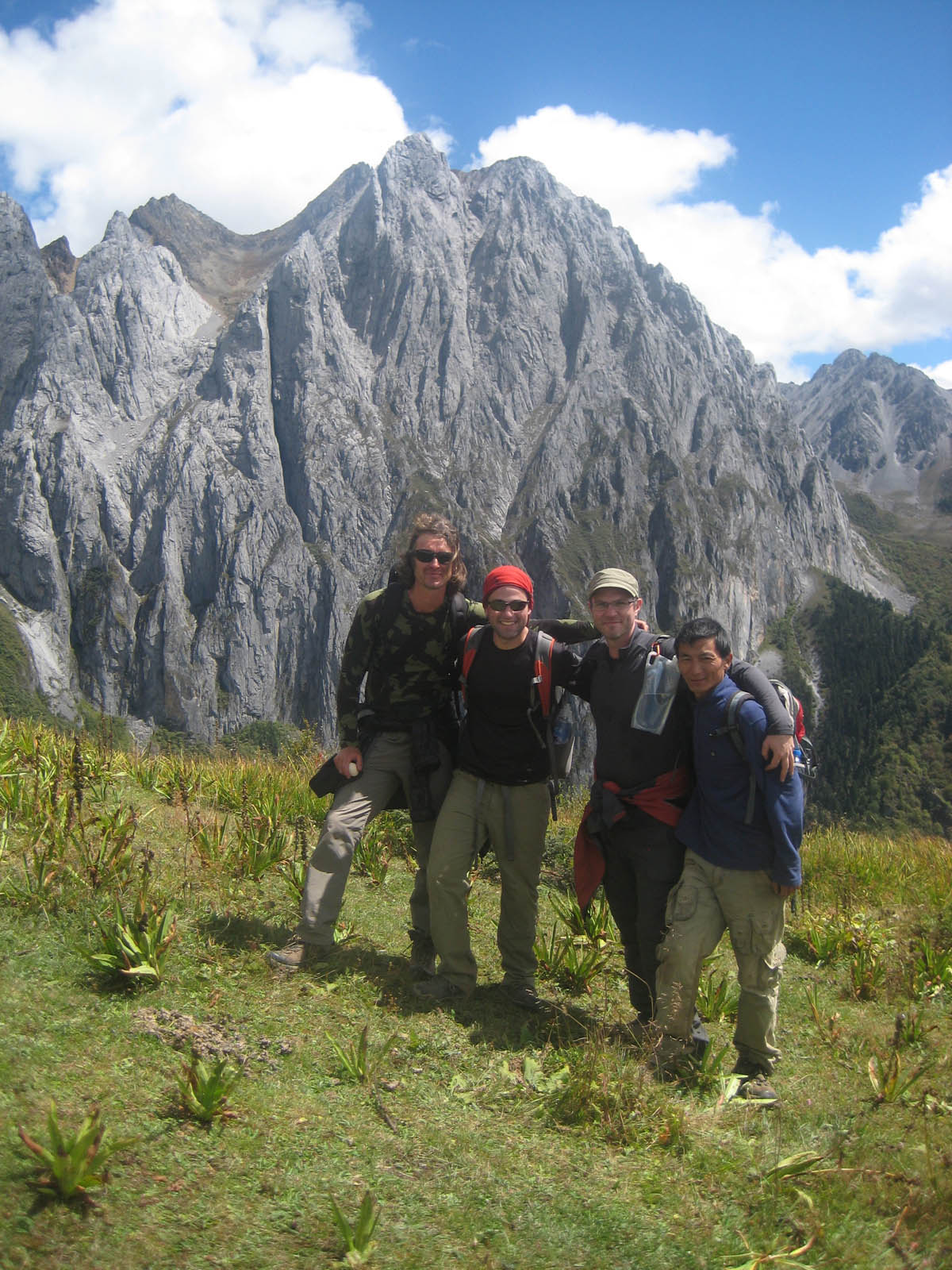
AsiaTravel team of Jeff Fuchs, Max Stein, David Fundingsland and Sonam Geleg at the end of the trek


———

For more information about educational journeys to Yunnan, contact us at education@wildchina.com.


THINK Global School videos their Journey to Tiger Leaping Gorge

Students at THINK Global School really got to experience Yunnan with a different perspective.  AsiaTravel exposed the students to Dongba culture, Tibetan language, and Tiger Leaping Gorge, among others.  Photographer / videographer Lindsay Clark put together some footage from the morning market in Shaping.  The class thrived off of the interactions with locals: “Snapping photos, speaking in Mandarin, trying new foods – everyone takes their own approach to this outdoor classroom.” (Clark, TGS)


THINK Global School videos their Journey to Tiger Leaping Gorge

Woman at rural market outside Dali, China

At the Zhonghe Temple in Dali, AsiaTravel Guide Zhang Jiong shared his knowledge on luck.  Check out the students aiming for good fortune.


THINK Global School videos their Journey to Tiger Leaping Gorge

“Zhang Jiong explains the meaning of the Fu symbol that sits in front of a Chinese temple. Students at THINK Global School spin three times – eyes closed – and try to touch the symbol to bring good luck to their families; a little lesson and humor atop the Dark Green Mountains in Dali, China.” (Clark, TGS)

Still, Brad Ovenell-Carter the Head of School felt, “The visit to the Zhonghe Temple was too short.  It would have been nice to stay at the hilltop for a while, perhaps to hold a drawing class and share a cup of tea.”

Thanks for the feedback, Brad!  AsiaTravel will definitely note this on our future journeys there.

———-

For more information about educational journeys to Yunnan, contact us at education@wildchina.com.

Photo by Brad Ovenell-Cartner, Videos by Lindsay Clark of Think Global School


Traveler’s Voice: Thrilled with our tour company, but not seduced by China

The following post was written by Jan Heininger and Jamie Reuter, AsiaTravel clients who traveled with us for two and half weeks in October of 2010.  Their journey took them through Beijing, Tibet, Yunnan Province. Guangxi Province, and finally to Hong Kong. This is the first of a series of articles he wrote detailing their experience.  We begin with their overall impression of China…

———-

Some people come away saying they “loved” China.  We didn’t.  Don’t get me wrong.  This was a great trip.  China was fascinating.  It had beautiful scenery.  It had lots of history and culture.  We had many very unique experiences.  Tibet was wonderful.  We saw the Forbidden City and the Great Wall.  We saw amazing scenery including the karst mountains in the Li River valley.  We saw and experienced (in our own way) the spirituality of Tibet and China.  We visited towns and areas still dominated by minority populations and tribes.  We had, alas, only a few great meals but we stayed in a number of really outstanding hotels.  We had excellent guides and drivers who gave us meaningful insights into China, its history, its culture and its peoples.  We came away with a much greater appreciation for how some of the more recent aspects of Chinese history (end of the empire, Mao, the Cultural Revolution and the change to the “new economy”) have molded how people live their lives today.  We walked through “old towns” and markets established a thousand years ago.  We got a better understanding of how life works under central control.  But we didn’t “love it.”  We were fascinated.  We will go back to visit other areas of the country.  We were thrilled with our tour company and will use them again.  But we weren’t seduced by the country’s charms.


Traveler’s Voice: Thrilled with our tour company, but not seduced by China


Part of our difficulties was due to the constant and sometimes overwhelming presence of Chinese tourists.  Chinese tourists are an odd group and not terribly accommodating or pleasant from a westerner’s perspective.  According to conversations with several people, Chinese tourists are less interested in seeing, learning and understanding, and much more interested in taking home pictures of themselves and cheap souvenir gifts to “prove” they had been to the big city and seen the elephant (so to speak).  In the context of China’s economic growth and the spread of wealth down into the middle classes and rural communities, millions of these tourists are on their initial trips out of their local communities.  They smoke a lot.  They spit.  They talk, stand up or even walk around during performances.  They push and shove to get to the front of a line – a survival skill, no doubt, in a country with 1.3 billion people.  In small numbers (anything less than several thousand), they are no worse than any other population of large groups discharging from parked ranks of tour buses.  You ignore their presence and carry on.  But for some reason, we were flooded with them.  Clearly, it was worst in Beijing, and our experience there may have made us hypersensitive to the issue throughout the remainder of the trip.  But our guides uniformly reflected on how they were seeing substantially many more national tourists than expected.  In prior years, the number of Chinese tourists had substantially diminished following their big national holiday (October 1).  This year, they just kept coming.  As an early example, I expected Tiananmen Square to be this huge, open square, just like the pictures I’ve seen.  Instead, all we could see were the heads of tens of thousands of tourists jamming an open space between a few monumental marble structures.  There was a 4-6 hour wait to get into Mao’s tomb (we skipped it).  Given the number of people present, the square itself didn’t even seem all that big.  For communities all across China, hanging out a “UNESCO Site” sign means you’re guaranteed millions of dollars of revenue from tens of thousands of Chinese tourists jamming little historic streets lined with shops selling plastic crap and cheap reproductions (mostly made in Viet Nam).  You can’t fault the Chinese for wanting to visit the hotspots within their own country.  But their numbers and manner definitely reduced our enjoyment and, in some cases our appreciation, for particular sights or experiences.
Second, China is clearly struggling with the size of its population, the extraordinary rate of growth in its economy and the rapid changes that are occurring in its distribution of wealth.  Improvements in their infrastructure (highways and airports in our experiences) just can’t keep up.  So in any largish city (and a country this size has lots and lots of cities with 5-10 million people), traffic jams, litter, pollution, clean water, lack of functional sewer systems, crowded public transport, crowded airports and disruptions due to construction are real problems.  I saw more Ferraris in Beijing in 3 days than I’ve seen in Washington D.C. in 30 years.  But most of them probably never get out of 1st gear due to the endless traffic jams there.  They’re like enormous pinkie rings, serving only to demonstrate the wealth of their owners.  Our trip included many, many hours in cars and vans averaging anywhere from 10-20 kilometers per hour – both in urban areas and while driving between rural towns.  Most tourist areas are struggling to deal with the explosion of tourism by Chinese nationals and foreigners, and some sites are, frankly, failing.  For example, we had to stand around for 15-20 minutes waiting for our guide to purchase tickets to get into the Forbidden City.  There was no way to pre-purchase tickets to get into sites.  And it wasn’t just for our small group of two.  Even the large groups stood around waiting, increasing the sense of congestion and crowding around key sites.  They just haven’t learned the secrets of how to move people along.
Finally (and there’s no polite way to say this) but…  Squat toilets were not our favorite Chinese experience.  Particularly when there aren’t any doors or walls between the “stalls.”  And you’d better bring your own toilet paper because you won’t find any outside of luxury hotels and airports (and even some of the airports only had squat toilets.)
I remember when my Grandmother Miller visited us in Germany back in the 1960’s and said something like “Germany would be a great place if it just wasn’t so full of foreigners.”  That’s been an inside, Reuter family joke for years.  I am very uncomfortable with the fact that my feelings about our China trip include even a tiny hint of this incredibly ethno-centric view.  I really do believe that I’m much more cosmopolitan than that.  But it can’t be argued that in the end, we just didn’t really “love” China as a country, and these were some of the reasons why.


Our tour company was AsiaTravel.  We could never say enough wonderful things about how well they actually performed.  They provided everything promised, including cars and beds big enough for Jamie.  Their guides were terrific: very helpful, informed and flexible.  While dealing with our early arrival is the best example of their flexibility, we regularly had conversations with our guides about the various options we had for spending a day.  They quickly picked up on our desire to skip the obvious and crowded and go for things that were more unusual and interesting.  They knew where the shops with “quality” goods were, and took us there.  They were very open about their own lives and experiences.  They taught us a lot about what it was like to live in the “new China.”  We highly recommend AsiaTravel to anyone planning a trip there.  They will work with you to create the type of trip you want, and then deliver it.  A very good friend of ours, who has travelled extensively, went on a 12 day trip to Yunnan, departing two days after we returned, and spent time in many of the same places we visited.  She used one of the “usual” tour companies.  The contrast between the two trips was remarkable.  If you’re going to China, use AsiaTravel.
Weather wise, we sort of lucked out.  The rainy season was supposed to have ended.  But everyone kept talking about how weather patterns had been delayed this year and that we were still in the tail end of the rainy season.  Weather.com kept predicting rain – with daily precipitation probabilities ranging from 60-80% for weeks at a time.  In reality, we had serious rain for only two days: one in Beijing (when we visited the Summer Palace and Temple of Heaven in our rain gear and under umbrellas) and one in Kunming (when a break in a steady rain let us wander around the Stone Forest without get too wet).  On the other hand, it was generally cloudy, overcast and about 10 degrees (Fahrenheit) colder than we expected.  While Jamie never put on his wool cap and gloves, he only wore his shorts and polo shirts after we got to Hong Kong.  Jan packed too many shirts with three-quarter sleeves and was stuck wearing her 2 long sleeve shirts day after day after day.  Neither of us even got close to putting on our bathing suits.

———

Stay tuned for more tales from Ms. Heininger & Mr. Reuter’s journey.  For more information about the destinations they visited, check out our destinations map here.