The Shangri-La Effect

Named one of the “up-and-coming” places to visit, it seems that the word “Shangri-La” is everywhere. The term, which is said to “evoke imagery of exoticism of the Orient,” has initiated a circular series of inspired events:

James Hilton coined the term in his 1933 novel Lost Horizon and described Shangri-La as an earthly utopia nestled high in the Tibetan Himalayas. His story and legend describe it as “a lost paradise where the ravages of time and history have been held back, where human beings live in harmony with nature, and where the wisdom of the planet is saved for future generations” (Michael Wood, BBC).

The Shangri-La Effect

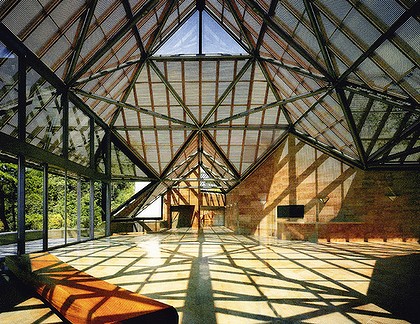
Inspired by this exotic legend, world-renowned architect I.M. Pei designed the Miho Museum with Shangri-La in mind:

The Shangri-La Effect

Located southeast of Kyoto, Japan, the museum was commissioned by Mihoko Koyama who founded Shinji Shumeikai, a new religious movement whose followers believe that by “building modernist architectural masterpieces in remote places they’re restoring the planet’s balance” (Jeff Sharlet, author).

This past year, the Paul Winter Consort collaborated with several different artists, including Yangjin Lamu, a “spiritual musician” from Tibet, to produce the song entitled “Miho: Journey to the Mountain,” which was inspired by and recorded in the Miho Museum.  At the beginning of the week, the song was named Best New Age Album of the Year at the 53rd Grammy Awards. According to Hexun.com, Yangjin Lamu is not only the Founder and Chairman of the China Overseas Tibetan Association, but she is first Chinese person – one with a Chinese passport – to win the prestigious award.

The Shangri-La Effect

Lost Horizons started the hunt for Shangri-La, the utopian destination that was purportedly found in the town previously known as Zhongdian. This destination has gone on to inspire everything from architecture to award-winning music to people’s perception of China. Perhaps the power of Shangri-La isn’t so mythical after all…

Photo Sources: AsiaTravel, The Sydney Morning Herald, Metro UK

Amne Machin – A Rush of White and a Kora

The following is an excerpt from Jeff Fuchs’ Tea and Mountain Journals, a blog by explorer, photographer and writer Jeff Fuchs.  Jeff is the 2011 recipient of AsiaTravel’s Explorer Grant.  He and friend Michael Kleinwort are currently traveling through unknown portions of the Tsalam route in Qinghai.

Below is an update from their journey…

———-

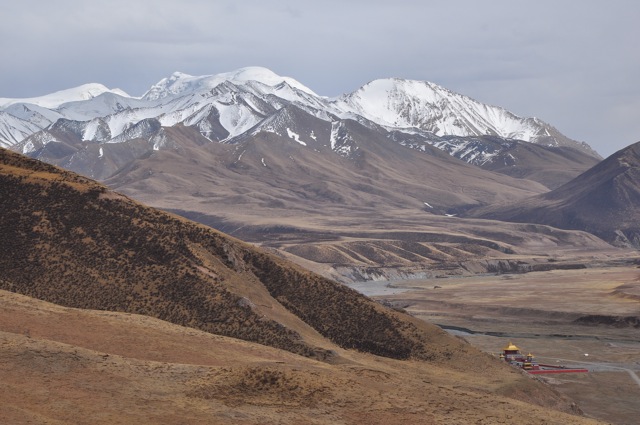
Amye Maqen (Amne Machin, Anye Machin) <http://en.wikipedia.org/wiki/Amne_Machin>, the stout, the muscular, and for much of time, the utterly hidden from the outside world…our first glimpse of it is of a snow capped wonder that appears far closer than it is. There seem to be as many ways of spelling it as their are potential descriptives. Neither wind blown sand nor a haze can obscure its brilliant bulk. It seems to hang from the sky as we come in from the northwest towards the makeshift town at its base, Xiadawu (or in the more flavoured local Tibetan ‘Da’wurr’ – ‘Place that is difficult for horses’). In Joseph Rock’s accounts of the mountain and bandit ridden regions back in 1930 he estimated the broad peaks of Amne Machin to be 30,000 feet, a guess that was later proven to be 3,000 metres off.


Amne Machin – A Rush of White and a Kora

Amne Machin from the northwest


The Amne Machin range itself is an eastern extension of the greater Kunlun Mountain range, one of Asia’s longest most legend laden mountain chains. Located in the Golog Tibetan Autonomous Prefecture it is here that the Yellow River (so named because of wind-blown loess that is carried in from Central Asia) rises before winding eastward. At its rounded and almost friendly white peaks it achieves just over 6,200 metres.

Mountains cannot be compared to other of their kind in my eyes. Mountains are landscapes, heaps of stone and snow unto themselves and each has their own thin-aired identity. Sacred to the Golog (Golok) nomads, Amne Machin is almost directly due east of our pristine salt lake near Mado (Mardo) that we’ve most recently left. It also lies on the route that nomads from southwest took to access their precious salt. Few nomadic caravans would pass up the chance to visit and circumambulate the sacred Amne Machin range while undertaking a perilous journey to source salt. Ever practical, the Tibetan traders saw the value of doing both trade for a revered commodity and a little cleansing of past ills.

This mountain that has long played a role in local nomad’s worship of the divine, has withstood weathering seasons and has become more iconic in the eyes of men over time. The fact that it lies as a northwest-southeast diagonal throughway for traders only increases the curiosity for Michael and I. How much is left in memory and physicality of the salt route legacy? How much of any trade route – seldom acknowledged, documented or discussed – will survive? It is in this way that these journeys and explorations are truly ‘exploratory’ with nothing being guaranteed.

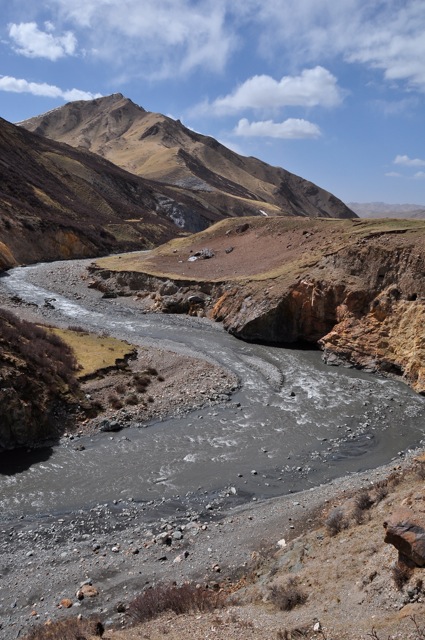
The town of Xiadawu, sits in a small cupped valley and is a dusty mess of pool tables, remarkably shabby huts and a main square of errant apathetic dogs that have forgotten their roles. Xiadawu’s decrepit appearance serves as an entry to something far greater than itself, Amne Machin, which erupts to the east. Flowing west out of the mountains past the town, the swerving breadth of the Nam Chu (Nam River) wanders through, over and around valleys in a never-ending search.

Amne Machin – A Rush of White and a Kora

Namchu (Nam River)

Our host, Tsering, is to be found out of town – it is he who will arrange our kora/ circumambulation around the great mountain. The ‘kora’ or counterclockwise circumambulation literally refers to a pilgrimage. For many eastern religions this act is believed to be a physical way to cleanse or clear away one’s past sins.

If in fact this is the case it may well take a few more than one rotation for Michael and I to wipe our collective slates clean.

Amne Machin – A Rush of White and a Kora

Around us the landscape ripples with Spring’s pending arrival – ridges verging on going from ochre to green. Still though, the high peaks remind in a glance that up here at over 4,000 metres winter isn’t really ever truly ‘over’.

Our host Tsering tells us that, yes, the salt traders came through here as part of their annual travels – more specifically nomadic traders, who, coming from further east, would add the kora of the mountain to their travels to the salt lakes. A kind of double-pronged travel plan: salt for need and profit, kora for life-cleansing benefits.

Amne Machin – A Rush of White and a Kora

———-

For the full post, please visit http://www.tea-and-mountain-journals.com/
Image: Jeff Fuchs

Saving the Secret Towers

The following is an excerpt from an article in The Wall Street Journal by Mitch Moxley, a Canadian journalist with national and international reporting experience. He’s written on politics, travel, business and other topics from China, Mongolia, Japan, Vietnam and the Philippines. He is currently based in Beijing, China.

———-

The ride from Chengdu to Danba Valley is one to be endured, not enjoyed. The journey is by a smoke-filled bus with tiny seats that barrels deep into the mountains of western Sichuan province, shaking and rattling on a single-lane road that is often strewn with fallen rocks. A hair-raising view out the window is of the Dadu River below.

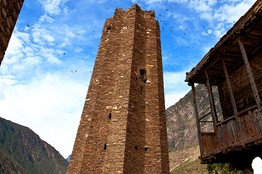
This is the route to one of China’s most enduring architectural mysteries. Ten hours and 400 kilometers into the journey, the valley opens to reveal green mountains topped with snowy peaks. On a ridge above stand a half-dozen rock towers, like ancient smokestacks.

The Secret Towers of Western China

View Slideshow

Saving the Secret Towers

James Wasserman for The Wall Street JournalOne of the many multi-faceted towers in the village of Suopuo, Danba County, Sichuan, China.


Across the remote, earthquake-prone regions of western Sichuan and Tibet, there are hundreds of these structures. They are built of cut stone, brick and timber, date back as far as 1,700 years and stand up to 50 meters tall. No one is sure of their purpose, though theories abound: They were watchtowers, way stations, status symbols. Some say they have religious meaning.

Striving to save the towers from the forces of neglect, earthquake and a planned hydropower dam are a small number of preservationists, including Frédérique Darragon, a 61-year-old global adventurer—sailor, dancer, trekker, polo player— turned amateur archaeologist by her love for these mysterious structures.

The daughter of a wealthy Parisian inventor and machine maker who died when she was 4 years old, Ms. Darragon spent childhood summers riding horses in England and winter breaks skiing in the Alps. She worked on a kibbutz in Israel and in 1971 sailed across the Atlantic in the first race from Cape Town to Rio de Janeiro. She returned to Paris, graduated from university there and then did some work as a model—”Not high fashion,” she says, “just for extra money”—played polo in Paris and Buenos Aires and became a lauded samba dancer in Rio.

During the early ’90s, Ms. Darragon spent several months a year traveling alone through China, often by foot in areas that are still rarely visited by Westerners. It once came close to killing her: In 1993, while searching for endangered snow leopards in Tibet, she suffered a stroke when a fire she built in a cave consumed too much of its oxygen supply. She lay for three days before being rescued by Tibetan shepherds.

Three years later, Ms. Darragon saw her first towers, while traveling near Danba. A year after that she saw similar towers in Tibet—800 kilometers away—and was hooked. “When I learned that neither Westerners nor Chinese had researched them and that practically nothing was known about them, I could not resist trying to crack their mystery,” Ms. Darragon says of her long affair with the ancient towers.

The Danba Valley, home to ethnic Tibetan and Qiang villages, is one of the best—and most accessible—places to explore the towers. Five kilometers from Danba city (danba means “town of rocks”) a series of sprawling villages collectively called Suopo has about 80, some in ruins but many still standing, and some of them more than 30 meters high.

Until recently, nobody knew the towers’ age with any real degree of certainty. There are references in texts from the Han Dynasty, which lasted for about 400 years starting in 206 B.C., but the peoples who historically populated the tribal corridor of Sichuan and Tibet lacked a written language, so there was no documentary evidence of the towers’ origin. Chinese archeologists had taken scant interest in the riddle.

Saving the Secret Towers

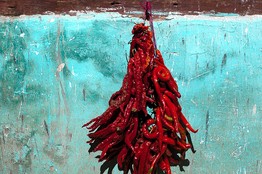
James Wasserman for The Wall Street JournalChiles hang outside a window in Danba County.

It was a linguist who wrote one of the first papers on the subject, in 1989. Sun Hongkai, now retired from the Chinese Academy of Social Sciences, had first seen the towers during a 1956 visit to Sichuan to investigate the Qiang language. “People in the area did not pay attention to the towers,” Mr. Sun says. “Many were destroyed during the Cultural Revolution. People used the stones for building materials.”

In the 15 years since Ms. Darragon was drawn to the mystery, she has devoted much of her life to cataloging, dating and fighting to preserve hundreds of the enigmatic stone skyscrapers.

In 2001, with funding from U.S. media mogul Ted Turner, a fellow sailing enthusiast she’s known for decades, she created the nonprofit Unicorn Foundation, dedicated to education and humanitarian projects.

“I’m very proud of Frederique and the work she’s done in China,” Mr. Turner says. “Her amazing discoveries are astounding, and her commitment and dedication to the preservation of some of China’s great artifacts and structures will always be admired and respected.”

————

To read the full article, click here. To inquire about journeys to see these towers in Sichuan, please e-mail info@wildchina.com.

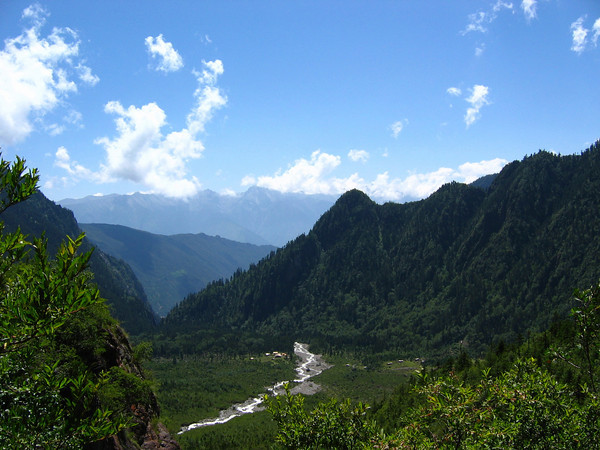
Amne Machin White and A Travelling Circus

The following is an excerpt from Jeff Fuchs’ Tea and Mountain Journals, a blog by explorer, photographer and writer Jeff Fuchs.  Jeff is the 2011 recipient of AsiaTravel’s Explorer Grant.  He and friend Michael Kleinwort are currently traveling through unknown portions of the Tsalam route in Qinghai.

Below is an update from their journey…

———-
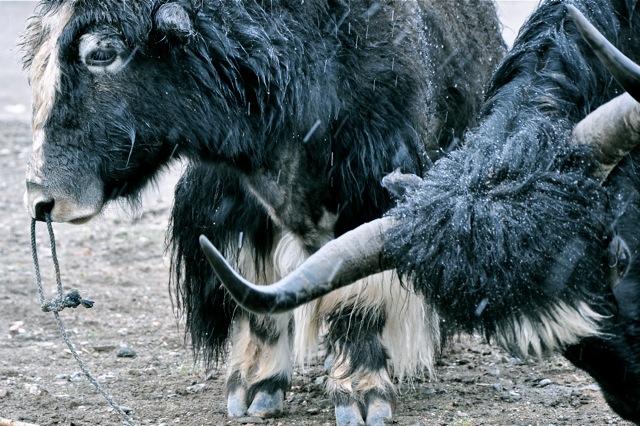
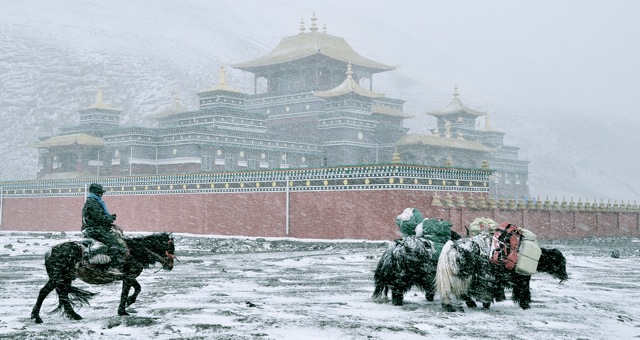
Our two yak stand still in the blowing white snow; around them there is nothing to suggest a specific time-period and looking at their ice-encrusted wool I imagine a time long ago when gas-spewing, noise machines on wheels hadn’t yet taken over – where movement on land required the foot or hoof. Here, now, in this blowing snow beneath a mountain it is remarkably easy to imagine this time.
Amne Machin White and A Travelling Circus

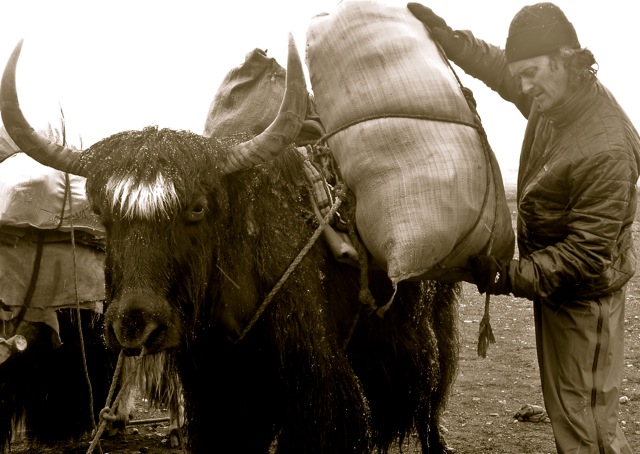
The yak stand before us resigned and powerful, and it is evident that it is in their DNA and memory banks to wait, to be loaded and to traipse where few beings can. Mobile, tough and silent they provide the broad backs for transport. Nomads delight in riding horses but in these parts no other ‘transporter’ can predictably claim the reliability title at altitude as can these behemoths.

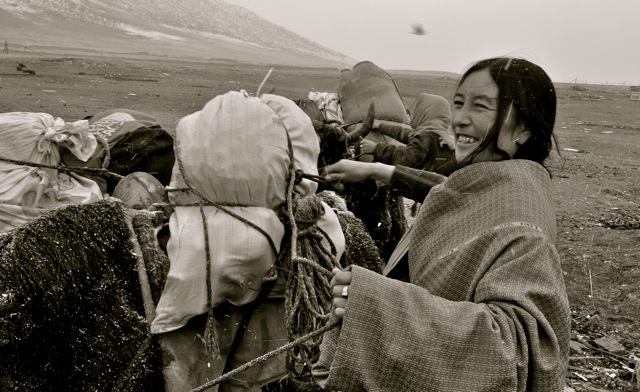
Apart from the yak, all things seem in rapid motion. Snow is contorting and rushing at us from above. The headwoman of the village is continuing to issue orders, while simultaneously tightening up yak wool cords around our gear.

Amne Machin White and A Travelling Circus

Ancient and essential, the art of loading and tying gear to mules or yak’s backs is something that has long been prized and traders often picked their muleteers or ‘yak-men’ based on their abilities in this skill. Our guide Neema, a short and slight man whose face wouldn’t be at all out of place in the Andes of South America is organizing our food and necessities into bigger bags that will also be tied onto the back and flanks of our yak. One item, an essential given the time of year is a double reinforced bag of dried yak dung patties – fuel for our life giving fires. We are above the treeline here at almost 4 km’s in the sky and the areas where we will tread will not yet have herds of yak…nor their vital ‘droppings’ for us to use.
Amne Machin White and A Travelling Circus

Huge flakes of snow explode into moisture as they pop against our jackets, and the mountains around us (that we can make out) are already building up their coats of white. The snow is unrelenting and it is hard to imagine a world without white. The winds are crafty, coming at us from all angles at once it seems.

Making our way out of the valley our vistas open up, but not our sightlines. They are paralyzed by drapes of white snow. Our contingent of moving bodies has somehow become eight bodies. The two yak seem to know precisely where they are going silently leading the way. Neema has mounted a chestnut pony – a lanky tough looking creature, and two dogs have joined along. One dog, a beige 10 kg livewire of energy looks part terrier and part fox, carrying a small diagonal scar on his snout which gives him the look of a seasoned street fighter.

The second dog, a Tibetan mastiff carries his black bulk easily and has the most forlorn brown eyes I have seen in a long while. Michael is wrapped in a black hood and I am encased for the wind and snow. Snow, as it does has at once darkened the entire day and made it so bright that we need the sunglasses for the glare.

Squeezing through a last bottleneck of space, we make out a hazy outline coming up to our left. Unseen to our right, down a plunging valley is the Nam River and the structure to our left, which clarifies as we approach, is the Ge Re Monastery, a new monastery that reminds me strangely of a mosque in shape. It sits as sort of a gateway into a bigger world beyond. It is still in the onslaught of snow…everything but the snow now seems still.

Amne Machin White and A Travelling Circus

———
For the full post, please visit http://www.tea-and-mountain-journals.com/
Image: Jeff Fuchs

It’s Pu-erhfectly healthy and delicious

It’s Pu-erhfectly healthy and delicious

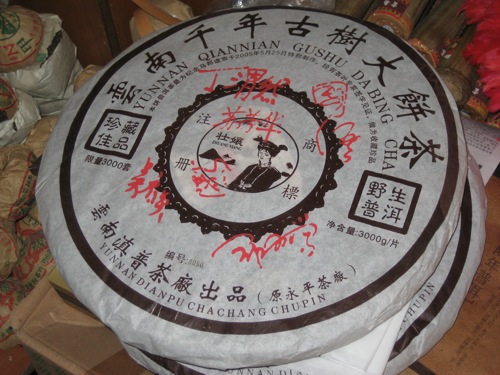
A disk of compressed Pu-erh tea for sale at a tea market in Yunnan

It’s not often that one encounters a tourist souvenir that lowers cholesterol, promotes weight loss and protects against cancer, vascular disease, cognitive degeneration and aging – not to mention providing important nutrients like amino acids.

But tea is believed to have these virtues and recent research shows that certain types of Pu-erh tea from China’s Yunnan province have particularly potent levels of beneficial chemical compounds.

AsiaTravel visits Pu-erh production areas in Yunnan on its trip ‘The Ancient Tea & Horse Caravan Road: An Expedition with Jeff Fuchs.’ Learning about the fascinating history of the ancient trade routes along which Pu-erh tea once traveled by horseback to Tibet is a highlight of many clients’ trips.

Another highlight is trekking in Yunnan through tea agro-forests and wild tea gardens where members of exotic ethnic minorities like the Bulang, Lahu and Akha have tended organic tea gardens for generations in the general area from which tea is believed to have first emerged.

In fact, it is believed to be these small-scale, natural growing practices which impart the best Pu-erh tea with heightened health benefits. Most tea in the world these days is produced in sprawling plantations, planted in neat rows in direct sunlight and often treated with chemical fertilizers, pesticides and other agricultural chemicals.

Not so with the finest Yunnan Pu-erh tea. To start with, it is not all produced from a genetically uniform crop. As we learned recently from the excellent book Tea Horse Road, Pu-erh is produced from a dozen wild cousins and hundreds of landraces of the Camellia sinensis plant – each particularly adapted to the climate of the particular hillside, or even grove, where it has traditionally been grown.

And instead of being grown in a tea monoculture, these trees (many reach an age of a few hundred years and a height of 50 or more feet) grow shaded from harsh sunlight in a natural ecosystem with hundreds of other plant, animal and insect species.

Thriving in their natural environment, agro-forest and tea garden trees produce higher levels of the beneficial compounds that first drew humans to start drinking tea, likely as a medical elixir, some three thousand or more years ago.

A study published last year in the Journal of Ethnopharmacology¹ compared Pu-erh from both terrace plantations and ecologically friendly agro-forests, measuring levels of tea catechins, flavonoid compounds that are thought to be beneficial to human health and are present to varying degrees in most non-herbal tea. The authors found that tea from the agro-forests had average catechin levels several times higher than the plantation tea.

So if you find yourself in southern Yunnan, relaxing after a day of trekking through ancient tea gardens and sipping on a cup of Pu-erh, you can feel good about the fact that a hike isn’t the only good thing you’re doing for your health that day. And don’t forget that a compressed cake packs great for the trip home.

1: See: Ahmed, et al “Pu-erh tea tasting in Yunnan, China: Correlation of drinkers’ perceptions to phytochemistry”, Journal of Ethnopharmacology 132 (2010) 176–185

Tsalam – The Ancient Salt Route

The following is an introduction to Jeff Fuchs’ Tea and Mountain Journals, a blog by explorer, photographer and writer Jeff Fuchs.  Jeff is the 2011 recipient of AsiaTravel’s Explorer Grant.  He and friend Michael Kleinwort are currently traveling through unknown portions of the Tsalam route in Qinghai.

Below is an announcement about their journey…

———-

The Route of White Gold


When: May, 2011

Who: Jeff Fuchs, Michael Kleinwort

Where: Southern Qinghai (Amdo)

One of the ancient world’s great and unheralded trade routes was the eastern Himalayas’ Tsalam, or Salt Road. Known to many Tibetans as “The route of white gold”, much of its desiccated remains rest at close to 4 km in the sky upon the eastern Himalayan Plateau.

Traversing some of the planet’s most remote and daunting terrain, the Tsalam passed through the snowy homeland of the fierce Golok nomads, notorious wolf packs and beneath the sacred Amye Maqen mountain range of southern Qinghai province (Amdo). Largely forgotten it remains culturally, historically and geographically one of the least documented portions on earth. The memories of a few traders carry on its almost fabled tale.

The route itself has never before been acknowledged (nor travelled) by westerners, and much like the Tea Horse Road, the last remaining traders who traveled its length are passing away and with them too, the memories of what for many was the only access path into the daunting nomadic lands.


Leading the expedition and transcribing the tale of Tsalam will be myself, with English entrepreneur and endurance athlete Michael Kleinwort joining me. Along with local nomadic guides and the odd mule, our “0 carbon footprint team” will attempt to travel the most isolated and unknown portion of the route – a remote nomadic portion from Honkor to the Maqu area.

The expedition in May of 2011 will be done entirely by foot and will access many of the last nomadic traders to document their precious recollections of travel along the Tsalam. The expedition is another of the ancient Himalayan trade routes I hope to re-expose to some light. Articles in select publications will appear upon completion of the journey.

Tsalam – The Ancient Salt Route

Jeff Fuchs

Tsalam – The Ancient Salt Route

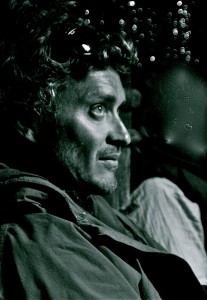
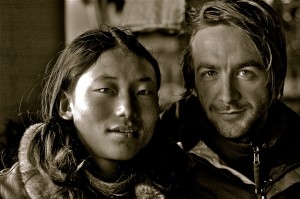
Lubden & Michael Kleinwort

———-

For more, please visit http://www.tea-and-mountain-journals.com/
Image: Jeff Fuchs

Snapshot from the road: Time travel in the Nu Valley

Snapshot from the road: Time travel in the Nu Valley

Sometimes when on the road, the past and present can collide in the most unexpected of places. We were reminded of this recently when on the road in the lush upper reaches of the Salween River in Yunnan, where the river is known as the Nu River.

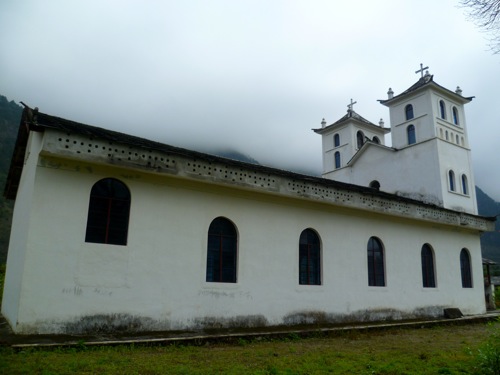
It was a Sunday morning and we’d been enjoying the Tibetan-style Buddhist architecture in hills near the remote town of Bingzhongluo. The fresh, invigorating air filled our lungs as we headed down into the valley, where we came upon a rebuilt Catholic church that had originally been constructed more than a century ago.

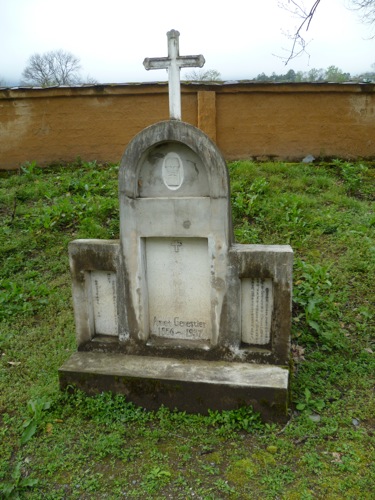
It was half past ten and mass was going to start at eleven. A small crowd of worshippers from the Lisu ethnic group was waiting to enter the building. We walked around to one side of the church where we came upon a small graveyard with only one headstone.

Upon closer inspection, we made out the name of the deceased: “Annet Genestier”. The name rang a bell instantly, as just one night earlier we had  re-read some of famed botanist/explorer Joseph Rock’s impressions of traveling through the Nu Valley, which were published in an article in National Geographic from August, 1926 entitled “Through The Great River Trenches of Asia”.

Snapshot from the road: Time travel in the Nu Valley

In the article, Rock described the animosity between local Tibetan lamas and a French church and mission, led by a stubborn priest surnamed Genestier.

Relating what back then was recent history of the mission, Rock wrote:

“Twice it has been burned by the Tibetan lamas of Champutong, and twice intrepid Father Genestier, who still lives in the Salwin Valley… had to flee for his life and find shelter among the Lissu further south.”

In 1937, Pêre Genestier died and was buried in this remote spot far from his native France. Standing deep in the mist-filled Nu Valley, we scanned our surroundings. It was hard not to feel that Genestier had stood in the same place nearly a century ago and seen almost the exact same scene that laid before us.

Whenever we travel, we do our best to read, or re-read, books or other materials about the places we plan on visiting. This not only gets us even more excited about our upcoming destinations, but small, almost negligible information such as the last name of a priest can suddenly make a connection that spans decades or even centuries.

These kinds of connections are at the heart of the importance of travel to our understanding of who we are and where we’ve come from.

———

For more information about this remote and still unknown region, also check out the film Deep in the Clouds by Liu Jie, winner of the Sydney Chinese Film Festival for Best Director. Also, travel to this destination on our AsiaTravel journey From the Salween to the Mekong: Hiking the 19th Century French Explorers’ Route.

Snapshot from the road: an unexpected World War II memorial

Snapshot from the road: an unexpected World War II memorial

The reconstructed wreckage of an American C-53 transport plane on display in Pianma, Yunnan

The C-53 Skytrooper’s battered fuselage is incongruous here in the small town of Pianma in one of China’s most remote corners. The transport aircraft is a relic of one of the Second World War’s most overlooked chapters – The Hump airlift.

Far from the ferocious battles in the Pacific, Allied forces were also waging a heroic and strategically vital campaign in the early 1940s to stop China from falling to Japanese forces. One part of this campaign was the team of rough-and-tumble fighter pilots of the Flying Tigers volunteer group and subsequent Air Force fighter pilot squadrons that achieved success against enemy fighters and bombers by using innovative tactics to make up for inferior equipment.
Snapshot from the road: an unexpected World War II memorial

World War II memorabilia on display in Pianma

But equally important was the 42-month airlift over the spine of the Himalayan Mountains that kept Allied forces in China supplied after Japanese forces cut off the Burma Road, a vital overland supply route. The route from northern India to air bases across southwest China is known as “The Hump,” after the nickname that pilots gave to the high mountain ranges that it passed over.
The Hump airlift, which began in 1942, is estimated to have delivered 650,000 tons of cargo, including drums of precious aviation fuel for Allied fighter planes based in Kunming, Baoshan and other hastily-constructed airfields across Yunnan. The legacy of this effort lives on today: AsiaTravel clients visiting Yunnan via provincial capital Kunming’s Wujiaba Airport are actually landing at a former World War II airstrip.
The resupply missions were operated by the China National Aviation Corporation (CNAC) with heavy support from the United States. CNAC was a branch of China’s embattled Kuomintang government, which was fighting a multi-front war against Japanese forces and had largely retreated to Sichuan and Yunnan in southwest China.
Supplies had to get through to China regardless of weather conditions, which added another layer of danger to the risky business of flying heavily-laden propellor planes over high Himalayan passes. The plane we are looking at now in Pianma was one of the airlift’s many casualties.
Snapshot from the road: an unexpected World War II memorial

Part of Gaoligong mountain range above Pianma

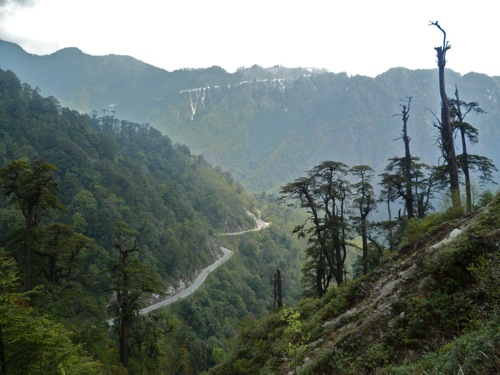
Pianma is along Yunnan’s western border with Myanmar. The town is situated in an extremely remote area on the western slopes of the Gaoligong mountain range. The jungles and mountains surrounding it are lonely and hauntingly beautiful. It is near here that an American pilot named Jimmy Fox and his two Chinese crew members crashed on 11 March 1943 while making the return flight to India from Kunming.
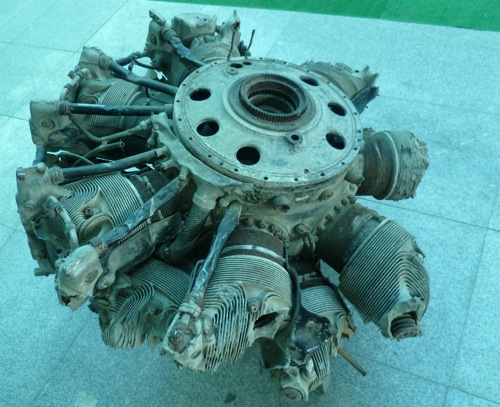
The C-53’s wreckage was discovered near Pianma by a hunter in 1996. Local people then reconstructed it and housed it in the memorial hall in which we are now standing, which was built with assistance from American donors. The reconstruction consists only of a shell with no wiring or instruments, and it is missing half a wing. There are parts of two engines and a wheel on display as well, and a collection of photos, books and other Hump and Flying Tigers memorabilia.

Snapshot from the road: an unexpected World War II memorial

Pianma is about the last place one expects to find a World War II museum, but as we have also noted recently while visiting Christian churches in the nearby Nu River valley near the Tibetan border, travel has the capacity to reveal remarkable collisions of past and present.
If you’re interested in China’s fascinating World War II history, consider our journey, “The Flying Tigers Route – 60 Years On,” or contact us today to let us craft a custom China experience that visits Pianma and other great spots the country.
————

Discover the unexpected with AsiaTravel. Contact us to start planning your journey: info@wildchina.com

AsiaTravel Explorer Grant provides adventurers the opportunity to turn their outdoor visions into real advancements in China exploration

AsiaTravel would now like to offer adventurers the opportunity to turn their outdoor visions into real advancements in China exploration through The AsiaTravel Explorer Grant.

The AsiaTravel Explorer Grant is a grant of USD 1,000 that will be awarded to adventurers seeking to push the boundaries of responsible, off-the-beaten-path travel in China.

AsiaTravel’s own story is one of exploration, self-discovery and challenge.  High up on the slopes of Tibet’s Mount Kailash, Mei braved the high altitudes and harsh landscapes to find true beauty of snowcapped mountains alight with the sunrise. The breathtaking view brought Mei a sense of fulfillment—yet she stood alone and exhausted from her journey. Disappointed by how little support was available for travelers looking to get off the beaten path in China, Mei was inspired to start her own travel company dedicated to offering stress-free and responsible travel to adventurous destinations.  The creation of the AsiaTravel Explorer Grant is a testament to supporting other explorers in finding authentic and life-changing travel experiences while protecting local cultures and environments.

AsiaTravel Explorer Grant provides adventurers the opportunity to turn their outdoor visions into real advancements in China exploration

In its initial year, the AsiaTravel Explorer’s Grant has been granted to Canadian explorer and writer Jeff Fuchs, with British entrepreneur and endurance athlete Michael Kleinwort joining him.  Along with local nomadic guides and the odd mule Fuchs and Kleinwort will attempt to travel the most isolated and unknown portion of the Tsalam route in Qinghai – a remote portion from Honkor to the Maqu area. The expedition in May of 2011 will be done entirely by foot leaving as little carbon footprint as possible. It will also access many of the last nomadic traders to document their precious recollections of travel along the Tsalam. The expedition is another in Fuchs’ desire to bring Asia’s long lost trade routes to light.

Looking to the future, AsiaTravel will be selecting winners based on the following criteria:

  • Focus on bringing to light a long lost route, a culturally significant issue, promoting aid in a remote community or a trip dealing with discovery or rediscovery
  • Passion and excitement for exploration
  • Past/current involvement with exploration in China
  • Risk management plan
  • Incorporation of Leave No Trace (LNT) principles
  • Low carbon travel
  • Participant skill levels commensurate with proposed itinerary.

For more information, please e-mail us at explorergrant@wildchina.com.
On the Road with Jeff Fuchs: The Sun and Wind in Golok

The following is an excerpt from Jeff Fuchs’ Tea and Mountain Journals, a blog by explorer, photographer and writer Jeff Fuchs.  Jeff is the 2011 recipient of AsiaTravel’s Explorer Grant.  He and friend Michael Kleinwort are currently traveling through unknown portions of the Tsalam route in Qinghai.

Below is a tale from this journey…

———-

May 4, 2011

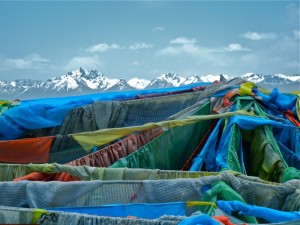
Sun (neema in Tibetan) blasts into the day as we wake to a reckless blue sky and a wind that hums. Snow capped peaks shimmer on the horizon and wind whips smoke and sand into mini-tornadoes.

On the Road with Jeff Fuchs: The Sun and Wind in Golok

All of Mother Nature’s elements are on display today in a show of force, and Michael and I both feel this bodes well for the journey. The city of Maqen (3700 metres) scatters for cover from winds that rip down the main street daring any to test it. Eyes burn from the suns rays and all of the goodies that the wind picks up and throws.

Much of expeditions or indeed any travel, involves waiting. Waiting for weather, for the right guides, for the correct directions…in this case we are waiting for word of our team, one member in particular, who can add a rare perspective on our journey.

One of my great desires is finally confirmed beyond a doubt today as we are greeted with the welcome news that one of the last of the Salt Road traders will in fact travel with us as our unofficial guide. Up until now this has been a slight question mark because of his health and age, but his desire has and is strong to accompany us. In his seventies, he and he alone, it seems, knows the ancient Salt Road portion that passes through the nomadic lands and that which we seek to travel. There is only one condition to him joining us and that is that he has a horse to ride during the journey. In his almost apologetic words, “my body, though once strong, is no longer capable of walking the route”. We are delighted as much of the younger generation has no idea of the Tsalam (Salt Road), and sadly seem to care less, and with him we are sure to get tidbits, tales and that crucial must, an innate knowledge gained from actually travelling the route.

Today I am also issued another warning about wolves. “They are out in great numbers in recent years, and they are far smarter than you”, a local tells me directly. I’ve no doubt about his information, as years back in this region I was to witness a site that remains in my memory bank still. Trekking through a remote portion near Golok, a friend and I watched a pack numbering almost two-dozen strong, rip into a flock of sheep with an efficient ferocity that was riveting. The act that unfolded was both brutal and impressive in both strategy and execution.

Michael and I are urged in the bright rays of the sun this morning to visit the local monastery, which sits as a tribute to another traveler: a monk who traipsed all over the Tibetan Plateau by foot with little more than a bag of tsampa (ground barley), some butter and a bit of tea (which of course set him high in my books).

On the Road with Jeff Fuchs: The Sun and Wind in Golok

We are told that to begin our journey through these stoic and staggering landscapes we should visit and appease the local deities and pay a gentle homage to the lands and beliefs that we now find ourselves. I’ve long felt that these little gestures set something in the mind at peace, a kind of genuflection of respect to local forces, however secular or otherworldly they might be.

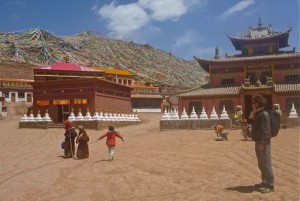
The monastery is more a series of small monasteries sitting at the north end of town, stupas, and flat-topped homes. All of this surrounds a huge mound of dirt hectares in size, which still now, is only now rediscovering life after a brutal winter. Prayer flags (loong da) cover the entire northwest face, flapping and billowing in winds that gain strength the higher we ascend.

————

For the full post, please visit http://www.tea-and-mountain-journals.com/