Abujee Trek in Northern Yunnan

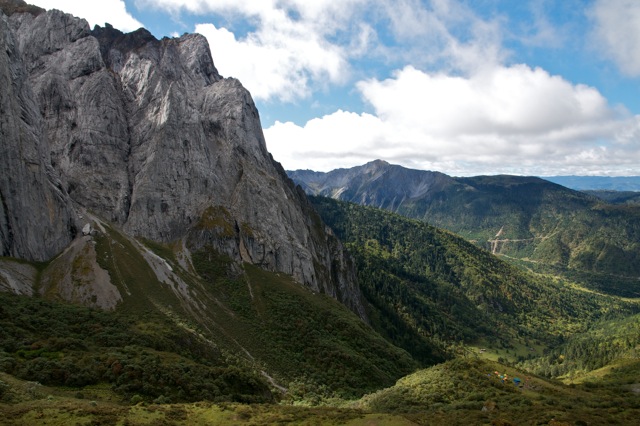
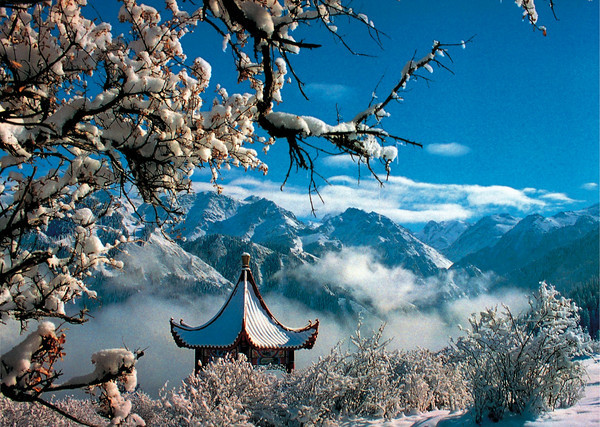
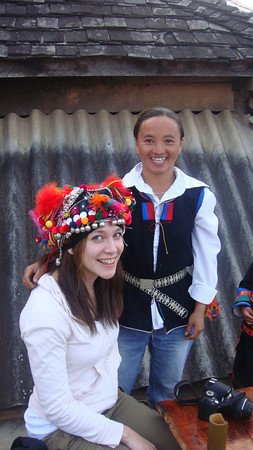
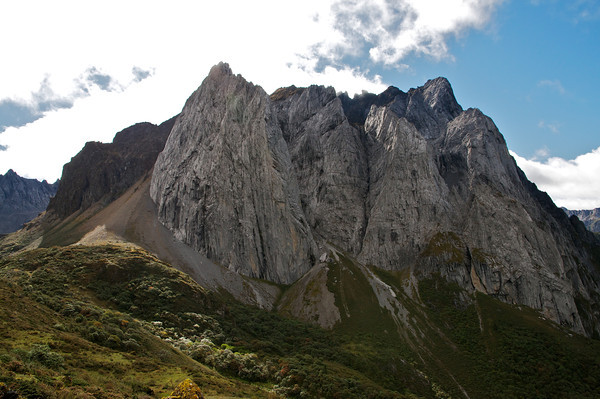
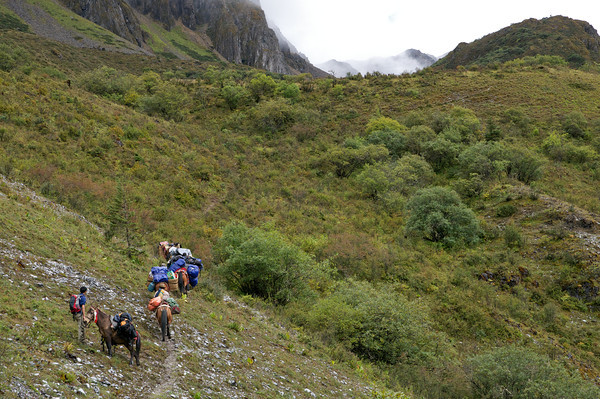
AsiaTravel recently took students from an international school on a multi-day trek in a remote region outside of Zhongdian (popularly known as Shangri-La). It was challenging hiking at altitudes upward of 4000 meters, but the students were resilient and enjoyed the rewards, including a high alpine lake that’s sacred to the Tibetans and Yi people.

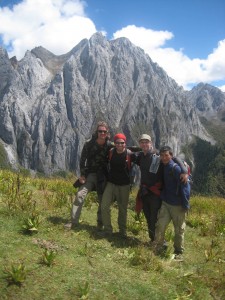
AsiaTravel expert Jeff Fuchs helped lead the journey. Fuchs shared valuable insights on the local culture and surroundings. Tibetan guide Sonam kept the group comfortable, especially when he broke into song. The horse team did well – even a two-week-old colt kept up!


Abujee Trek in Northern Yunnan


Abujee Trek in Northern Yunnan

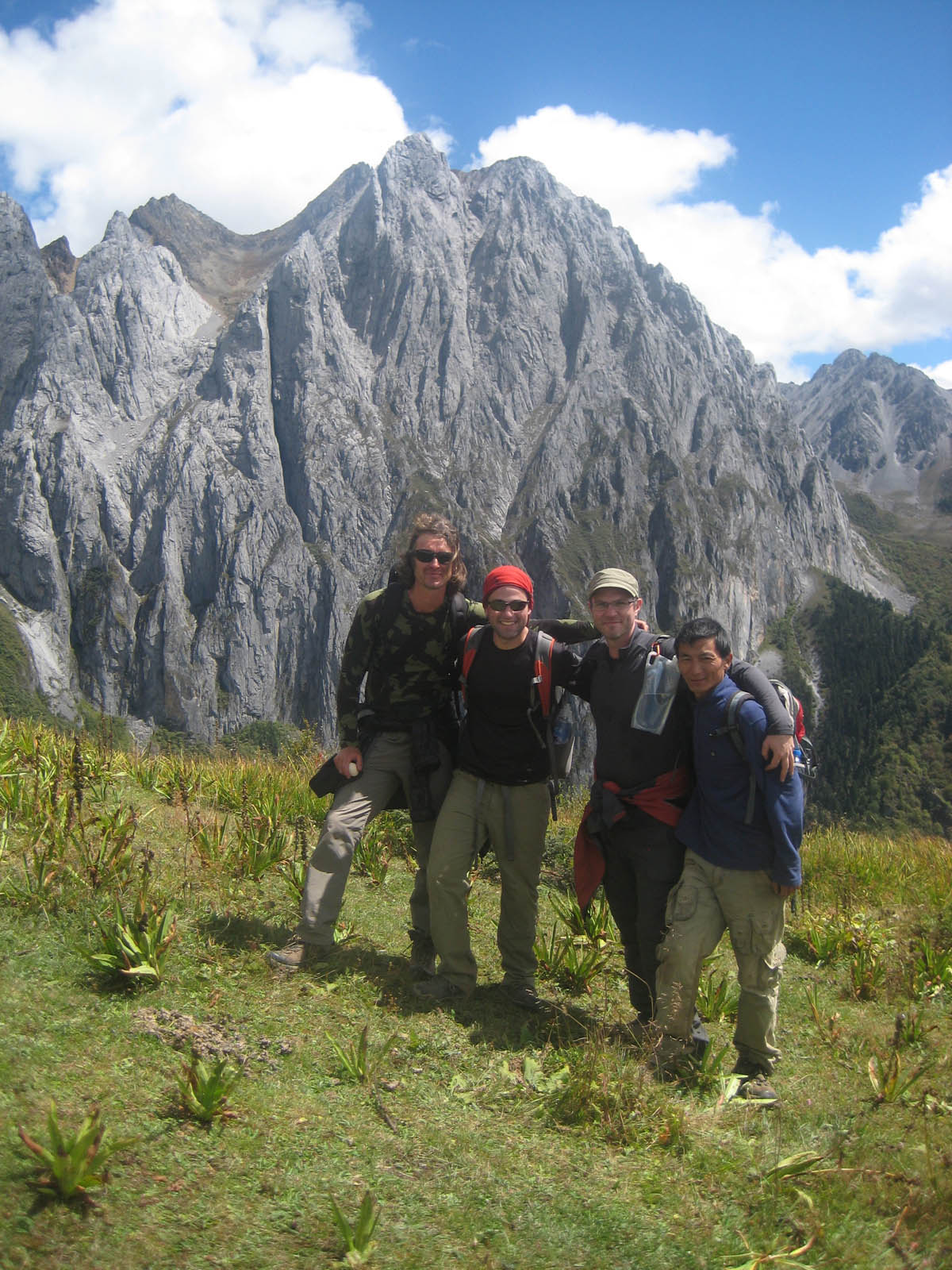
AsiaTravel team of Jeff Fuchs, Max Stein, David Fundingsland and Sonam Geleg at the end of the trek


———

For more information about educational journeys to Yunnan, contact us at education@wildchina.com.


Traveler’s Voice: It’s not rudeness; it’s simply cultural norms

A couple months ago, you heard from AsiaTravel travelers Jan Heininger and Jamie Reuter saying that they were thrilled with [their] tour company, but not seduced by China.  Their journey in October of 2010 took them through Beijing, Tibet, Yunnan Province. Guangxi Province, and finally to Hong Kong. Here is the second part of a series of articles detailing their experience.  Stop 1 – Beijing…

———-

We flew to Beijing via Toronto on Air Canada.  Our plane was equipped with lie-flat, business class seats.  OK food.  Great lounge with free dinner in Toronto.  The tickets were half the price of other airlines.  Definitely recommend Air Canada for anyone travelling to China or other points in the Far East.  12 hour flight with 12 hour time change meant we didn’t have to reset our watches which was sort of weird.  It took both Jan and me several days to get past the time shift.  12 hours is tough (though Jan thinks it’s easier than 8 hours).

Oddly, we arrived a full day early.  We had figured: depart on Thursday (10/14), cross international dateline and arrive Saturday.  So our hotel and ground arrangements all were set up to begin on Saturday.  I’m still not quite sure how or why we went wrong, but we actually arrived on Friday.  So there we were in the Beijing airport: no Chinese money, no one to meet us, and few people with any English to help us sort out what to do.  After an hour-long comedy of errors (cell phone with locking key-pad and no instruction booklet, low volume on cell phone, receiving text message instructions in Chinese characters, etc.), we finally convinced our tour company that we were actually in town and received their instructions.  We were asked to take a mass-transit “airport express” train into town because it would take too long for our actual guide, Andy, to come pick us up.  We didn’t really understand this at the time but our subsequent experience with traffic jams demonstrated the wisdom of this suggestion.  Eventually, we managed to get our luggage, get money, find the train, buy tickets, get off at the right stop (the last one) and meet up with our guide who then took us to our hotel.  By this time, we had finally sorted out that the timing screw-up was actually our fault, and not an error by our tour company.

Our hotel in Beijing was the Opposite House (don’t ask about the meaning behind the name; I don’t know it), an ultramodern, minimalist-design hotel in the embassy district.  Very, very nice—the kind of lovely boutique we prefer.  In fact, tourists (both Chinese and western) routinely came in to photograph the interior spaces.  Good bed, wooden sinks and bath (a little odd), good shower, great service, and a very good breakfast.  The breakfasts were fairly uniform (and excellent) across all of our hotels.  By a large, they were based on large and diverse buffets with egg stations, bacon, cheeses, breads, rolls and muffins, cereal, yoghurt, etc.  In addition, they had a whole range of stuff for oriental breakfasts.  If you’ve never seen this, it includes broth, noodles, and a wide variety of meats, vegetables, fish, seaweed, sprouts, tofu, etc that are combined in a big bowl as a sort of breakfast soup to be eaten with chopsticks.  The broth itself is simply “slurped” down.  We looked at it.  We tried it and poked around a little.  But basically we stuck with the western fare for breakfast.  We excused ourselves by saying that two good Chinese meals a day was enough and who wants seaweed for breakfast?  There were no really good breads or hard rolls anywhere in China until we got to Hong Kong.  Maybe it has to do with the types of wheat they grow or something?

Once settled in Beijing, we did all the usual things.  We went to Tiananmen Square (covered with tourists).  We toured the Forbidden City.  We had Peking Duck (greasy).  In the rain (on our third day) we visited the Temple of Heaven and the Summer Palace.  We drove past a couple of Olympic sites (the Water Cube and the Bird’s Nest Stadium).  We took a pedi-cab tour of a hutong, a traditional Beijing neighborhood jammed in between all of the various high rise apartment buildings.  The hutongs are sort of like old, single story, traditional ghettos that are slowly being consumed by new high-rise construction.  But the Chinese who live in them love their traditional way of life, though they have no private baths or toilets.  The pre-Olympic destruction of several hutongs caused such a fury that it seems that the local “Central Committee” is trying them out as tourist attractions to see if showing them off can provide a positive financial return.


Traveler’s Voice: It’s not rudeness; it’s simply cultural norms

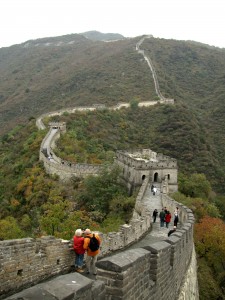
Our favorite things were the Ceramics Museum within the Forbidden City, and the Great Wall.  The museum was a quiet, deserted haven away from all the crowds with very good signage in both Chinese and English.  The Great Wall looked exactly like all the pictures you’ve seen of it.  But actually experiencing it was special.  We visited the Mutianyu section, which is a partially restored but far less touristy section of the Wall.  Jan and I took a long (2.5 hour) hike along its top.  The Wall actually just follows the crest of a mountain ridge.  The path along the top of the Wall can be extremely steep in places.  We both ended up with sore thighs and calves from climbing up and down some really steep and long stretches of steps, but loved the experience.

Traveler’s Voice: It’s not rudeness; it’s simply cultural norms

The food in Beijing was very so-so.  They seem to use a lot of oil so the food was very greasy and not all that flavorful.  Even when we went to a restaurant that specialized in Peking Duck, we were pretty underwhelmed.  We were not terribly adventuresome in our choices, so we probably missed a lot of what a real “foodie” would find interesting and good about Beijing food.
One of the oddities of being in China was the Chinese tourists’ fascination with us.  It started in the Tiananmen Square where this nice couple asked if they could have their picture taken with us with the Forbidden City in the background.  According to our guide, this was due to the inherent weirdness of westerners in general, and a tall, bearded westerner like Jamie in particular.  While this first incident was unique in that it included Jan, 10 or 12 times during the trip some couple or group of giggling girls or whomever wanted Jamie to pose with them for a photo – more or less to prove to their friends back home that they had seen, and even touched, a foreigner—but mostly because Jamie was so tall and looked even taller with his Australian Tilley hat.  Another tall American that we met on the trip had similar experiences.  After a while, the whole thing became a bother and bit irritating.  It was, in some small way, like having paparazzi chase after you.  It eventually made me feel like a creature in a zoo that people gawked at.  Weird.  And yet, despite such experiences and our reaction to the hordes and hordes of Chinese tourists, we found the Chinese, as individuals, to be friendly and welcoming.

We spent hours in traffic going to and from the Great Wall, and trying to get around inside the city.  Drivers are crazy there.  They push and shove in traffic using cars, trucks and buses pretty much the same way they push and shove in queues.  As one guide told us, there is no concept of personal distance in China (unlike in Japan where they create their own).  It’s not rudeness; it’s simply cultural norms. However, they always beep their horn when passing (they are taught to do this).  And when passing, they pull back into the right lane when the front seats have barely passed the front of the car being overtaken.  Several times, I was sure that we would clip the front of a car being passed but we never did.  Crossing a street on foot was also a challenge.  Initially I thought that cars were aiming at us on purpose.  Later, I realized that there just wasn’t any concept of pedestrians having the right of way.  A car making right hand turns just keeps going.  It was up to the pedestrians to get out of their way.  Given that the city was laid out in huge squares, Beijing was not a walkable city anyway.

Beijing was clearly an example of the “new China.”  Designer stores were everywhere.  Many young people clearly had lots of money and were stylishly dressed.  There was a long line outside an Apple Store near our hotel, as people waited to buy iPhones at five times the US price.  High rise condominiums and office buildings were everywhere.  Some brand new, some older and clearly showing their age.  Construction cranes were everywhere.  Our guides quipped that China’s national bird was the crane (i.e., steel crane, not feathered; get it??).  But the old neighborhood (hutong) near our hotel didn’t have a sewer or clean, public water.  Beijing was clearly a city of contrasts, with rapid change being driven by the “new” China economy.

———-

Stay tuned for more tales from Ms. Heininger & Mr. Reuter’s journey.  For more information about adventures in Beijing, see a sample itinerary here or contact us at info@wildchina.com.

All photos by Ms. Heninger & Mr. Reuter. To see all of their photos, visit AsiaTravel’s flickr page here.


Explorer Grant Open for Submissions

Find a new route on the Tibetan Plateau. Trace the origin of the Yangtze and Yellow River. Assess the newfound growth years after the Sichuan earthquake. The vision perseveres in whatever the journey may be.

Several people embody these qualities and take action: Li Bo, Director at Friends of Nature, China’s first environmental NGO; Edward Wong, one of the Beijing correspondents for The New York Times; Yu Hui, National Geographic China editor.

Explorer Grant Open for Submissions

The AsiaTravel Explorer Grant is a grant of up to USD 3,000 that is awarded to adventurers seeking to push the boundaries of responsible, off-the-beaten-path travel in China. All submissions for the 2012 AsiaTravel Explorer Grant are due by November 15, 2011.

AsiaTravel selects our explorers winners based on the following criteria:

• Focus on bringing to light a long lost route, a culturally significant issue, promoting aid in a remote community or a trip dealing with discovery or rediscovery
• Passion and excitement for exploration
• Past/current involvement with exploration in China
• Risk management plan
• Incorporation of Leave No Trace (LNT) principles
• Low carbon travel
• Participant skill levels commensurate with proposed itinerary

For more information, please e-mail us at expedition@wildchina.com or visit http://www.wildchina.com/explorer-grant to download the application.


Traveler’s Voice: The dominant characteristic of Lhasa is its spirituality

Continuing with the travel series written by AsiaTravel travelers Janet Heininger and Jamie Reuter, we move on to their next destination. Stop 2 – Lhasa, Tibet…

———-

On Tuesday, October 19, we flew 3,000 km to Lhasa, Tibet on Air China, changing planes in Chengdu.  Our Air China flight was just fine, even in economy class.  Leg room was barely adequate but people didn’t seem to lower their seat backs as much as in the US.  All internal Chinese flights advertise a strict weight limit of 20 kgs per checked bag and 5 kgs for a limit of one carry-on (plus a purse or small bag).  While we met these requirements on all seven of our internal flights, we ultimately decided that the rules weren’t very strictly or uniformly enforced any more than they are in the US.  The new Lhasa airport is way out of the city (90 kms.).  After being met by our guide, Nyima, and our driver, we went to our hotel and crashed.


Lhasa’s urban area is at 11,800 feet and has a population of around 300,000, up from around 10,000 in 1959.  It was one of our favorite places on this trip.  Due to the risk of altitude sickness, we both took Diamox as we had in Peru and had no problems with headaches or the altitude at all—even when hiking.  As an oddity, you should know that, in spite of its size, China operates with only a single time zone.  In any other county that large, you would expect to have 4 or even 5 different time zones.  But here, everyone is on Beijing time.  People in the western sections merely follow the sun more than the clock when it comes to scheduling things and routine work hours vary accordingly.


The political situation in Tibet is fairly complicated.  But in very brief summary, Tibet was founded as the religious and administrative center of Tibetan Buddhism in the 7th Century.  Until 1959 when the most recent reincarnation (literally) of the Dali Lama went into exile, the Potala Palace was also the earthly home of the leader of the Yellow Hat branch of Tibetan Buddhism.  Tibetans clearly feel they should be independent.  China, with the backing of its armed forces, the People’s Liberation Army (PLA), clearly has indicated that it has no intention of giving up its jurisdiction over the Tibetan plateau even though it has given it the cosmetic, official name of the “Tibetan Autonomous Region.”  With PLA forces clearly in evidence, China continues a not so stealthy take-over by sending ever more Han Chinese (the ethnic group most prevalent in Beijing and NE China) to live in the area.  Roughly 1/3rd of the population and ½ of Lhasa’s population is Han Chinese.  It had one very good hotel, with a super luxury St. Regis Hotel to open just after we left (11/15).


Our hotel was the very good one, the Four Points run by Sheraton.  It was quite nice (4+ stars) but not spectacular: very comfortable, clean, modern, good service, quiet, good breakfast (the standard fare), good views of mountains, and walkable distances to main sites (although taxis and pedi-cabs are both cheap).  It had a spa (as did most of our hotels), but we never seemed to get around to using them.  Our guide, Nyima, was terrific.


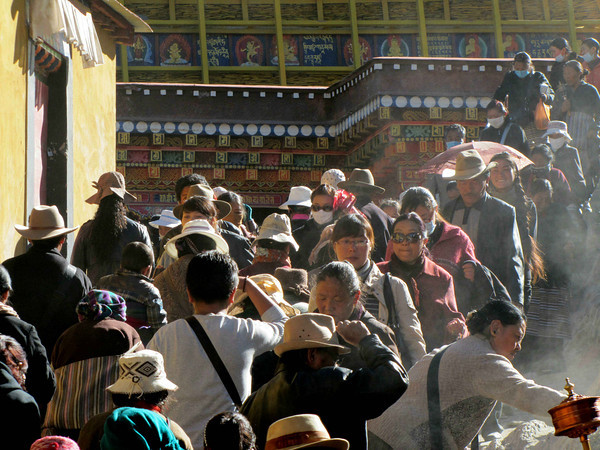
The dominant characteristic of Lhasa is its spirituality.  To begin, there are simply all of the local monks, monasteries, nuns, and nunneries, and various temples and holy sites.  According to our guide, we happened to be there at a special time on the calendar – the first full moon after the harvest.  As a result, thousands of Tibetan Buddhist pilgrims and nomads, many in traditional, tribal costumes, were in the city and surrounded its religious sites.  Pilgrims had lots of traditional activities including:


  • Circumambulations: walking clockwise around a religious temple (or site, or city, or monastery, etc.).  As an example, there was a huge crowd (6-10 people wide) that made a continuous ring of people walking around the Johkang Temple.  Always clockwise.  A few very rude tourists might go the other way, but Nyima (our somewhat spiritual guide) never would have let us do it.
 

Traveler’s Voice: The dominant characteristic of Lhasa is its spirituality

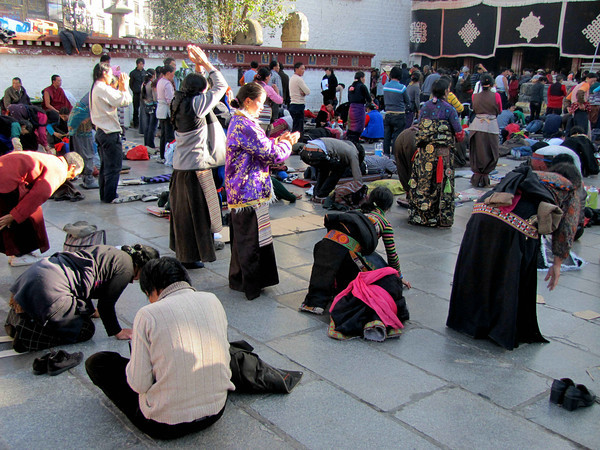
  • Prostrations: repeatedly stretching out face down on a mat, arms and hands extended out toward a temple or icon and then returning to a standing position, hands folded.  Repeat indefinitely.  This was like watching an aerobics show in slow motion.  Whole crowds would be doing it, each independently.  Old people.  Young people in stylish clothes.  Kids.  Nomads in traditional garb.  Sometimes they did this in place.  Sometimes they would embark on a circumambulation made up of repeated prostrations.  So while circumambulating, you might suddenly see this person stretched out on the ground, making their way around a holy site, one body length at a time.  The crowd barely noticed, and simply flowed around them on their own circumambulation path.
 

Traveler’s Voice: The dominant characteristic of Lhasa is its spirituality

  • Burning incense: Scattered around the holy sites were huge, white, 15 foot tall incense burners.  Actually more like furnaces, they spewed out clouds of white smoke and smell.  Once, one was so full that flames were shooting out of the top.  People constantly tossed in more incense as offerings.


  • Burning Yak butter candles: mostly an indoor activity.  In and around temples, there would be these urns of yak butter with 10-30 burning wicks.  Pilgrims carried tubs of yak butter and they would periodically add a scoop or so to a candle as an offering as they passed through a temple.  Sometimes the floor was greasy with spilled yak butter and you had to be careful how you walked.


  • Donating money: All of the local religious institutions survive on community donations.  So everyone is constantly leaving money behind.  Even our guide, Nyima.  While I’m sure that he visits many of the sites with tours 2 or 3 time each week, he still (very discreetly) would take a one Yuan note (about 15 cents) and stick it in a crack by a Buddhist statue, or drop one in a pile of other bills near a particular altar.  Sometimes he prostrated himself before a particularly important shrine.  Once, after we spoke with a group of nuns who were burying a new pipe (in very rocky ground) for the water supply for their nunnery, he walked out of his way to drop off the equivalent of $3 US to (according to his instructions) buy some extra food for the four hard-working nuns.


I could go on and on about prayer flags, monks and monasteries, religious icons and art, and so on.  It was never overwhelming at any particular moment (unlike the tourists in Tiananmen Square).  But after 3 days of being confronted with this stuff, it became a little awe-inspiring and deeply moving.


Food in Lhasa was just fine–nothing special but a lot better than in Beijing.  One of the hallmarks of Wild China is that meals are covered and they were mostly in local restaurants – generally ones not patronized by other westerners.  We really appreciated and enjoyed our eating experiences, even when we weren’t crazy about the taste.  They did have really good cucumber salads.  I had yak steaks a couple of times.  One night we went to a very tasty Nepalese restaurant.  One night we went to a small restaurant with an OK buffet dinner and saw an after-dinner show of traditional Tibetan music, costumes and dancing – interesting and worth while.


In spite of the altitude, the weather actually was warmer than in Beijing.  We had partially cloudy skies with some sun that provided stunning views of the surrounding, snow-covered mountains.  (Weather.com said 80% chance of rain daily for our entire visit to Tibet).  It would be quite cold in the morning and at night, yet warm up during the day so we’d have to roll up the sleeves of our travel shirts.


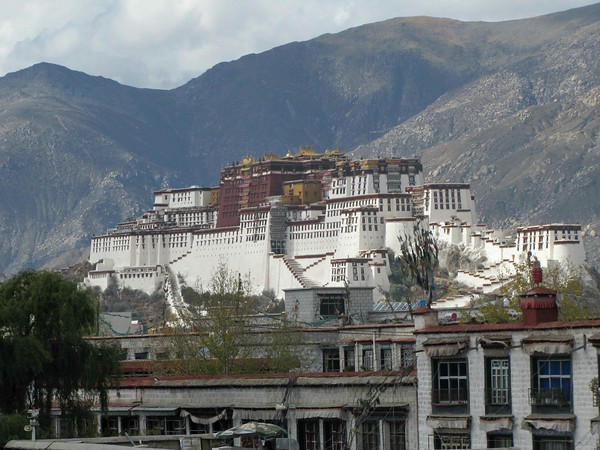
Our first day in Lhasa began at the Potala Palace.  This iconic red, white and gold building has over 1,000 rooms and 10,000 shrines, and sits atop a 1,000 foot tall mountain in the middle of the city.  The first palace on this site was built in 637 AD.  The most recent version was completed in 1694.  The white parts are a blinding white.  They were close to finishing the new, annual coat of white wash.  Apparently, they just pour it on (the walls angle out slightly) and it just runs down the side.  As a result, you have to be careful where you sit or what you lean against because white dust is everywhere.  The only way up is a long series of stairs which you share with pilgrims.  Pilgrims get in free, tourists pay and are limited to 2,300 tickets per day.  Pictures and words really don’t do this place justice.  You can just feel its age.  Once inside, you’re following a path through murky, dark rooms, up and down ancient, wooden stairs, through chapels and shrines, mixing with various pilgrims, while smelling burning yak butter and incense.  It has to be experienced to be believed.  2 hours after entry, we popped out on the other side and made our way back down a long series of stone stairways.
 

Traveler’s Voice: The dominant characteristic of Lhasa is its spirituality

We then went to a very odd place known as Sanje Tongu–also spelled Sangye Tungu.  As far as tourist guide books or even encyclopedias are concerned, this place doesn’t even exist.  It’s tucked in behind Chokpori, one of the three “sacred” mountains within Lhasa.  After walking through several narrow streets lined with market stalls (too narrow to drive), you come to a small open space.  One side is a tall, flatish stone surface on the backside of Chokpori, 60 feet tall by 120 feet wide that is covered with sacred carvings and paintings of 1,000 Buddhas.  Nearby is a smoking incense burner.  There is also a flat surface for people who are doing their prostration rituals.  There is also a special new sort of pyramid.  It is made up of tens of thousands of flat pieces of slate on which special prayers have been carved.  This stack of slate prayers is 50 feet tall, and you can circumambulate around it (clockwise of course) while spinning prayer wheels and chanting a mantra – om mani padme hum.  (We did the walk and the spinning but didn’t chant much.)   It was a quiet, private place where people came to pay spiritual homage and a special place to visit and experience.  Apparently, this site is considered very sacred and used to be the location of a Tibetan school for traditional medicine which was destroyed by the Red Guard during the Cultural Revolution in the 1960s. But it is slowly being recreated by Lhasa’s devout residents.


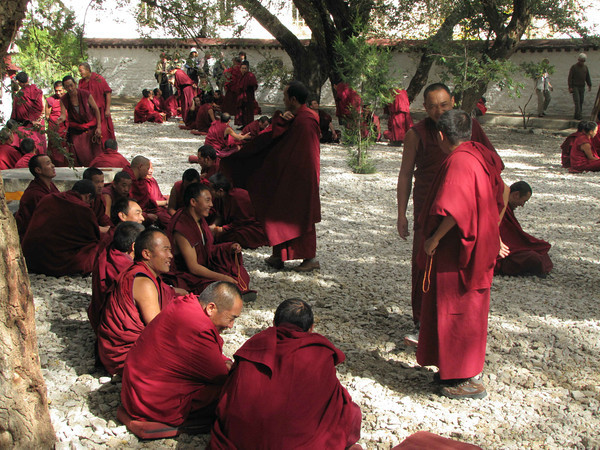
Later in the afternoon, we went to the Sera Monastery on a hill at the edge of town.  The unique aspect of this place is its school for monks.  Every afternoon at 3:30, the students and teachers come to the “Debating Courtyard” for debates.  That is, they have a lesson in the morning.  They meditate on their lesson.  Then in the afternoon, they gather in little groups of 2-10 monks, some teachers and some students, and begin a question and answer style debate.  It was very loud and boisterous.  They speak loudly.  They laugh and obviously challenge and argue with each other.  And when they make what they think is their best point, they do this combination loud hand clap and pointing gesture.  It was very interesting to watch.  Some monks appeared to be playing to the 50 or so tourists watching with video cameras from the edges though that might merely have been our interpretation since there apparently is a set of ritual gestures used for these debates.  Others were clearly involved in serious, intense discussion and debate.  Our guide said that most of it was kept real by the teachers present who guided the discussions.  We found it fascinating to watch.
Traveler’s Voice: The dominant characteristic of Lhasa is its spirituality

On our second day in Lhasa, we begin at the Pobonka [also known as Pabonka] Potrang monastery.  It was 7 kms outside the center of the city and up about 1,000 feet (12,800 feet altitude).  Its principal claim to fame is a small cave that was used by the founder of Tibet for meditation during the early 7th Century.  Currently, it has only small number of monks.  After a brief visit, we hiked up a trail (gaining another 500 feet in altitude) to the even smaller Thasi Shu Lin [also spelled Thasi Chöling] hermitage.  While climbing slowly and steadily to avoid oxygen deficit, we saw thousands of strings of prayer flags hung across gullies to catch the wind.  The wind is presumed to spread the beneficial thoughts on the flags across the valleys below.  So, the more wind the better.  Thus, you always see collections of these flags in places with good wind, like the tops of mountains or across rivers, streams and gullies.  After crossing a ridge, we descended a winding path to the Bakhue [also known as Chupzang or Chubzang] nunnery.  Here we encountered the nuns burying a new plastic water main to bring fresh water down the mountain into their cistern.  This nunnery is also known for its political activism.  Many members were arrested during political demonstrations in the late 1980s against Chinese occupation.  This political activism may be due, in part, to the fact that the original nunnery was destroyed by the Red Guard during the Cultural Revolution and was only recently rebuilt.


After lunch we visited the Jokhang Temple, the most sacred temple in Lhasa.  It was originally built in 642 AD.  By now, you can guess the drill: lots of pilgrims (some in native dress), burning incense and yak butter candles, crowds of people doing circumambulations and prostrations, dark shrines with statues of various protectors, each stuffed with one Yuan bills.  Inside, this temple has one of the most venerated statues of Buddha.  Outside is the Barkhor, a key path for the circumambulation around the Jokhang Temple.  It is also the central marketplace, lined with stalls selling a whole variety of stuff to the pilgrims while their do their walks.  For sale is everything from everyday clothes, to religious stuff, scarves, art, and even a few very high quality shops.  Jan and I spent some time shopping and came home with an original thangka painting of a Buddhist figure known as the “White Tara” (the bodhisattva or goddess of longevity, compassion and health), whose male counterpart is Amitayus.  We almost also bought a really fascinating picture of Jambhala, the Buddha of wealth and prosperity.  After some consideration, we decided that displaying it at home would be a little too much like creating a private altar to greed.  So we passed (although we probably shouldn’t have since it really was a cool painting).  We also shopped for a Tibetan rug.  However, it turns out that hand-made Tibetan rugs cost just as much ($2-5 K) as hand-made rugs in Turkey or Morocco – or Tibetan ones in NYC, and though we need a rug for the breakfast room, we don’t need one at that price.


During the morning of our last day in Lhasa, we went back to a couple of sites (Jokhang Temple, Barkhor and Sanje Tongu—) to complete some purchases.  We also took the opportunity to tie several long white scarves we had been given as traditional greetings around a pole near the Jokhang Temple to seek protection for the remainder of our trip.  Nothing bad happened over the next week or two, so it must have worked.  In addition, this was a most special, full-moon holy day, and so the pilgrims were out in huge numbers and the incense furnaces were belching smoke.  There was even a line of pilgrims doing a circumambulation of the entire city.


Given the density of pilgrims, the Chinese army had to make sure that their presence was obvious and noted.  Periodically you would see small patrol units marching to their assigned areas around the city.  They would just march down the middle of a busy city street, ignoring traffic and lights and basically expecting everyone and everything to get out of their way.  This is, of course, very rude.  But it probably also is very effective as demonstration of their literal dominance and control.


We drove back out to the airport around lunch time.  We had a great noodle soup with fried bread sandwiches stuffed with beef at a little dive near the airport.  It was the best meal of the trip so far.

———-

Janet and Jamie traveled with AsiaTravel in October of 2010.  For journeys to Tibet, check out our website here or contact us at info@wildchina.com. To read the other parts of their journey, see the following articles:

  1. Thrilled with our tour company, but not seduced by China
  2. It’s not rudeness; it’s simply cultural norms.

Photos & post by Janet Heininger & Jamie Reuter.


AsiaTravel Expert Spotlight: A Devil’s River of Heat by Jeff Fuchs

Winner of the 2011 AsiaTravel Explorer Grant, Jeff Fuchs says, “Nice as it is to sleep within walls, I feel slightly claustrophobic and long to get out to the fresh air and unencumbered sight-lines again.”  From his Tea and Mountain Journals, here is the latest update from his journeys in southwest China…

———-
The kora, for Buddhists and Hindus, circumambulating in a clockwise direction follows the apparent movement of the sun. The sun in question is now hidden as we wake in the camp of Chube’ka. Tucked into the valley there is only cold air seeping out of the earth and into us. Sleep was touch and go, though there are no immediate reasons as to why – sleep isn’t always a comforting time in the mountains.


AsiaTravel Expert Spotlight: A Devil’s River of Heat by Jeff Fuchs

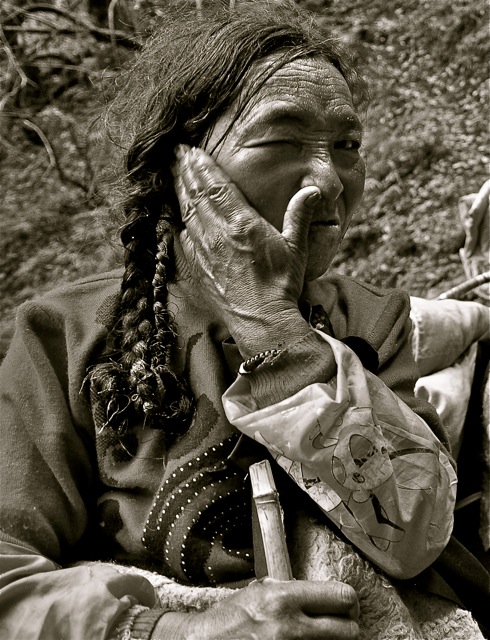
Another of the faces that stay with me. A nomadic pilgrim, having just dunked her head in a stream wipes the remnants off. Toughness in the mountains is a minimum requirement and it is never something flaunted…it simply is


Reke has slept badly and his normally patient face is tight and explosive looking. Michael wants a tough day and he is impatient to push the bodies into the redlines. Kandro looks at me over tea telling me that today will be “up, up, up”. Drolma is ever-smiling steering our morning with liquid, food and the kind of quiet care that women the world over can provide. Our big man Tseba sits quietly away from the fire with a bowl of tea with those big chocolate eyes straying into the skies. I find his moods a good gauge of the days to come for us.


AsiaTravel Expert Spotlight: A Devil’s River of Heat by Jeff Fuchs

With every day, new arrivals, new destinations and always new departures


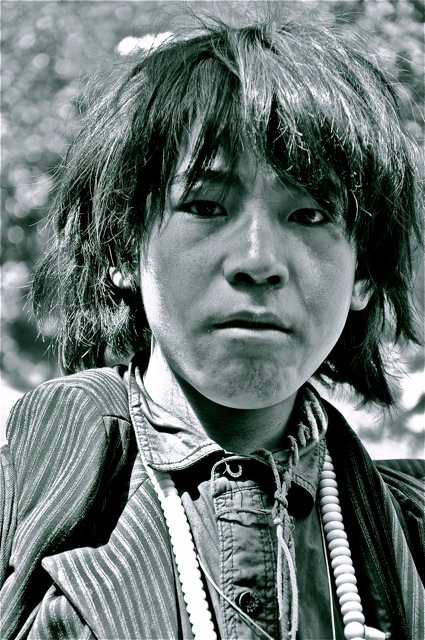
Pushing the pace we make good time catching and then falling into pace with a large group of nomadic pilgrims, led by a slightly deformed young man whose strengths seem realized in the ascents. He is a mess of dust, disheveled hair and of magnificently wild eyes that flick everywhere in a moment. He wears a suit coat slung as only a Tibetan can sling a piece of clothing: loose, one arm out and tied in a casual knot at the waist. The young boy’s back is hunched and one arm appears longer than the other. His being looks like he has been hunted for his entire life. He moves with the uncanny smoothness of a cat. It is as though his distorted body has become his supreme vessel. I suspect he pushes himself to punish and purify his past and future lives respectively…karma, in his mind at least, may be to blame for his malformed back. I cannot stop looking at him.


AsiaTravel Expert Spotlight: A Devil’s River of Heat by Jeff Fuchs

he young man that made such an impression on me. Bent by disfigurement, his simian strength and agility ate up the kora in gulps


His chin seems perpetually puckered as though he has been engaged in the effort of simply living. And of course I am aware that I, in my way, I maybe creating an entirely different picture in my head than he really is. I cannot help but feel though, that every pilgrim group we encounter has a titan or self appointed guardian leading it. This face is one that stays in the mind long after the features have disappeared.

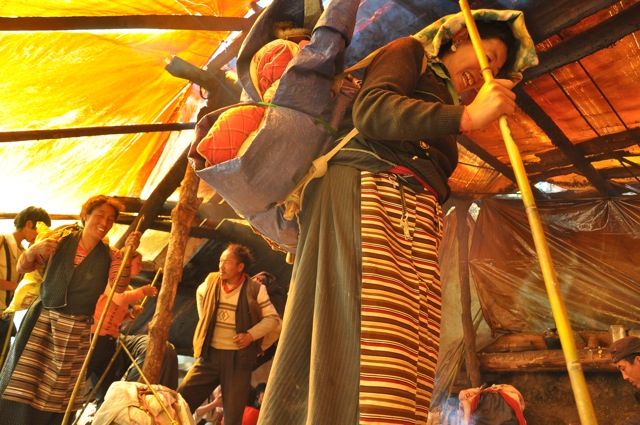
We make it up 1000 metres before lunch to Nang Tong La, lunching at the auspicious ‘Karmapa Spring’. Around us are entire clans feasting away in a yellow plastic enclosure…and there he is, the misshapen boy running every which way preparing, arranging and creating for his band of travelers. Our eyes meet and I smile and he doesn’t, but there is a millisecond of something from those haunted eyes before moving on.


AsiaTravel Expert Spotlight: A Devil’s River of Heat by Jeff Fuchs

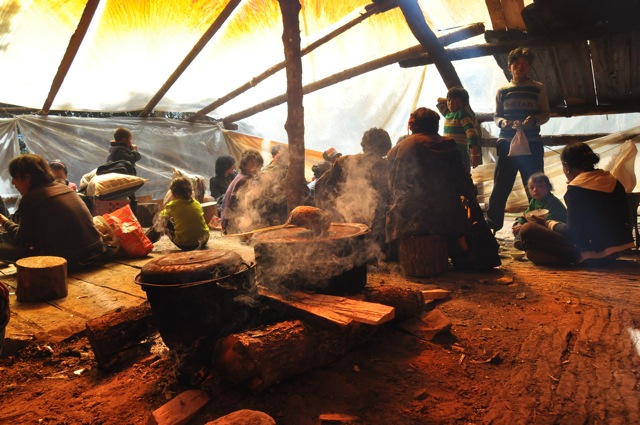
Lunch tents became populated during mid-day and would empty out in minutes only to wait for the next day's hungry


———-

For the full account from Jeff’s journey, visit his blog Tea and Mountain Journals. To travel with Jeff on a AsiaTravel journey along the Ancient Tea & Horse Caravan Road, click here or contact us at info@wildchina.com.

All photos & post by Jeff Fuchs.


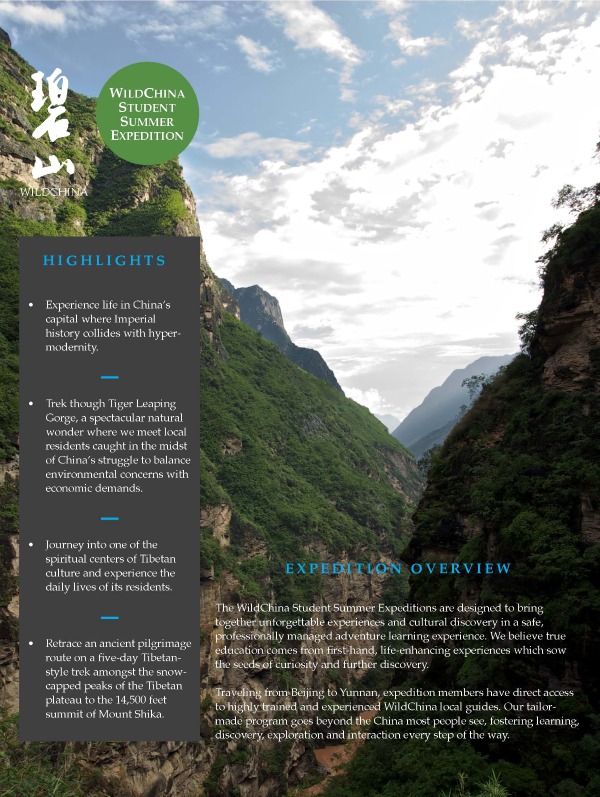
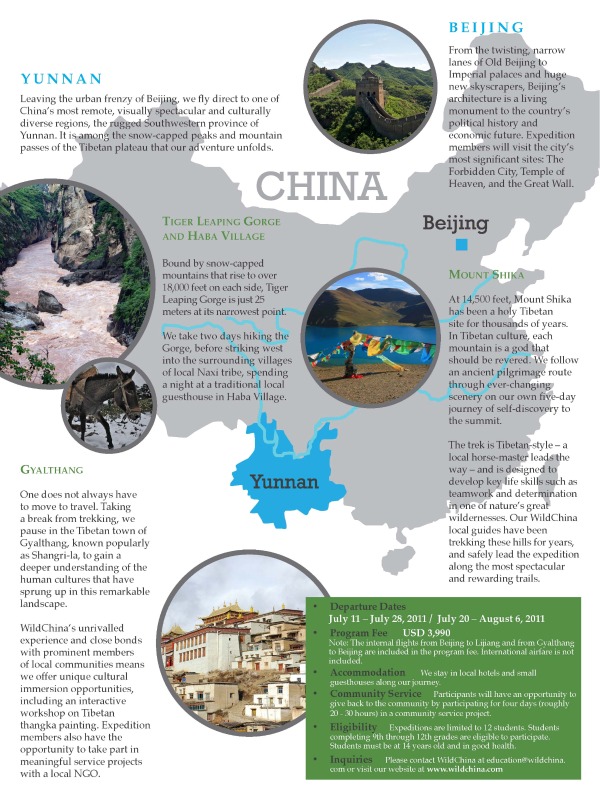
AsiaTravel Student Summer Expedition

We would like to introduce a new experience in educational travel in China – the AsiaTravel Student Summer Expedition.

Designed to bring together unforgettable experiences and cultural discovery in a safe, professionally managed adventure learning experience, highlights of this program include:

– Experience life in China’s capital of Beijing where Imperial history collides with hyper-modernity

– Trek through Tiger Leaping Gorge, a spectacular natural wonder where we meet local residents cuaght in the midst of China’s struggle to balance environmental concerns with economic demands.

– Journey into one of the spiritual centers of Tibetan culture and experience the daily lives of its residents.

– Retrace an ancient pilgrimage route on a five-day Tibetan style trek amongst the snow-capped peaks of the Tibetan plateau to the 14,500 ft summit of Mount Skika.

– Participants will have an opportunity to give back to the community by participating for four days (roughly 20 – 30 hours) in a community service project.

Quick FAQs:

Q. Who is this expedition for?

A. Students ages 14+ and entering 9 – 12 grade are eligible.

Q. When does the journey depart?

A. There are two programs running in the summer of 2011: July 11 – July 28 and July 20 – August 6

Q. How much is the program fee?

A. USD 3,990. This fee includes domestic but not international airfare.

———

Please see the flier below for more details.  To enquire about this trip, please email education@wildchina.com.

AsiaTravel Student Summer ExpeditionAsiaTravel Student Summer Expedition

T+L’s Hottest Travel Destinations of 2012: Xishuangbanna in Yunnan Province

Featured in the January 2012 issue of Travel + Leisure as one of the “Hottest Travel Destinations for 2012“, AsiaTravel’s journey in Xishuangbanna, Yunnan made the cut!

T+L’s Hottest Travel Destinations of 2012: Xishuangbanna in Yunnan Province


Xishuangbanna (pronounced she-shwang-ban-na), in the southern part of China’s Yunnan Province, is in many ways overlooked by the Western tourist, cowed by the gems of Lijiang and Shangri-la to the north. In fact, Xishuangbanna is one of the province’s hidden gems.

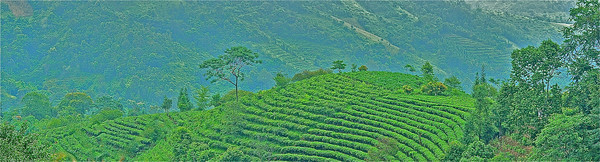
Nestled between Laos and Myanmar in Yunnan’s south, Xishuangbanna seems a world away from the popular tourist destinations in the north. Home to a wide variety of tea plantations, and boasting the oldest tea tree in the world, Xishuangbanna was once the beginning of the ancient Tea and Horse caravan road, which brought tea from southern Yunnan up to Tibet. Tea production and cultivation has been part of Xishuangbanna’s history for hundreds of years, which can be seen throughout the minority villages that dot the countryside.

T+L’s Hottest Travel Destinations of 2012: Xishuangbanna in Yunnan Province


When traveling to Xishuangbanna and planning your trip, there are a few important highlights to keep in mind. First and foremost, it is important to get a sense of the minority culture in the region through visiting minority villages and interacting with the people. The largest ethnic minority in the area are the Dai people, and there are many easily accessible villages around the capital of the region, Jinghong. The region offers miles of excellent hiking through tea plantations between villages, and homestays can be arranged in various villages, for a more authentic experience. Another of Xishuangbanna’s highlights are the markets that dot the villages and towns. These range from animal markets, fruit and vegetable markets, and areas to buy goods. Just meandering through the aisles of these markets is an eye opening experience, as is purchasing some of the fares and sampling the local cuisine (anything from dried chilies to local pastries, to various cooked meats). AsiaTravel is thrilled

with the opening of the Anantara Xishuangbanna Resort & Spa and cannot wait to send guest there!

Trips can be arranged in Xishuangbanna any time of year, with spring, winter, and autumn being the best times to visit – just email info@wildchina.com for more information!

T+L’s Hottest Travel Destinations of 2012: Xishuangbanna in Yunnan Province


———-

Interested in traveling to Xishuangbanna? Take a look at Pushing China’s Southern Boundary: Trekking in Xishuangbanna, a six day trips that starts and ends in Jinghong or Ancient Tea and Horse Road, an expert led trip by Jeff Fuchs. If you book Ancient Tea and Horse Road before December 30th, 2011 (11:59 PM EST) you will receive a fantastic promotion!


AsiaTravel’s Best of 2011

It’s that time of year.  The holidays, mulled wine, time with family and, of course,  recapping the highlights of the past 12 months.  Everyone at AsiaTravel could not resist the opportunity to create our own “Best of 2011 China,” so we sat down earlier this week to compile a few of our favorite things from 2011.

As an early holiday present, we present to you AsiaTravel’s Best of 2011…

Best Themed Journey: Ancient Tea and Horse led by Canadian explorer Jeff Fuchs leverages Fuchs’ vast knowledge of Yunnan’s rich tea culture and his vast local connections.  Living in remote Shangri-la for many years definitely has it’s upsides, and all of our travelers who journey with Jeff benefit from his insider access into local Tibetan communities along this trip.

AsiaTravel’s Best of 2011


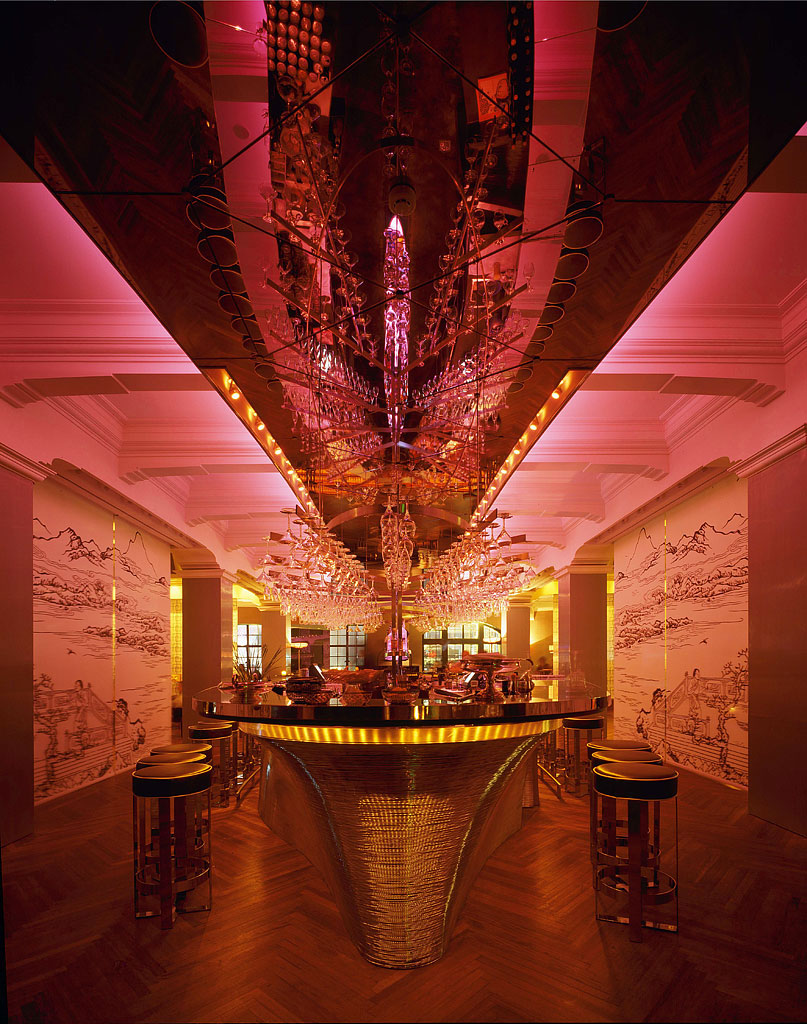
Best Nightlife: With Beautiful people, divine champagne cocktails and an atmosphere that couples East-West glamour, The Glamour Bar in Shanghai is our favorite watering hole in Shanghai.  We are looking forward to stopping by in March when we will be in town for the M on the Bund Literary Festival.

AsiaTravel’s Best of 2011


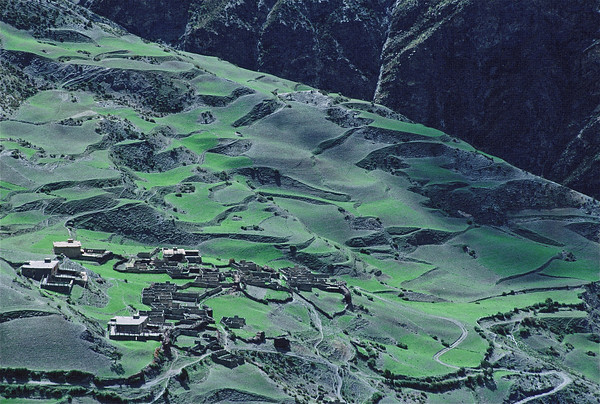
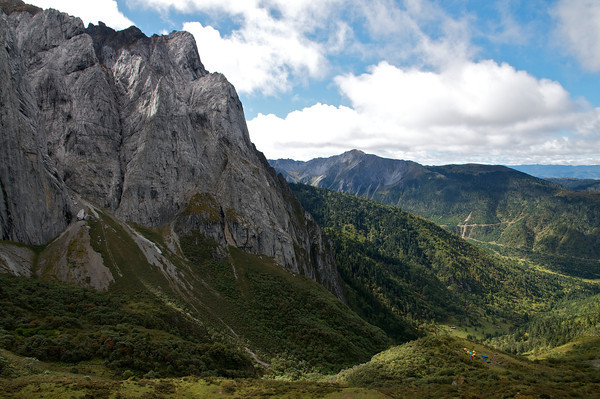
Best Off-The-Beaten-Path Adventure: Few have ventured to Abujee in Yunnan province, a sacred mountainous region near Shangri-La. Tibetan-style trekking through nomadic villages acclimates adventurers to life above the treeline at over 4,000 meters. The exhilarating challenge rewards sojourners with snow-capped dolomite peaks, lush forests, and crystal clear alpine lakes.

AsiaTravel’s Best of 2011


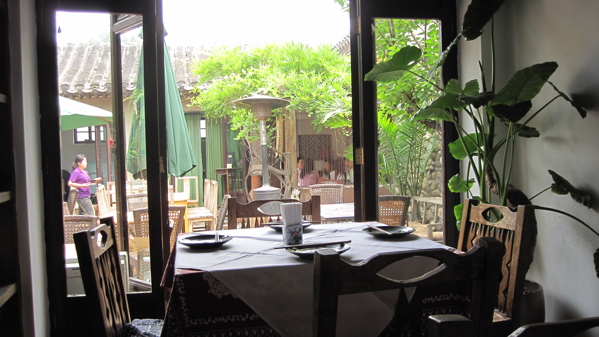
Best Culinary Experience: Dali Courtyard in Beijing is the best place in town to bring out of town visitors. The food is so delicious that even AsiaTravel Founder & Yunnan native Zhang Mei head to this restaurant when she has cravings of home! Try their Yunnan cheese– you will not be disappointed.


AsiaTravel’s Best of 2011


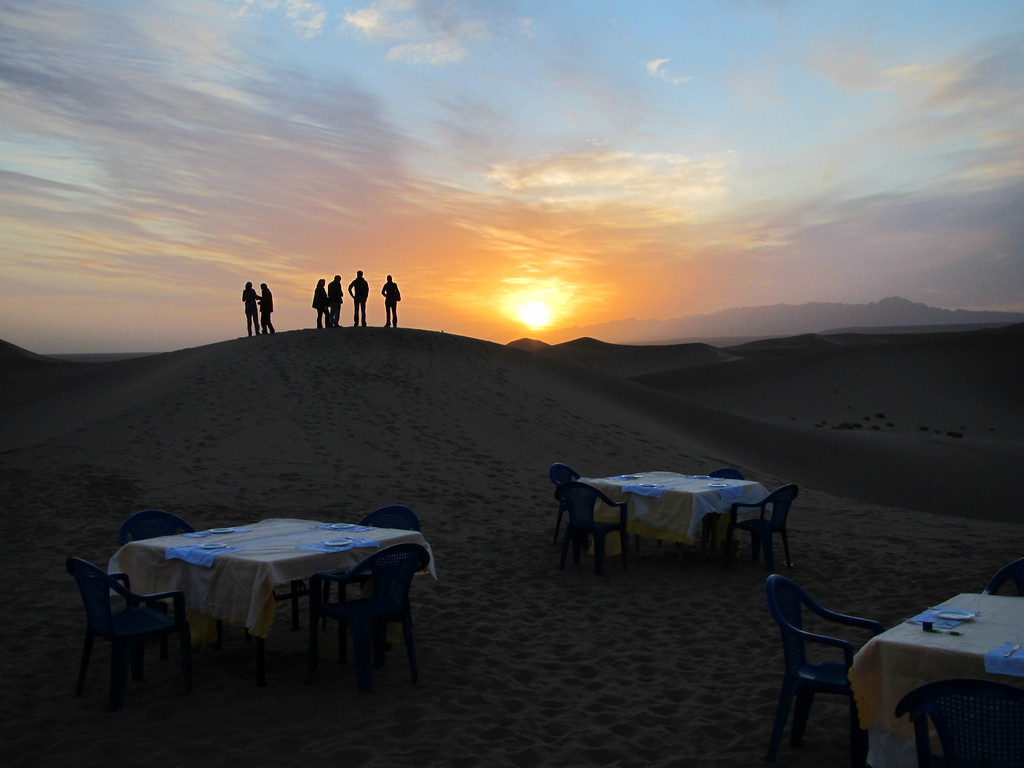
Best Special Event: This past year, AsiaTravel organized a wow team-building event in Dunhuang, Gansu.  We took 20 corporates out into the desert to compete in an Amazing Race style event with challenges including dune buggies and desert camping.

AsiaTravel’s Best of 2011


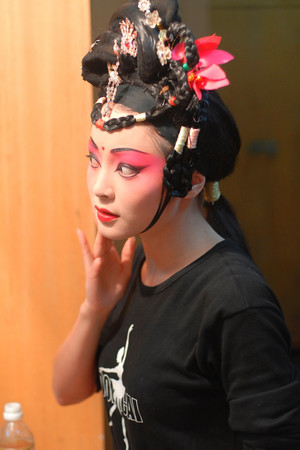
Best Culturally Immersive Experience: A private Beijing opera viewing is all the more memorable when you can be a part of it! Clients had the opportunity to try on traditional opera wardrobe and have complete make-over, with faces painted just like the local professionals. Let’s just say that this experience makes for a very different holiday card for your family!

AsiaTravel’s Best of 2011


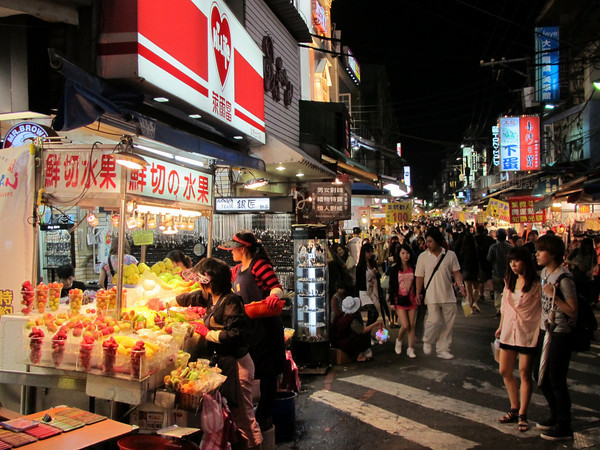
Best Educational Experience: Moving away from the mainland for the first time this year, clients were particularly excited about our new educational trip, Taiwan Treasures.  The great thing about Taiwan is that you can spend the morning soaking in the ancient culture and history of Taipei and then easily venture out of the city in the afternoon for a great hike to stretch your legs.  Don’t even get us starting on the fantastic night markets!

AsiaTravel’s Best of 2011


Best AsiaTravel Spiritual Experience: Looking to do a bit of cleansing of the soul in the upcoming year? The combination of piercing blue skies and devoted worshippers who throng Lhasa’s streets to pay homage to the sacred Potala Palace and Jokhang Temple make this destination the most spiritually rich place in China.  Visit Tibet On the Roof of the World: A Family Adventure

AsiaTravel’s Best of 2011


We hope you enjoyed a few of AsiaTravel’s highlights from 2011.

———-

Photos: First photo by Jeff Fuchs, final photo by Bruce Bai


AsiaTravel Explorer Grant Finalist: Venturing to Garze Prefecture in Sichuan Province by Zhang Shanghua

Last of the 2012 AsiaTravel Explorer Grant Finalists, we have Mr. Zhang Shanghua, a scientist at Chengdu ChemPartner Co., Ltd.  Mr. Zhang wants to travel to experience this “primitive natural beauty and the most authentic religious atmosphere” and share his findings with the outside world. Here are a few spots he plans to explore…

———-

With a population density of less than 4.4 people per square kilometer, the natural beauty and the local cultures of Baiyu County in the Garze Tibetan autonomous prefecture of Sichuan province are extremely well-preserved. My journey to explore these areas can be divided into three phases: east, north and south.

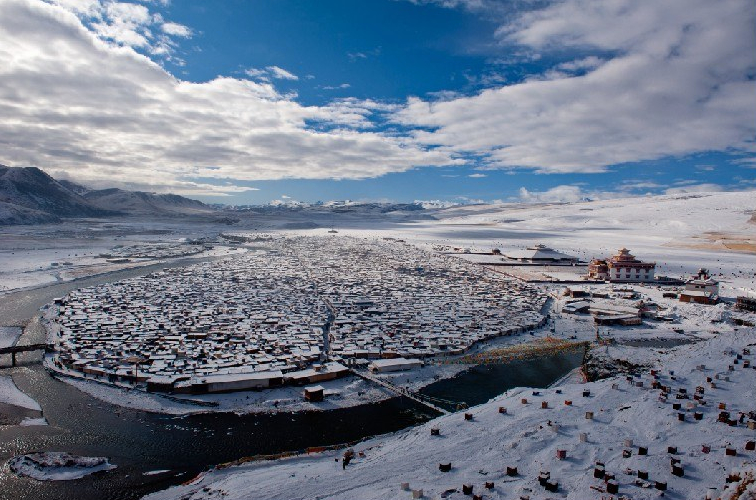
The eastern region of Baiyu County is home to the Yaqing Monastery and the Chaqingsongduo Nature Reserve.  I was pleasantly surprised to find that AsiaTravel Explorer Grant finalist Ms. Yasmin Cho is also looking to explore this area.  Without her expertise in the religion of this area, my perspective at the Yaqing Monastery, in contrast, will simply be that of an observer.

AsiaTravel Explorer Grant Finalist: Venturing to Garze Prefecture in Sichuan Province by Zhang Shanghua

Winter at Yaqing Monastery

Surrounding this area is also stunning biology —  The Chaqingsongduo Nature Reserve houses two-thirds of the world’s population of white-lipped deer or Thorold’s deer, the second largest glacier in the prefecture (the largest is Hailuoguo glacier in Luding County), and the sources of numerous streams and rivers, and the peak of the mighty Mount Gongga. Due to the limited transportation infrastructure in this region, the cliffs and peaks of this range have been traversed by very few.

On the second portion of the journey, the northern region, I plan to visit the Baiyu and Kathok Monasteries, some of the oldest sites of Tibetan Buddhism. The sacred allure of these holy places is something I can’t resist – the classic debates of ancient texts, the huge scale of the property, the rich history of Tibetan handicrafts in the area are all waiting to be discovered.


AsiaTravel Explorer Grant Finalist: Venturing to Garze Prefecture in Sichuan Province by Zhang Shanghua

On the last section of my planned exploration of Sichuan, I’ll begin by leaving Mount Menggu 4,900 meters high down into the Fire Dragon abyss and the villages along Jinsha River. Because this area is so inaccessible, it was not until the late Qing Dynasty that it was officially placed under Chinese government jurisdiction. In present day, the influence of the old, local tribes is still dominant.

In all of these places, I hope to talk to local people, access the un-explored naturaly beauty and document my experience so that more people from around the world can have a better understanding of this hidden part of China.

———-

Photos and post by 2012 AsiaTravel Explorer Grant finalist Mr. Zhang Shanghua, translated by AsiaTravel


Traveler’s Voice: Sacred region in Shangri-la

The following post was written by a student from Concordia International School Shanghai who traveled with AsiaTravel to Abujee in September 2011.

———-

Trekking amidst the tranquility and nature that is Abujee, a sacred region in Shangri-la, Yunnan, was a rewarding experience that garnered many new friends and beautiful memories. On this trip, our group studied aspects of Buddhism through a visit to a monastery and a private meeting with a lama, a spiritual leader. Interaction with the local horsemen also allowed us insight into Tibetan culture and lifestyle. On a particular night, we were warmly welcomed into the home of a Tibetan friend of our guides’ for dinner, where we sampled the delightfully explosive yak butter tea and enjoyed their traditional song and dance, which we reciprocated with a hilarious rendition of the “Hokey-pokey”.”

Traveler’s Voice: Sacred region in Shangri-la


After chilling in town and a “leisurely” hike on the first day, we began our trek on the barely-touched-by-foreigners path to Abujee. The physical demands of the trail called for mutual encouragement and individual strength that drew the group closer, both to each other and to the majestic terrain of Shangri-la. Through sweat, burning muscles, and the amazing leadership of Jeff “The-Guy-with-the-hair” Fuchs, Sonam “Beast” Geleg, and AsiaTravel’s David and Max, many of us surprised ourselves with our own ability to push onward and succeed.

Traveler’s Voice: Sacred region in Shangri-la


Amidst games of Big Two, sing-offs, campfires, and appalling encounters with monstrous bugs, we laughed and learned and grew. Thus were born “Goat-girl”, “Sugar-boy”, “Falcwynn”, and the sophisticated and refined game of “Abububall”.

Traveler’s Voice: Sacred region in Shangri-la

On that dreaded last day, each one of us looked wistfully at the distant mountains, waving goodbye with a bittersweet smile and a heavy heart, reluctant to leave the place that would henceforth cause us to smile fondly.

And so, I ruefully conclude that the trip was a lot like this passage—a process both fun and funny, albeit a tad trying at times, and regretfully, much, much too short.

———-

This young student traveled with AsiaTravel in September of 2011.  For journeys to Abujee, check out our website here or contact us at info@wildchina.com.