
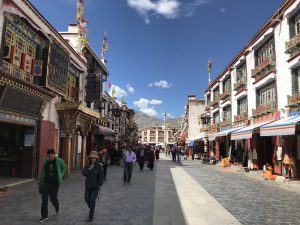
 Barkhor Street is a street that shows the Tibetan customs. Here you can feel the customs of the Tibetan area, and it is mainly surrounded by shops and restaurants around the Jokhang Temple and the places where you can manage all kinds of small objects. Here what you will feel more is the devout worship of the Tibetans, and the shops on both sides are for sale the decorations that feature a variety of Tibetan style. Walking in a clockwise direction, you will find several exits that can be reached in different directions to the city of Lhasa. The transportation in all directions makes the Barkhor Street the busiest and bustling street.
There are some seats placed on both sides of the street. When you are tired, you can take a break. Especially during the Chinese New Year, there are more Tibetans who come to kowtow to pray. These seats really help a lot of people. You will feel happy when you see them kowtowing happily there.
On the back of the Jokhang Temple, there is the most famous Makye Ame. The legend about the beauty of the Sixth Dalai Cangyang Gyatso attracts many diners. It is not necessarily for eating, but for an atmosphere, even if standing in the restaurant on the second floor, you can imagine how Cangyang Gyatso at that time came out of the palace and went to drink alcohol for a date.
 Of course, here you can also buy some favorite Tibetan style ornaments, turquoise, Nanjiang carnelian, Dzi Beads, etc., all of ornaments showing the beauty of Tibet can be almost found here, if you have patience, you can have a good chat with the owner, and the price will be very acceptable too.
At night, the wind sound of the Barkhor Street is very loud, the people there are very quiet, the best order is in the city of Lhasa, and what left there are peace and tranquility.
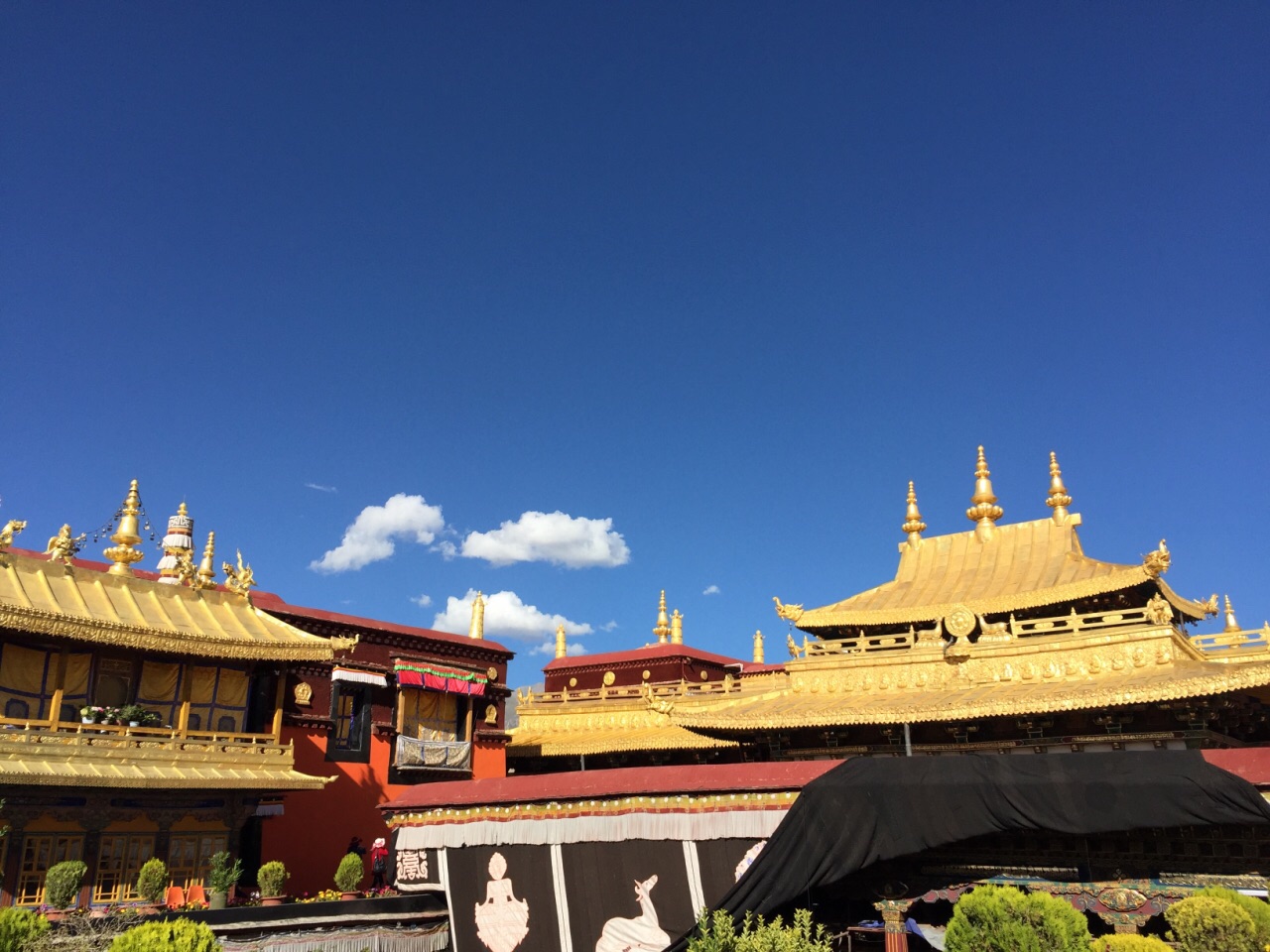 The Jokhang Temple, in Tibetan language is called “Jingkang”, and it is the end of the pilgrimage of Tibetan Buddhist believers. The sacredness of the Jokhang Temple is not inferior to the Potala Palace.
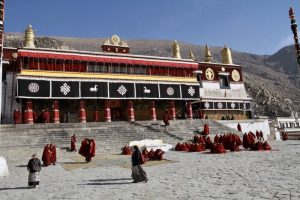 Drepung Monastery is the largest and highest-ranking temple in the Gelug Sect of Tibetan Buddhism and the largest temple in the world. The white buildings are covered with hillsides, and looking from the distance, it is like a huge pile of rice. There are some well-known buildings in the temple, including “Gandanpozhang”, “Cuoqin Hall”, and the four “Zhacang” and the affiliated Kangcun. In addition, the “Tibet’s Largest Kitchen” next to the Cuoqin Hall served as a task for more than 10,000 monks to cook and make tea during their heyday. What you can’t miss in the Drepung Monastery is a large-scale debate ceremony every afternoon. The squatting people are in groups of two, one sits on the ground, the other stands on the opposite side, and the verses are debated in exaggerated movements. The scene is very interesting. Every year at the Sho Dun Festival, Drepung Monastery holds the largest buddha ritual in the Tibetan area, displaying a giant Buddha image Thangka on the hillside, attracting a large number of believers and tourists to pray, whose scene is very spectacular.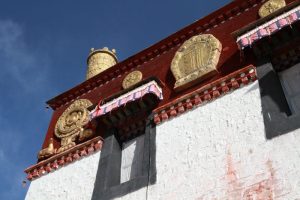
 Norbulingka is on the edge of the Tibet Museum. It is known as the summer palace of Lhasa, and it is the residence of the Dalai Lama. In the summer, the plants are flourishing and the Norbulingka is beautiful. The colors are very good. Outside of Norbulingka it is a park where local citizens can relax and enjoy the sun lazily.
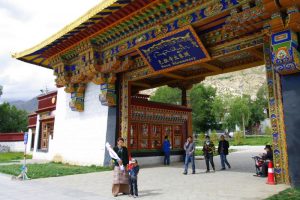 The debate of Sera Monastery is very famous. The Debate Garden is at the northern end of the main entrance. The time for debate is generally from 15:00, and you can watch it at will. The martial arts work is fixed every Monday to Friday afternoon and is open to visitors. What is more formal than the usual debates are the regular seminars, which are held by the monks to discuss and even debate the Dharma. The daily debate is an auxiliary method for the lamas to understand the meaning of the righteousness and improve their cultivation.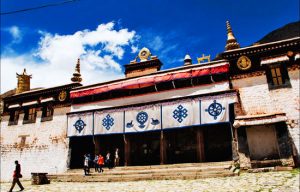
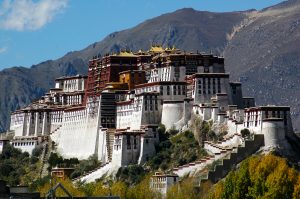
 For most of people who take a tour to Tibet, the Potala Palace is their top 1 choice there.